 Edge AI has been positioned as the future of IoT for some time, but turning that idea into a shippable product has proven difficult. Many embedded systems operate under tight power budgets, limited memory, and strict lifetime requirements. In those conditions, adding AI has often meant redesigning the architecture or accepting compromises that undermine the original product goals.
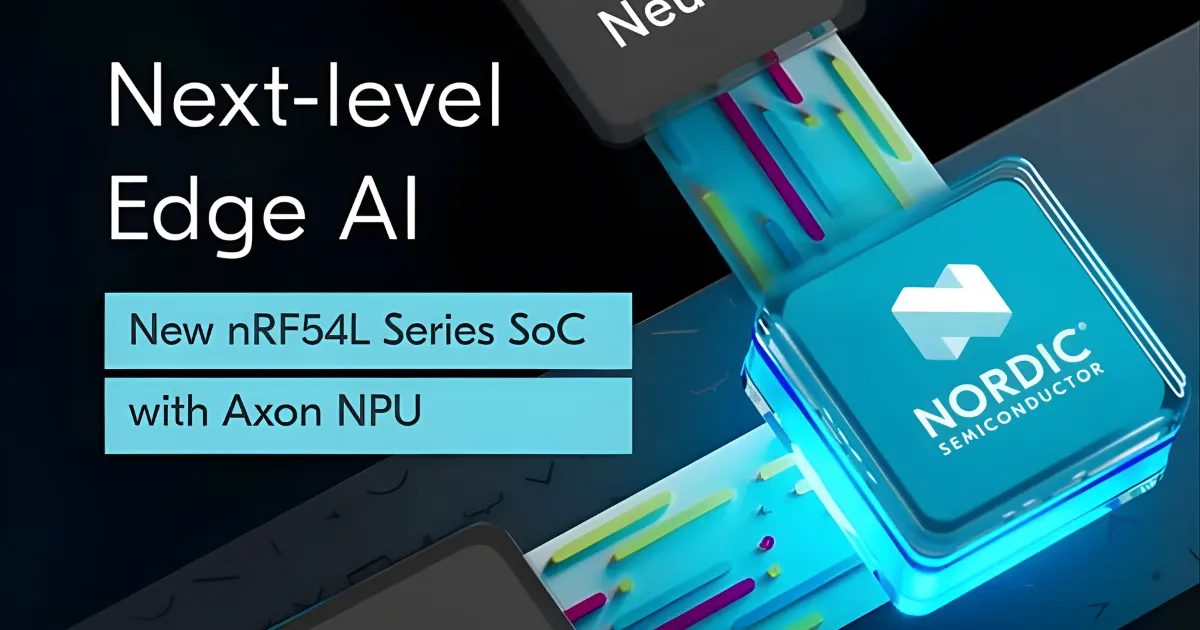
Nordic Semiconductor is taking a different approach. Rather than treating edge AI as a specialist feature, it is positioning local intelligence as a natural extension of low-power embedded design. The combination of the new nRF54LM20B system-on-chip, Nordic Edge AI Lab, and support for compact Neuton models is aimed at making inference feasible in devices where it previously did not make sense.
Why Edge Decisions Matter in Battery-Powered Systems
In many IoT products, the problem is not collecting data. It is deciding what to do with it. Continuous streaming to the cloud consumes energy, introduces delay, and often adds little value when most of the data is uneventful. For devices that rely on small batteries or energy harvesting, that overhead becomes a limiting factor very quickly.
Running inference locally changes the balance. The device evaluates sensor input as it is generated and reacts when conditions meet defined thresholds or patterns. Only the outcome is transmitted, not the raw signal. That approach reduces radio usage and allows systems to respond immediately rather than waiting for cloud-side processing. In practice, this can extend operational life and simplify system behavior in environments where connectivity is intermittent or costly.
nRF54LM20B Integrates AI Acceleration at the SoC Level
The nRF54LM20B is the first large-memory device in Nordic’s nRF54L Series and the company’s first wireless SoC to include the Axon neural processing unit. Axon is designed to handle inference workloads efficiently, removing that burden from the main processor and keeping energy consumption predictable.
Alongside the NPU, the device integrates 2 MB of non-volatile memory, 512 KB of RAM, and a 128 MHz Arm Cortex-M33 with an accompanying RISC-V coprocessor. This combination allows application logic, connectivity stacks, and inference to coexist without the resource contention that often appears in smaller devices. Support for Bluetooth LE, Bluetooth Channel Sounding, and Matter over Thread reflects the expectation that edge intelligence will increasingly sit inside connected products rather than isolated sensors.
Model Size as a Design Constraint, Not an Afterthought
For many embedded engineers, model size is the first practical barrier to edge AI. Large models complicate validation, consume memory needed elsewhere, and introduce risk when updates are required. Neuton models are designed with those constraints in mind from the outset.
Measured in kilobytes, these models fit comfortably within the memory budgets of constrained devices. That size influences how they behave in real systems. Smaller models are easier to test, simpler to certify, and less disruptive when integrated into firmware that must meet safety or compliance requirements. Nordic Edge AI Lab allows developers to generate models based on their own data, enabling tasks such as motion analysis, biometric monitoring, or anomaly detection while keeping raw data on the device.
This matters because it changes who can use edge AI. Teams without deep AI expertise can still deploy useful inference, rather than treating it as a research project that sits outside the main development flow.
Separating Local Decisions From Long-Term Management
As intelligence moves closer to the sensor, long-term management becomes part of the system design rather than an operational concern added later. Models are refined, usage patterns evolve, and regulatory expectations increasingly extend into deployed behavior.
Nordic separates these responsibilities cleanly. Inference runs locally, where timing and power consumption are critical. Cloud services support updates, diagnostics, and fleet-level visibility without being part of the real-time decision path. This structure allows products to evolve over time without increasing latency or pulling additional energy from the radio.
For engineers designing connected devices today, the shift is subtle but important. Edge AI is no longer about proving that inference can run on small hardware. It is about deciding where local intelligence simplifies the system, reduces overhead, and makes long-term operation more predictable.
Learn more and read the original announcement at www.nordicsemi.com
You may also like