
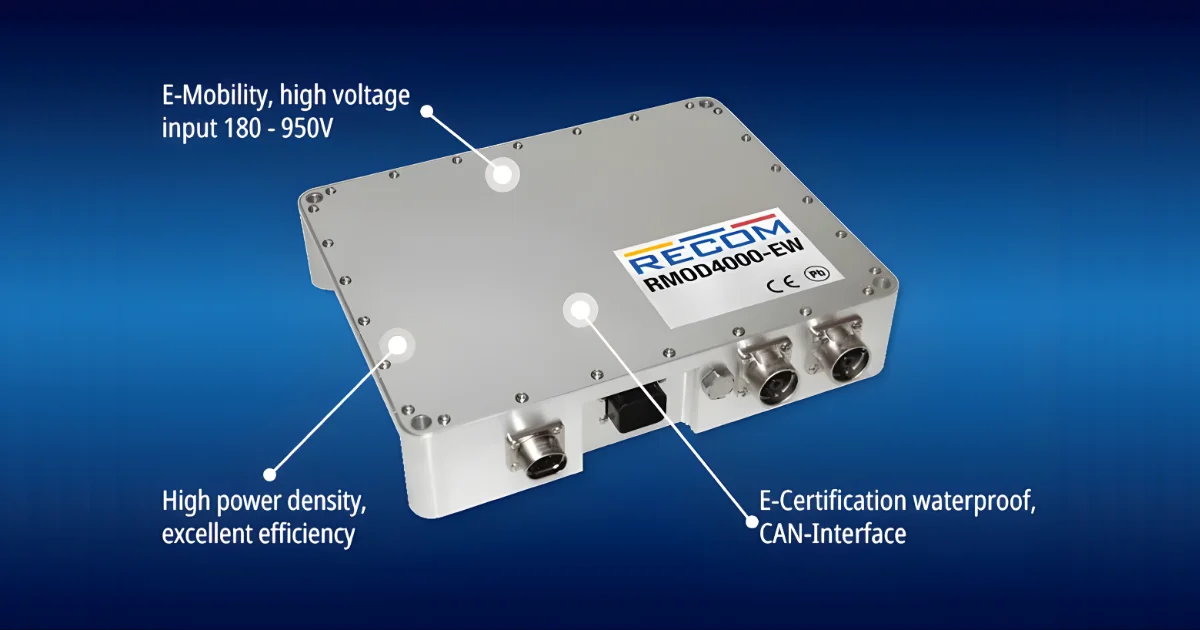
 High voltage battery systems in heavy equipment rarely behave like the clean diagrams in application notes. Traction packs swing, regenerate, sag under load, and spike during switching events. At the same time, the low voltage network still expects a stable 14V or 28V rail as if nothing unusual is happening upstream. That disconnect is where many auxiliary power designs start to struggle. RECOM’s RMOD4000 sits directly in that gap, converting 180 to 950VDC traction inputs into isolated low voltage rails without asking the rest of the system to compensate.
What makes this range relevant is not just the headline 950V ceiling. Many off highway platforms are moving toward higher pack voltages for efficiency and cable weight reduction, but auxiliary converters often lag behind. Designing a discrete front end that survives both nominal operation and transient conditions at those levels quickly becomes a thermal and isolation exercise. The RMOD4000 approaches it as a sealed, self contained stage rather than a board level compromise.
Wide Input Conversion In Real Mobility Conditions
The module delivers up to 4kW depending on operating point and maintains efficiency approaching 95 percent. At this power level, efficiency is not just about numbers on a datasheet. A few percentage points lost becomes heat that must leave the enclosure somehow. The availability of baseplate cooling or integrated liquid cooling ports reflects that reality. In practice, designers can align the thermal path with the rest of the vehicle architecture rather than building a separate airflow strategy around the converter.
The input window spanning 180 to 950VDC covers legacy 400V class systems as well as newer 800V platforms. That flexibility matters for equipment manufacturers who may reuse auxiliary architectures across product generations.
Reinforced Isolation And Transient Robustness
Isolation between traction and auxiliary domains is non negotiable in electrified systems. The RMOD4000 provides reinforced isolation compliant with IEC62477-1 and meets vehicle related standards such as ISO6469-3 and ISO 7637. Those standards address not only steady state operation but also the transient environment seen in real vehicles. A common challenge is ensuring that load dumps, switching spikes, and electrical noise do not propagate into control electronics. Here, input under and over voltage lockout combine with active inrush control, while the output side remains fully regulated and protected against over current, over voltage, over temperature, and short circuit conditions. This matters because auxiliary rails frequently power communication modules, safety controllers, and sensor systems that cannot tolerate unstable supply behavior.
CAN J1939 Control And Parallel Operation Strategy
One detail worth noting is the integrated isolated CAN J1939 interface. Rather than treating the DC DC stage as a passive block, the design allows monitoring and adjustment of output voltage through the vehicle network. In fleet or industrial platforms, remote diagnostics can reduce service time and simplify fault tracing. The inclusion of hardware ignition control and a high voltage interlock function also aligns with typical safety architectures.
The internal ORing function with active current sharing enables multiple units to operate in parallel. In real systems, redundancy is often preferred over a single higher rated converter. Being able to parallel modules without external balancing networks reduces complexity at the system level.
Sealed Construction For Off Highway And Marine Platforms
The mechanical design reflects the intended environment. The cast aluminum enclosure is sealed to IP67, protecting against water and dust ingress. Dimensions of 316 by 254 by 83 millimeters position the unit for installation in equipment bays rather than passenger vehicles. Sealed plug in connectors and integrated coolant interfaces simplify installation in forklifts, automated guided vehicles, loaders, tractors, and electric marine platforms where vibration and exposure are expected.
For engineers, the takeaway is not that this is a higher power DC DC. It is that auxiliary conversion in high voltage mobility systems is becoming a packaged subsystem rather than a board level exercise. As traction voltages rise and equipment electrification expands beyond passenger cars, the supporting power stages must tolerate both electrical extremes and environmental stress without constant redesign.
Learn more and read the original announcement at www.recom-power.com
You may also like