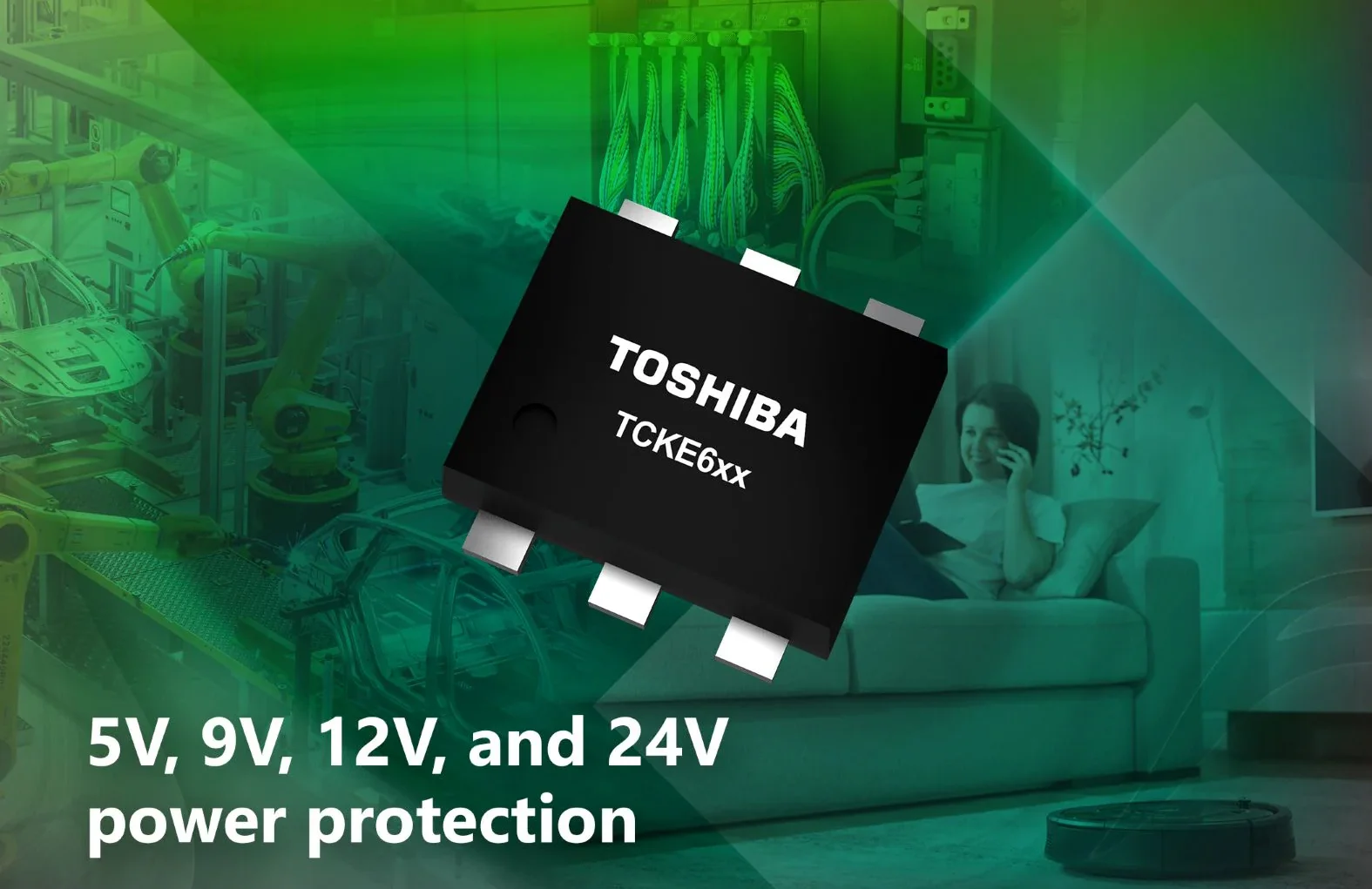
 Power rails fail more often from abuse than from outright design mistakes. A connector gets hot plugged into a live 24V backplane. A motor stalls and drags the supply down. A wiring error sends more voltage into a board than it was ever meant to see. In those moments the protection stage is not just a safeguard, it becomes the thing deciding how much damage is allowed to happen. Toshiba’s TCKE6 40V eFuse IC family is aimed at that decision point, replacing passive fuse elements with something that actively shapes how a rail behaves under stress.
Moving Beyond Melt-To-Protect Fuse Behavior
Glass and chip fuses have done the job for decades, but they operate on accumulated heat. Current rises, metal warms, eventually the link opens. By then the downstream circuitry has already seen the surge. The TCKE6 devices take a different approach. They monitor current as it increases and begin limiting it instead of waiting for destruction to occur. Overvoltage protection is also built in, which is not a minor detail on industrial rails that can ring or overshoot during switching events. Rather than acting as a sacrificial link, the device behaves more like a gatekeeper that restricts what is allowed to pass through.
This matters in PLC modules, robotics platforms, and mixed signal boards where microcontrollers, ADCs, and communication ICs sit directly behind the protection stage. Those parts rarely fail instantly. They degrade. Controlling the energy during a fault slows or prevents that silent damage.
Operating Across 3.3V To 30V Industrial Rails
The series is rated for 40V and operates from 3.3V up to 30V, which places it comfortably across common 5V logic rails and 12V or 24V industrial systems. That span allows a single protection concept to migrate between product variants without redesigning the power entry each time.
Under steady load the internal conduction path keeps resistance low enough that voltage drop is not a practical concern. You do not want your protection component introducing unnecessary heating on an already constrained board. When a short develops, response time becomes more important than absolute current rating. The device reacts quickly, limiting current before excessive energy builds in traces or downstream converters. Thermal monitoring is internal. If die temperature rises beyond safe limits, conduction is halted. The rail does not collapse unpredictably. It is managed.
TSOP6F Footprint And Real Layout Impact
Protection tends to live at the board edge, near connectors where space is already contested. The TCKE6 family uses a TSOP6F package at roughly 2.9 mm by 2.8 mm with a height around 0.8 mm. That size allows placement close to the power entry without forcing surrounding circuitry outward. On compact consumer systems such as robotic vacuum cleaners, or in dense industrial I/O modules, even a few millimeters of saved area can simplify routing and airflow.
Reducing discrete components around the entry stage also trims parasitic effects. Multiple resistive and thermal elements interacting during a fault can create unexpected behavior. Integrating current limiting, overvoltage control, and thermal shutdown into one device reduces that complexity and makes simulation closer to reality.
Configurable Fault Response For System Designers
Not every system wants the same recovery behavior. Some consumer platforms benefit from automatic retry once a transient clears. Industrial control equipment often requires a latched shutdown so supervisory firmware can make the decision to re-enable power. The TCKE6 lineup includes both styles. Certain versions expose status flag outputs or enable control pins, allowing the host controller to monitor or command the protection state. One variant supports switching between retry and latch modes through external control, which is useful if safety requirements shift during development.
As distributed power architectures become more common and sensitive electronics operate closer to higher energy rails, active eFuses are gradually replacing simple fuse links. The TCKE6 series fits into that shift by turning power entry from a passive failure point into something that behaves with intent.
Learn more and read the original announcement at www.toshiba.semicon-storage.com
You may also like