
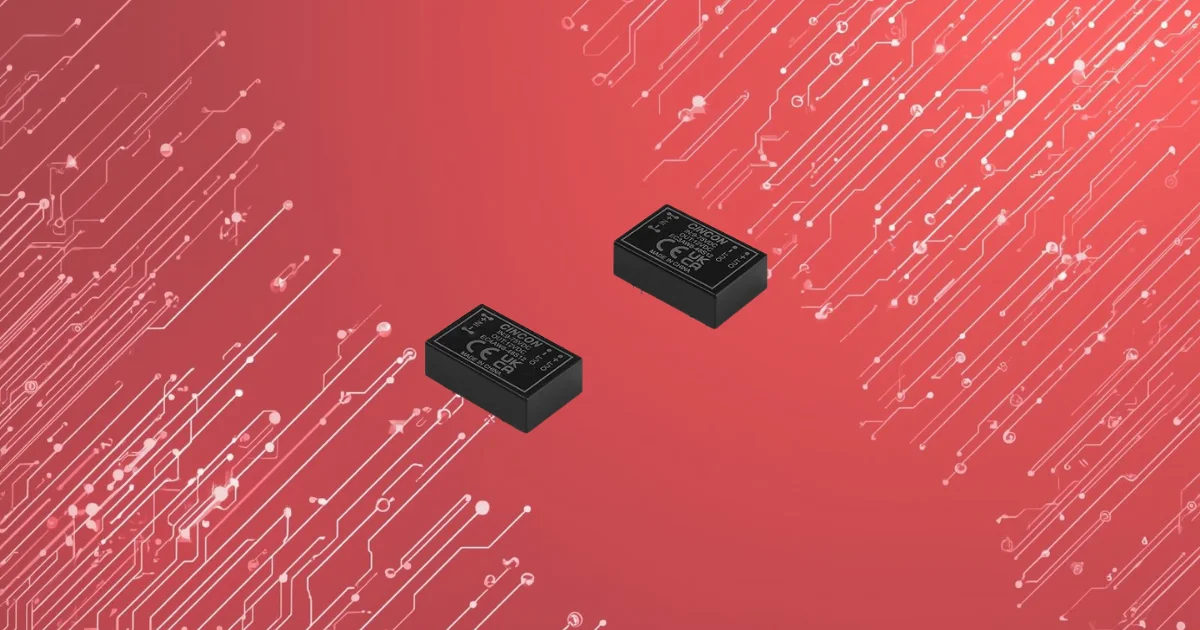
 Wide input DC-DC converters are often chosen because the system designer does not fully trust the rail feeding them. Battery strings sag. Industrial buses fluctuate. Telecom lines drift depending on load and distance. Designing for 12V, 24V, and 48V systems separately adds complexity that quickly multiplies across product variants. Cincon’s new EC3AW8 and EC4AW8 series approach that problem from the input side first, stretching coverage from 9V up to 75V so a single module can tolerate what the upstream supply decides to do.
8:1 Input Range Across 12V 24V And 48V Rails
An input window that spans 9 to 75V covers the typical 12V, 24V, and 48V industrial buses with margin left over. That range reduces the need to stock multiple converter variants for different platforms. In distributed power systems, where front-end supplies can vary under load or across geographies, having that headroom simplifies qualification. The converters deliver either 3W or 6W of regulated output, available in common single outputs such as 3.3V, 5V, 12V, and 15V, as well as dual rails for analog sections that still depend on symmetrical supplies.
Efficiency reaches up to 87%, which is not extreme but becomes relevant when thermal constraints tighten inside sealed enclosures. Low no-load input current, down to single-digit milliamps, reduces standby draw in systems that spend long periods idling. In battery-backed equipment, that detail accumulates over months of operation.
DIP-24 Form Factor And 3000V Isolation
Both series use a standard DIP-24 footprint measuring roughly 1.25 by 0.8 inches with a height around 0.4 inches. That size fits existing layouts without reworking mounting schemes. Input-to-output isolation is rated at 3000VDC, supporting separation requirements in industrial and IT environments. Maintaining that isolation inside a compact footprint often means tradeoffs in thermal density, so the specified operating range from -40°C to +105°C with de-rating is worth noting. Case temperature can reach +115°C, which suggests realistic expectations for enclosed systems rather than laboratory conditions.
Remote on and off control is available as an option, which allows system designers to manage sequencing or standby behavior without external circuitry. It is a small integration detail, but in complex backplanes it prevents unnecessary auxiliary logic.
EMI And Protection Without External Filtering
Meeting EN 55032 Class A without an external filter reduces component count at the input stage. In space-constrained boards, eliminating even a small common-mode choke or additional filter network can simplify routing. Protection features such as input undervoltage lockout, output overvoltage protection, overcurrent protection, and continuous short-circuit tolerance are built in. Those protections are expected in this class of converter, but their integration affects how much additional circuitry must surround the module.
Compliance with MIL-STD-810F for shock and vibration, along with altitude support up to 5000 meters, positions the series for installations beyond controlled office environments. Industrial automation cabinets, field instrumentation, and distributed telecom nodes tend to experience more variation than specification sheets imply.
Where Ultra-Wide Input Modules Fit
Modules with an 8:1 input ratio are rarely about performance alone. They are about absorbing variability upstream. In distributed architectures and embedded industrial systems, rail instability is often treated as a given. A converter that tolerates 9 to 75V without forcing a redesign simplifies product families that must operate globally.
The EC3AW8 and EC4AW8 series do not attempt to redefine efficiency limits. Instead, they consolidate voltage coverage, isolation, protection, and EMI compliance into a format that fits existing footprints. For many industrial designs, reducing variant count and filtering overhead can matter as much as raw conversion efficiency.
Learn more and read the original announcement at www.cincon.com
You may also like