
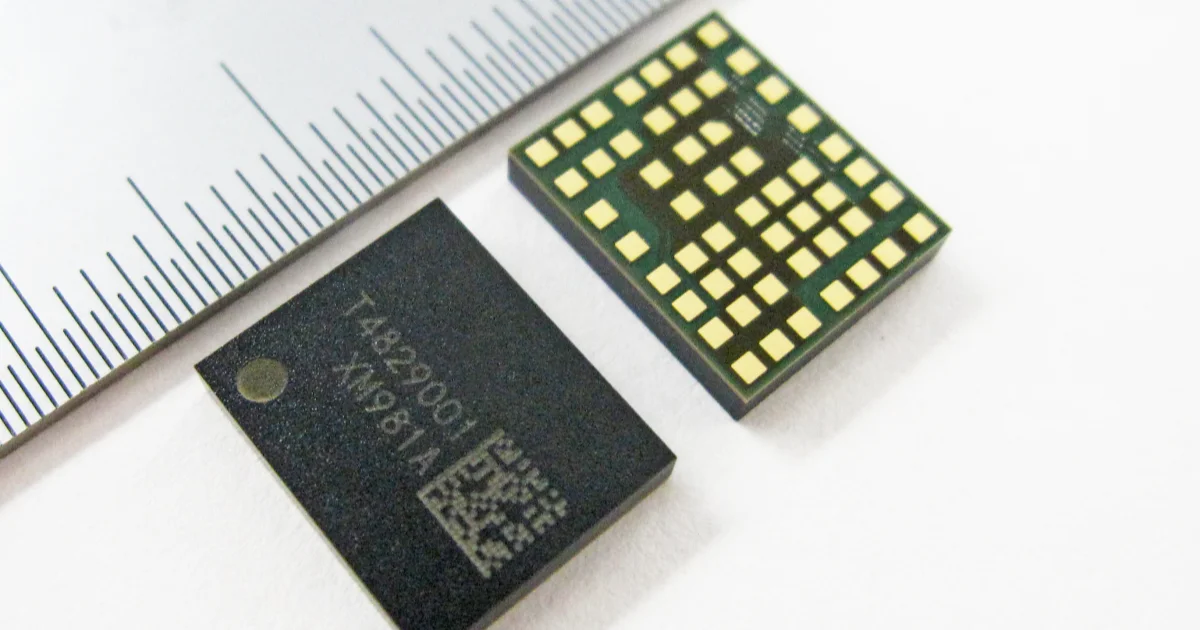
 The shift toward 48V distribution is not about elegance. It is about current density. Higher bus voltages reduce copper losses and cable bulk, especially in industrial and communication equipment where power levels keep climbing. But a large portion of downstream circuitry still expects 12V. Reworking every legacy rail just to accommodate a higher input bus is rarely practical. Torex’s XM981A approaches that transition differently, generating a fixed one-quarter output directly from a 20V to 60V input without using an inductor.
Fixed 1/4 Conversion and the 48V Migration Problem
With a 48V input, the module produces 12V. That ratio is fixed at one quarter of the input voltage, which means it is not a general-purpose adjustable regulator. It is a targeted intermediate bus device. The intent is clear. Allow a system architect to migrate the primary distribution rail to 48V while keeping the existing 12V ecosystem intact.
In many platforms the 12V domain powers fans, control logic, gate drivers, and secondary converters. Redesigning that entire infrastructure adds cost and risk. A dedicated intermediate bus stage that drops 48V to 12V efficiently simplifies the transition. It acts as a bridge between two voltage eras without forcing a full architectural rewrite.
Inductor-Less Topology and What That Changes
The XM981A uses a charge pump topology instead of a conventional step-down converter with a switching inductor. Removing the inductor changes more than the BOM. Magnetic components consume board height, generate stray fields, and complicate layout when high current loops expand across the PCB. An inductor-less approach avoids that magnetic noise source entirely.
During 48V to 12V conversion, the module reaches approximately 96.5 percent efficiency at 2.4A output. That number matters less as a headline and more in thermal context. At intermediate bus levels, even a few percent of loss can translate into measurable heat density. High efficiency reduces the thermal burden placed on downstream regulators and the enclosure itself. The external component count is also minimal, with only input and output capacitors required as major supporting elements. That reduces layout complexity in designs already constrained by high-density mounting requirements.
Scaling Current Without Redesigning the Rail
Each XM981A device supports up to 6A output current. The module also allows parallel operation of up to four devices, enabling a theoretical maximum of 24A when configured accordingly. Current scaling in this manner avoids the need to source a completely different regulator when system requirements increase. Instead of re-architecting the power stage, designers can replicate modules and distribute current.
Parallel operation introduces its own layout and thermal considerations. Current sharing behavior and trace symmetry become important once devices are combined. But the option to scale output without abandoning the 48V to 12V concept gives system designers flexibility as power envelopes expand.
The module is housed in a compact LGA-52C01 package measuring 9.5 by 11.5 by 2.1 mm, keeping profile height low in equipment where vertical clearance is often as constrained as board area. As more systems migrate to higher distribution voltages while retaining legacy 12V subsystems, intermediate bus solutions like this begin to feel less optional and more structural.
Learn more and read the original announcement at www.torexsemi.com
You may also like