
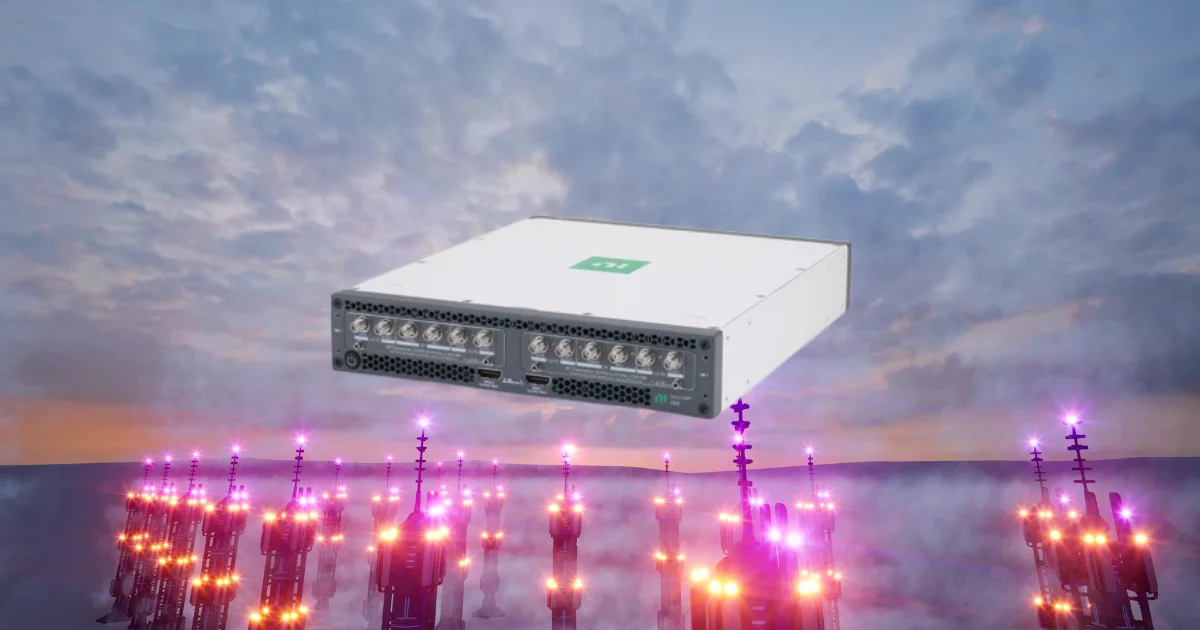
 RF systems tend to reveal their constraints the moment you try to scale them beyond the bands they were first designed for. When engineers start pushing into regions where radar, satellite links and early 6G experiments overlap, the usual bench tools begin to show their limits. That is the context where the NI USRP X420 enters the picture because it is one of the few software defined radios that reaches into the twenty gigahertz region without turning the architecture into a pile of external hardware. It changes the way researchers approach high frequency work simply by folding bandwidth, coherence and range into one box that behaves more like an instrument than a peripheral.
A Wide Frequency Window That Supports Emerging Signals
What makes the X420 stand out is not just the twenty gigahertz upper edge. It is the fact that its behavior across that span stays usable enough that radar pulses, satellite return paths and FR3 waveforms do not need major compromises before they reach the front end. The radio reaches into Ku and X band, which opens space for non terrestrial networks, wideband sensing trials and experimental communication layers that sit above conventional 5G allocations. By giving engineers access to these frequencies in a single SDR, the device lets the same platform cover early prototyping, controlled lab testing and iterative waveform development. You end up spending more time exploring signal behavior and less time stitching together mixers, external LOs and custom filters to make a test setup cooperate.
Phase Coherence That Simplifies Complex Architectures
Multi channel systems expose weaknesses very quickly. When separate receivers begin drifting out of phase, the entire experiment becomes difficult to trust. The X420 builds coherence directly into the architecture by sharing the local oscillator between channels so the system does not rely on external synchronization chains. That matters in MIMO radar, distributed sensing and beamforming research where phase alignment is not negotiable. Eliminating extra synchronization hardware also means fewer points where noise or drift can leak into measurements. This helps researchers create setups that behave consistently enough to validate algorithms rather than forcing them to debug the measurement chain itself.
Bandwidth That Lets Wide Signals Behave Naturally
Modern waveforms do not fit neatly into narrow bands. Integrated sensing and communication schemes, wideband radar sweeps and high data rate satellite signals require large instantaneous bandwidths to capture their full behavior. The X420 is built to handle these wide signals in a way that avoids forcing researchers to break waveforms into slices. That gives engineers the ability to observe full spectral structures, distortion patterns and dynamic behavior without the artifacts that appear when bandwidth becomes the bottleneck. The radio acts as a wide lens rather than a narrow viewport, letting engineers explore entire signal classes that would otherwise require more specialized equipment.
A Software Defined Platform Backed By Instrument Level Stability
The defining trait of the X420 is that it behaves like an SDR but feels closer to a piece of lab grade test equipment. Its architecture supports long sessions of continuous capture and generation without the instability that sometimes appears in lower tier platforms. This becomes important for researchers in academic labs and aerospace environments where experiments need repeatable conditions to verify algorithms or record rare events. The platform supports rapid iteration because the hardware does not need to be rebuilt every time the experiment shifts slightly. Researchers move from concept to validation without losing time to manual calibration steps or fragile synchronization setups.
Learn more and read the original announcement at www.emerson.com
You may also like