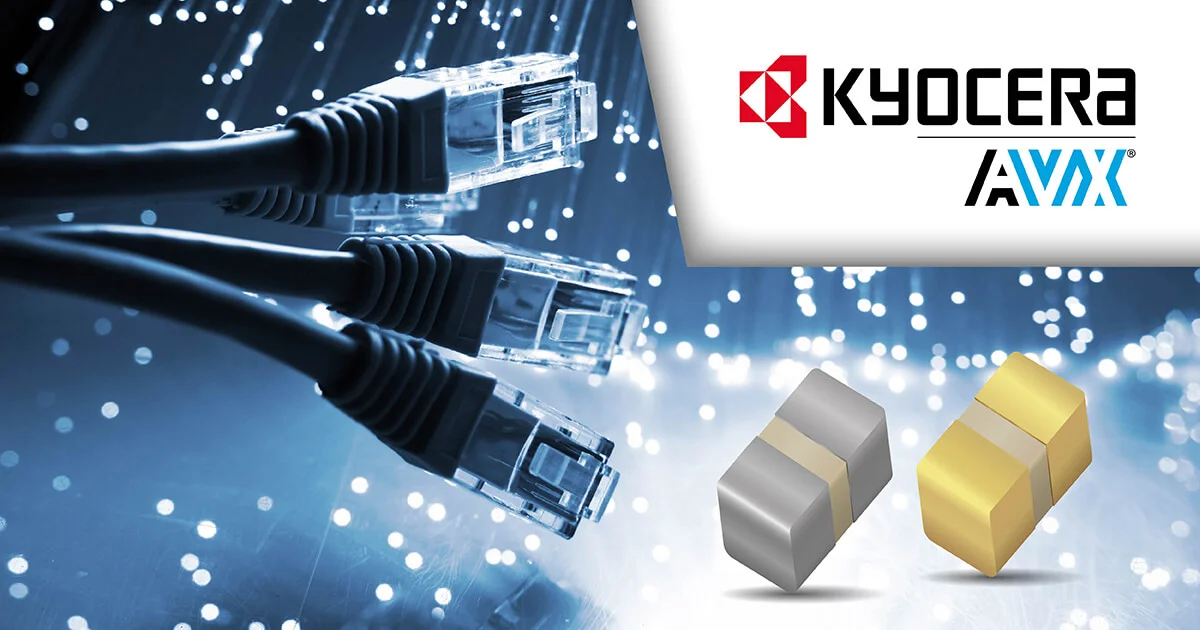
 Optical communication hardware tends to reveal its limits in unexpected places. Engineers often focus on amplifiers, photodiodes, and modulation paths, but the passive components sitting between those blocks quietly decide how much bandwidth the entire chain can sustain. A coupling capacitor that behaves perfectly at a few gigahertz can start drifting once the system pushes into tens or even hundreds, and the frequency response you thought was flat begins to tilt. The updated 550 and 560 Series UBC capacitors from KYOCERA AVX land in this exact pressure zone because they are tuned for the span where small variations in return loss and insertion loss become the difference between clean link behavior and unexplained jitter.
Broadband Performance That Holds Shape Beyond Traditional RF Limits
The extended versions of the UBC family are meant for the bandwidths optical communication systems are now forced to run at. They carry their response across a range that stretches from kilohertz through millimeter wave frequencies, and the behavior stays controlled enough that the capacitor does not become the bottleneck as the optical module climbs toward the upper end of its modulation capability. The new additions sit in the smallest case sizes where parasitics usually ruin the clean theoretical response. The ceramic structure and termination choices keep the series resistance and inductance from distorting the signal path, so the device feels more like a predictable broadband element than a capacitor with hidden limitations. As frequencies pass into the region where many components begin to fall apart, the UBC parts continue to pass energy without introducing the kind of slope that complicates equalization.
Construction That Targets Stability Under Extreme Bandwidth Pressure
Rugged construction is not usually the first phrase associated with tiny RF capacitors, but it matters when environmental drift can shift the impedance profile. The one piece ceramic design helps the device stay consistent as temperature moves, which optical systems feel acutely because their front ends often sit near thermal gradients. The metallization stack prevents the terminations from leaching into the solder, keeping joints mechanically stable and electrically predictable even when the assembly process or field conditions become demanding. Extending the voltage rating up toward one hundred volts also pushes these parts into applications that previously required mixing different capacitor families, which often produced uneven broadband performance. Now a single series can bridge the gap between modest voltage needs and mmWave frequency requirements without dragging additional parasitics along with it.
A Wider Capacitance Spread That Opens New Optical Paths
The newer 0402 values allow designers to choose coupling points and feedback paths that would have previously required settling for something close rather than ideal. When working with transimpedance amplifiers, laser drivers, or broadband receivers, the relationship between the capacitor value and the system’s impedance environment becomes delicate. A small shift in capacitance can skew the frequency response in ways that only reveal themselves when the link runs at full rate. With capacitance now spanning from near zero to hundreds of nanofarads, the UBC family allows tighter tailoring of high speed optical chains without forcing compromises at either the low or high end of the spectrum. This becomes especially important in ROSA and TOSA modules where space is minimal and every passive must behave exactly as expected.
A Passive Element That Pushes System Architecture Forward
Optical communication has been scaling faster than many supporting components can keep up, which is why broadband capacitors have become a limiting factor in places where they used to be an afterthought. The expanded UBC lineup provides a passive element that keeps pace with the architectural shifts happening in datacenters, coherent optics, RF sampling front ends, and distributed fiber systems. As systems move toward higher order modulation and wider bandwidth per channel, these capacitors play a more direct role in shaping the signal path. They help maintain the integrity of circuits that stretch from traditional RF into regions where few passive components behave cleanly, and that consistency gives designers more headroom when pushing toward the next generation of optical hardware.
Learn more and read the original announcement at www.kyocera-avx.com
You may also like