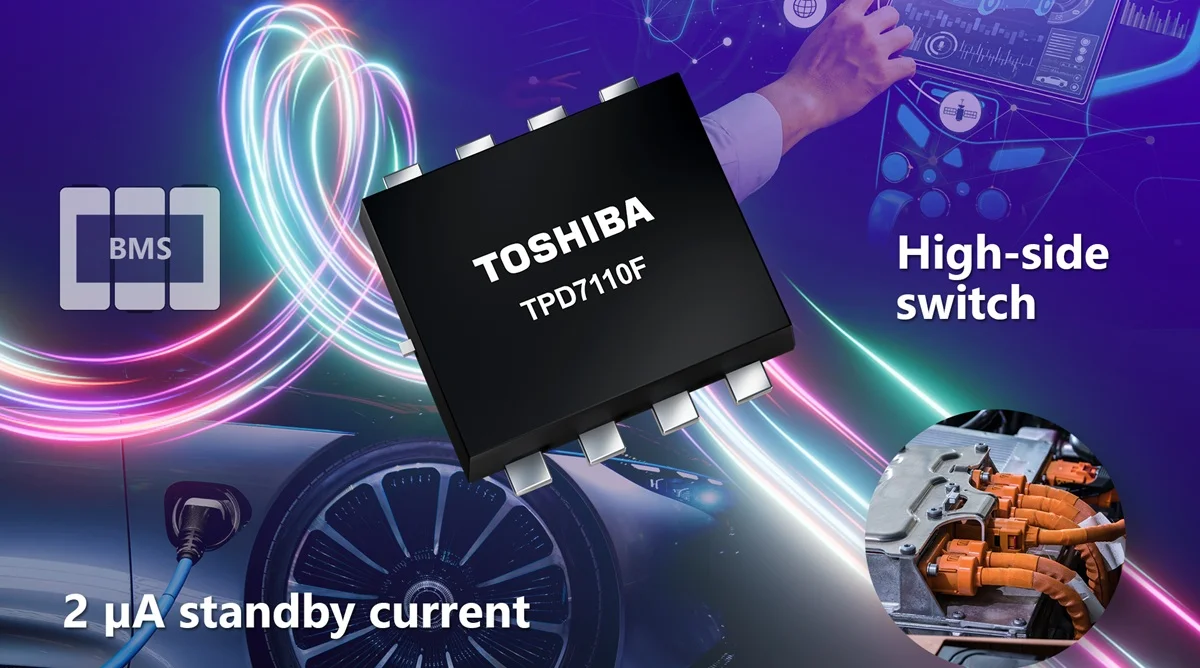
 Designers see the limits of automotive power systems not during steady operation but during the unpredictable transitions that expose weak points. A battery can be connected in reverse during service, a redundant rail can drift out of tolerance, or a module can attempt to feed current back toward the source before the controller has time to react. These are the conditions that quietly shape the reliability of body control modules or battery management units. Parts intended to clean up those interactions often grow in footprint or complicate routing around the high-side switch. The TPD7110F from Toshiba Electronics Europe targets this intersection where protection, redundancy, and size pressure converge and where a simple diode solution no longer behaves well enough.
Creating an Ideal Diode Path Without Heavy Losses
The TPD7110F builds its behavior around an internal charge pump paired with an external N-channel MOSFET. Instead of relying on a conventional diode drop that wastes voltage and heat, the controller drives the external FET as a low-loss path that behaves like an ideal diode under forward conduction. What makes this useful is not only the reduction in loss but the way the device reacts when polarity changes or when the rail encounters unexpected switching behavior. The internal capacitor in the charge pump removes the need for an external component, which gives designers a way to build a controlled high-side path without the usual supporting network. This becomes noticeable in modules where space is constrained and where the power stage competes with sensors, logic, and communication hardware for every square millimeter.
Reverse Polarity and Reverse Current Interactions
Automotive systems often spend more time dealing with incorrect or transient conditions than with true normal behavior. Reverse polarity at the battery is a common failure in the workshop, and the TPD7110F absorbs this scenario using its protection stage before energy reaches downstream circuitry. The device also monitors the voltage across the MOSFET to block reverse current, preventing load-side energy from pushing back into the supply during rail collapse or switchover. This blocking function can be disabled when the system requires reverse flow, such as when energy needs to be recovered into the battery. The ability to shape this behavior without adding separate circuitry gives designers more control over how the module interacts with the broader electrical system, especially when rails combine during redundant supply operation.
Packaging That Changes Placement Decisions
The controller arrives in Toshiba’s PS-8 package, which measures about 2.9 by 2.8 millimeters. That footprint reduces mounting area relative to MSOP-8 devices often used for similar roles. In a dense module the change is noticeable because it frees routing space around the high-side FET and helps reduce trace length to the load. Shorter traces reduce parasitic effects that become more visible during rapid transients, especially when back-to-back MOSFETs are used to create electronic load switches. The internal capacitor further simplifies the layout because designers do not have to adjust for placement or clearance around an external charge pump capacitor. When tolerances tighten late in development, this small reduction in passives often determines whether the design fits without mechanical changes.
Low-Current Behavior Shaped for Always-On Automotive Modules
Automotive modules spend long periods in low-power or standby states, which makes quiescent current more important than conventional switching performance. The TPD7110F draws around 100 microamps during operation and approximately 2 microamps in standby. These levels give designers more flexibility to keep parts of the module powered without exceeding the overall current budget. In battery management or body control systems that must stay responsive without draining the battery, this low-current profile becomes a practical advantage. It enables designs that maintain safe power paths while still meeting strict sleep current requirements.
Learn more and read the original announcement at www.toshiba.semicon-storage.com
You may also like