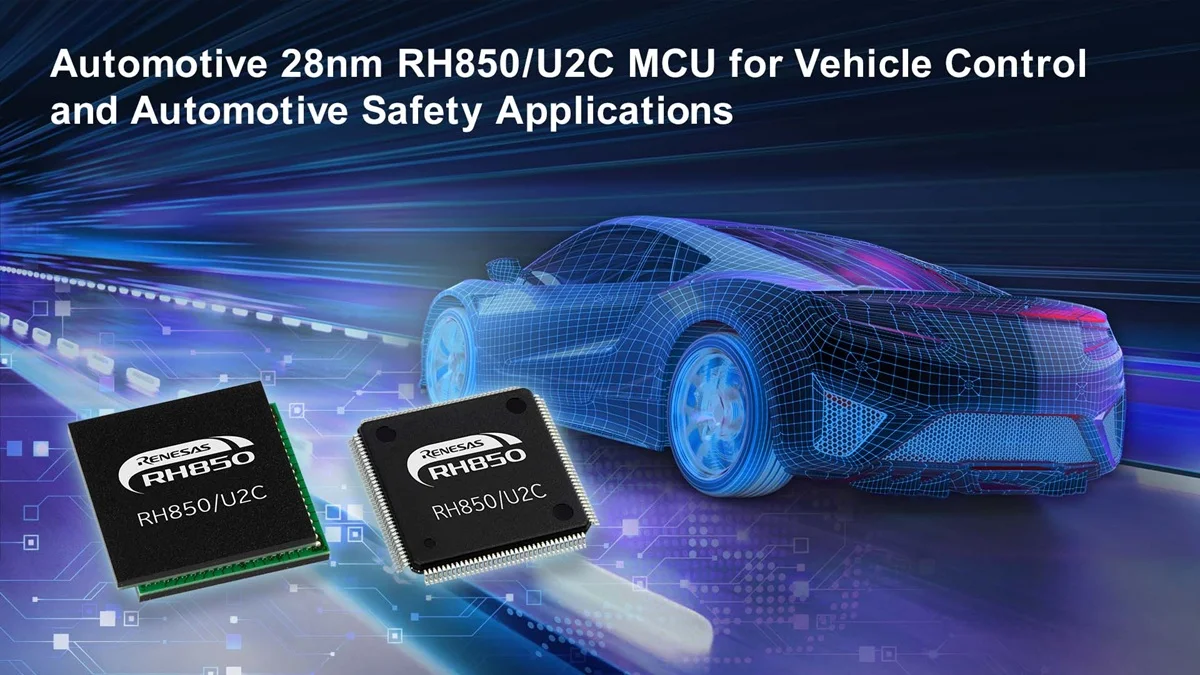
 Vehicle electronics have been getting crowded for years. Not physically crowded in the enclosure, although that happens too, but crowded in the sense that every ECU seems to do more than it used to. A module that once handled a single subsystem now manages communication traffic, safety monitoring, diagnostics, and software updates at the same time. The microcontroller inside that ECU ends up juggling a lot of responsibilities. Renesas’ new RH850/U2C sits in the middle of that situation, aimed at control units that need modern network connectivity and high safety integrity without jumping straight to the highest performance tier.
Four Cores And Lockstep For Safety-Critical Control
Inside the device sit four RH850 CPU cores running at speeds that reach 320 MHz. Two of them can operate in lockstep. That detail matters in automotive electronics because lockstep execution allows the system to detect faults by comparing parallel instruction results. If something diverges, the safety mechanism notices. The MCU also carries up to 8 MB of embedded flash. That space tends to disappear quickly once the full stack is present. Boot code, diagnostics, network stacks, safety logic, secure firmware handling. Modern ECUs rarely run tiny programs anymore.
Renesas positions the device as a lower tier addition to the RH850/U2 family. Existing designs using RH850/P1x or RH850/F1x controllers can move across without completely rebuilding their system architecture.
Network Interfaces Reflect Changing Vehicle Architectures
Vehicle networking used to be fairly predictable. CAN handled most real-time control traffic while LIN served simpler peripheral nodes. That model is slowly changing as vehicle architectures move toward domain and zonal layouts. The RH850/U2C reflects that shift in its interface set. Ethernet support includes 10BASE-T1S as well as time sensitive networking at 100 Mbps or 1 Gbps. CAN-XL appears as well, extending bandwidth beyond what older CAN variants could manage.
Legacy interfaces remain present. CAN-FD, LIN, UART, CXPI, I²C, I²S and PSI5 all appear in the interface list. That combination lets the MCU operate in mixed environments where older ECUs still exist alongside newer network segments. In practice this sort of interface mix becomes useful during long platform transitions. Automotive platforms rarely move everything to a new architecture at once.
Safety Integrity And Cybersecurity In The Same Device
Automotive control systems now face two different categories of reliability. Functional safety remains the first. Cybersecurity has quietly become the second. The RH850/U2C supports functional safety requirements up to ASIL D under ISO 26262. That level usually appears in systems where failure is not acceptable. Steering systems, chassis control, battery management. Security requirements follow the ISO/SAE 21434 framework. The device includes support for several cryptographic approaches, including emerging post-quantum methods along with algorithms required in various international regulatory environments. Hardware acceleration handles much of the cryptographic workload. Without that support the CPU cores would spend a surprising amount of time processing secure communication tasks instead of application logic.
Power Consumption Inside A Packed ECU
ECUs have another constraint that tends to appear late in development. Thermal margin. More software capability and more network activity eventually translate into higher energy consumption. The RH850/U2C is fabricated using a 28 nm process node. That alone reduces active power compared to older generations. The device also introduces dedicated standby modes that lower energy usage when the ECU enters deeper sleep states. Those details matter in systems that spend large portions of their life waiting. Body electronics, for example, can remain powered while the vehicle itself is not actively operating. When power consumption drops, thermal design becomes slightly easier. In sealed automotive environments that margin is rarely wasted.
A Smaller Entry Point In The RH850 Automotive Line
Renesas introduced the RH850 family more than a decade ago and has shipped billions of units since then. Over time the lineup expanded to cover everything from simple control nodes to higher performance domain controllers. The RH850/U2C fits toward the lower end of the newer U2 generation. It offers the connectivity and safety capabilities required for modern vehicle platforms without pushing all the way into high-end computing territory.
For developers maintaining long-lived automotive platforms, devices like this tend to act as transition points. New networking capabilities appear. Security requirements increase. At the same time the system still has to coexist with hardware designed many years earlier.
Learn more and read the original announcement at www.renesas.com
You may also like