
 Hard-switching power stages tend to punish the body diode long before anyone wants to talk about it. In bridge and inverter circuits, reverse recovery can quietly become one of the uglier loss mechanisms on the board, especially once switching frequency rises and the thermal budget is already tight. You can improve the main MOSFET figures, shrink the layout, optimize the driver, and still find the diode behavior dragging the whole stage back toward heat and wasted margin.
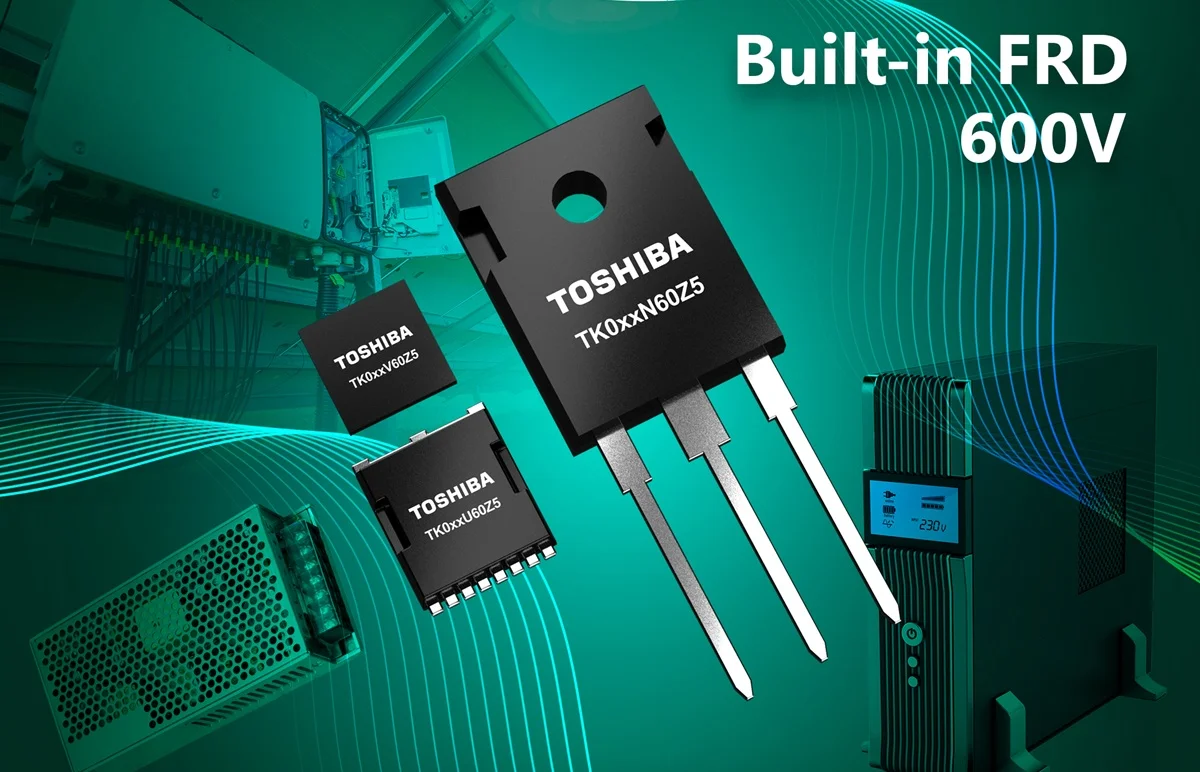
Toshiba’s new DTMOSVI 600V HSD devices are aimed right at that problem. The DTMOSVI 600V HSD family is a series of N-channel super junction power MOSFETs with built-in fast-recovery diodes for switched-mode power supplies, UPS systems, and photovoltaic power conditioners. In a typical server power supply or inverter stage, these parts sit in the switching path where conduction loss, gate-drive loss, and reverse-recovery behavior all end up competing with efficiency and thermal design.
What makes this release interesting is not just the voltage class. Plenty of 600 V super junction MOSFETs already exist. The more useful shift here is that Toshiba is trying to improve diode recovery inside the same device rather than leaving reverse-recovery behavior as the familiar weak point in faster bridge and inverter topologies.
Reverse Recovery Is Still A Real Efficiency Problem
The new parts use lifetime control technology, which intentionally introduces defects into the diode to increase carrier recombination speed. That sounds slightly brutal, but it gets at a real switching problem. When the body diode recovers too slowly, reverse current and stored charge start showing up as extra switching loss, extra noise, and more thermal stress than the schematic looked like it should create.
Toshiba says that compared with its existing DTMOSVI 600 V series without a built-in high-speed recovery diode, the new products reduce reverse recovery time by about 60 percent and reverse recovery charge by about 85 percent under the stated measurement conditions. Those are meaningful improvements in the kinds of circuits where the diode gets forced into the conversation whether the designer wanted it there or not.
That matters in data center server power supplies, UPS hardware, and PV power conditioners because those are exactly the sorts of systems where higher efficiency targets tend to collide with hard commutation and real thermal limits.
Package Choice Changes What The Same Silicon Can Do
Toshiba is also spreading these devices across TO-247, TOLL, and DFN8×8 packages, which gives the release more practical value than a single-package launch would. Package choice in power design rarely feels glamorous, but it usually decides how much current, heat, and layout flexibility the part can actually deliver once it lands on a real board.
The standout part in the announcement is the TK058V60Z5, which reaches a typical RDS(ON) of 0.050Ω in a DFN8×8 package. That is the sort of number that becomes interesting because of where it sits. Getting that level of on-resistance in a more compact package makes sense for space-restrained power supply circuits where designers are trying to keep efficiency up without automatically moving to a larger footprint.
The family also benefits from Toshiba’s optimized gate design and process. According to the company, that cuts the figure of merit RDS(ON) × Qg by about 36 percent and RDS(ON) × Qgd by about 52 percent compared with the previous DTMOSIV-H generation at the same voltage rating. Those are the kinds of improvements that tend to show up across conduction loss, switching loss, and driver burden all at once rather than in one isolated metric.
Faster Power Supplies Usually Need Better Models Too
One of the more grounded details in the release is that Toshiba is pairing the parts with simulation support rather than treating the silicon as the whole story. The company says both G0 SPICE models for quicker functional checks and G2 SPICE models for more accurate transient reproduction are available, along with an online circuit simulator.
That matters because switching power losses do not usually become obvious from headline datasheet numbers alone. The difficult part is often seeing how the device behaves once parasitics, timing, and transient conditions all start interacting. Better models do not fix the circuit, but they do make it easier to find where the real compromises are before the hardware starts getting hot. The broader point here is fairly simple. In 600 V power conversion, efficiency gains are no longer coming only from lower on-resistance. They are also coming from how well the device behaves during the messy parts of switching. That is exactly where these new DTMOSVI HSD parts are trying to earn their place.
Learn more and read the original announcement at www.toshiba-electronics.com
Technology Overview
The DTMOSVI 600V HSD family is a series of 600 V N-channel super junction power MOSFETs with built-in fast-recovery diodes for high-efficiency power supply circuits. The devices are offered in TO-247, TOLL, and DFN8×8 packages, and include a product variant with typical RDS(ON) of 0.050Ω in DFN8×8. Toshiba states the new parts improve reverse recovery time and reverse recovery charge compared with earlier DTMOSVI devices without the built-in high-speed recovery diode.
Frequently Asked Questions
What are Toshiba DTMOSVI 600V HSD MOSFETs used for?
They are used in switched-mode power supplies, uninterruptible power supplies, and photovoltaic power conditioners.
What packages are available for the new DTMOSVI 600V HSD devices?
Toshiba lists TO-247, TOLL, and DFN8×8 package options.
You may also like