
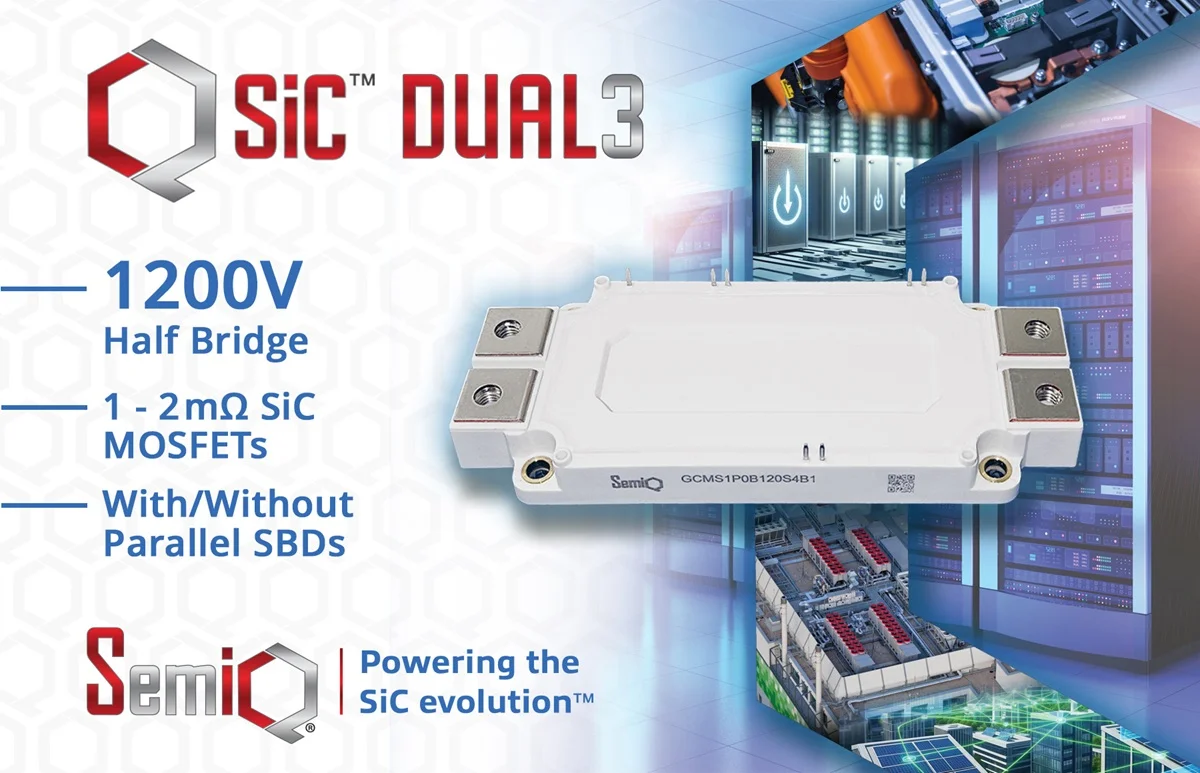
 Not every silicon carbide module launch is really about switching speed. Sometimes the more important question is how much system disruption comes with the move away from IGBTs. In high-power converters, that trade has always been awkward. Efficiency improves, sure, but the mechanical envelope, thermal path, gate-drive behavior, and redesign effort all start dragging into the decision at the same time. SemiQ’s new QSiC Dual3 family sits in that part of the market, where the value of a SiC module depends just as much on how easily it enters an existing power stage as on the raw device physics underneath it.
The QSiC Dual3 is a family of 1200 V half-bridge SiC MOSFET modules used for high-power conversion in systems such as data center cooling drives, grid converters in energy storage, and industrial motor control. In a liquid chiller or active front end, that half-bridge stage is doing more than switching current. It is also deciding how much heat the rest of the converter has to live with, how large the heatsink becomes, and whether the transition away from older silicon architectures is actually worth the trouble.
The Real Story Is Not Just Lower Loss
SemiQ is offering six devices in the series, split across 1 mΩ, 1.4 mΩ, and 2 mΩ variants. Some include an optional parallel Schottky barrier diode, which the company says helps cut switching losses further in higher-temperature operation. That part is easy enough to understand on paper, but the more interesting signal is how the lineup has been positioned. This is not being sold as a general-purpose SiC module family. It is being framed around specific converter roles where efficiency, thermal loading, and physical density all start becoming limiting factors together.
Two of the modules are specified at 1 mΩ, with power density reaching 240 W/in3 from a 62 mm by 152 mm package. That is the sort of number that matters less as a headline and more as a system constraint. Once converters start moving into higher-density thermal environments, especially around AI-linked data center infrastructure, electrical performance and cooling architecture stop being separate discussions.
Why Data Center Cooling Is Becoming A Power Semiconductor Story
The mention of liquid chiller applications is not incidental. Cooling infrastructure in data centers is becoming a much larger electrical problem than it used to be, partly because AI compute loads have pushed both rack power and thermal density into uncomfortable territory. Compressor drives and active front ends are now part of that wider efficiency calculation, which means the power modules inside them are being judged not just on conduction and switching loss, but on the cost they impose on enclosure size, cooling hardware, and overall converter weight.
SemiQ says the QSiC Dual3 series supports 250 kW liquid chiller applications, and that gives the launch a more specific context than a generic industrial SiC release. It is one thing to offer a high-voltage half-bridge module. It is another to shape it around applications where thermal overhead is already under scrutiny before the inverter is even designed.
Built To Replace IGBTs Without Starting Over
One of the more practical claims in the release is that the QSiC Dual3 family has been developed to replace IGBT modules with minimal redesign. That matters because a lot of conversion projects do not begin with a blank sheet. They begin with an existing topology, an existing mechanical constraint, and a growing need to claw back losses without rebuilding the whole platform around a new module format.
SemiQ also notes that all MOSFET die have gone through wafer-level gate-oxide burn-in testing above 1,450 V. Alongside the low junction-to-case thermal resistance, that points to a family being positioned as a serious infrastructure part rather than a lab demonstration of what SiC can do. The promise of smaller, lighter heatsinks follows naturally from that, but only because the thermal path and switching behavior are already being treated as system-level considerations.
Power Density Only Matters If The Rest Of The Converter Can Use It
This is usually the dividing line with high-power module launches. Power density sounds compelling right up until the surrounding converter cannot make meaningful use of it. Bus structure, thermal extraction, packaging constraints, and EMI behavior all decide whether the extra density helps or simply creates a different kind of engineering problem. That is why the QSiC Dual3 family feels more relevant than a straightforward spec announcement. SemiQ is not just pushing lower RDSon numbers. It is trying to make SiC feel mechanically and electrically close enough to older IGBT designs that the upgrade path becomes easier to justify in real hardware.
Learn more and read the original announcement at www.semiq.com
Technology Overview
The QSiC Dual3 is a family of 1200 V half-bridge SiC MOSFET modules for high-power converters in applications such as data center cooling systems, energy storage grid converters, and industrial drives. The series is available in 1 mΩ, 1.4 mΩ, and 2 mΩ RDSon variants, with optional parallel Schottky barrier diode versions. SemiQ states that two 1 mΩ devices reach a power density of 240 W/in3 in a 62 mm × 152 mm package.
Frequently Asked Questions
What is the QSiC Dual3 used for?
The QSiC Dual3 is used in high-power converter applications including motor drives for data center cooling, grid converters in energy storage systems, and industrial drivers.
What voltage and RDSon options are available in the QSiC Dual3 family?
The series is rated at 1200 V and is offered in 1 mΩ, 1.4 mΩ, and 2 mΩ RDSon versions.
You may also like