
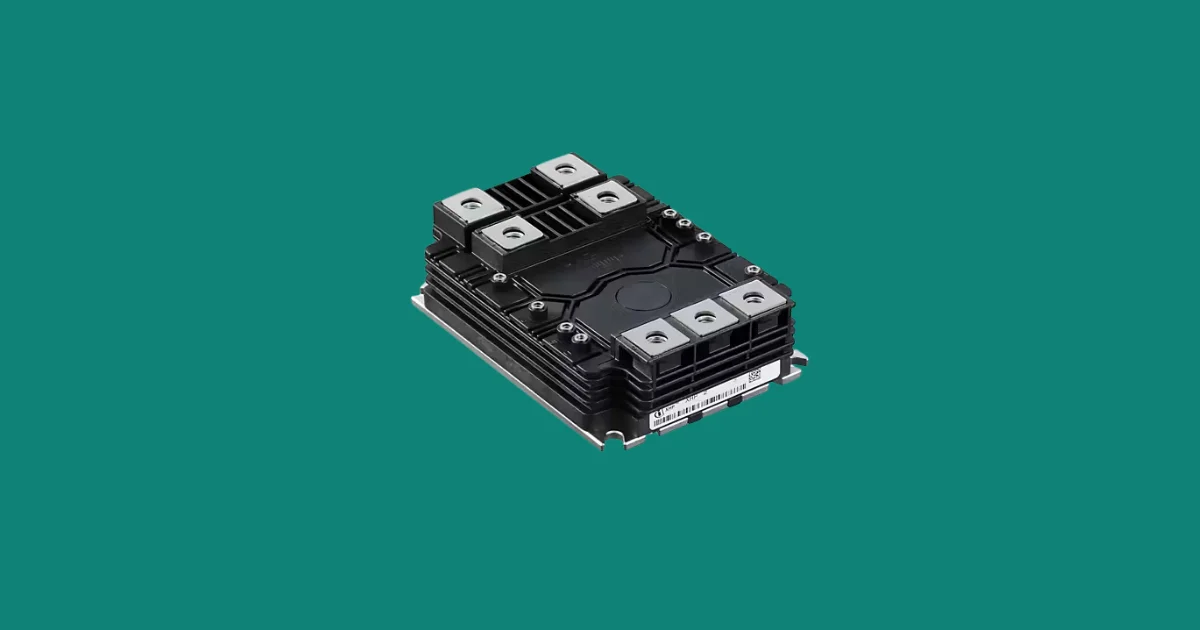
 Infineon Technologies has added new 2300V CoolSiC MOSFET variants to its XHP 2 high-power module family. The parts are built for high-voltage renewable energy and industrial power converters using DC-link voltages up to 1500V, including wind, photovoltaic, and battery storage systems.
The XHP 2 CoolSiC modules use silicon carbide MOSFETs to reduce both switching and conduction losses compared with conventional silicon devices. The 2300V variants cover RDS(on) values from 1mΩ to 2mΩ, depending on the module, with 4kV or 6kV isolation options available. FF1000UXTR23T2M1, FF1300UXTR23T2M1, FF2000UXTR23T2M1, and FF1000UXTR23T2M1_B5 are available now from Infineon and its distribution partners.
2300V SiC Devices For 1500V DC-Link Designs
1500V DC-link designs are already common in larger photovoltaic, wind, and battery storage systems. Running at a higher DC-link voltage reduces the current needed for the same power level, which can ease some conduction losses and reduce stress elsewhere in the power path. Silicon carbide is a good fit here because it can reduce both switching and conduction losses compared with conventional silicon devices. In a large inverter, those losses affect more than the semiconductor choice itself. They feed into heatsink size, cooling design, cabinet volume, switching frequency, and the amount of margin left in the converter. Infineon says the modules can help inverters reach higher efficiency and power density, or run at higher switching frequencies to reduce harmonics and system size.
XHP 2 Package Supports Larger Parallel Power Stages
The modules use Infineon’s XHP 2 package, which is designed for high-power converter platforms. One of the more practical details is the symmetrical switching behavior, which helps when multiple modules need to be paralleled in larger power stages. That's useful in megawatt-class converters where a single module may not carry enough current on its own. If parallel devices do not switch evenly, the design can end up with current sharing problems, extra losses, and hotter devices in parts of the power stage. The standardized XHP 2 platform gives designers a way to scale the converter while keeping the module format consistent across different power levels.
Thermal And Reliability Details Built Into The Module
All variants include Infineon’s .XT interconnection technology, which is used to improve reliability and extend operating lifetime under thermal and power cycling. That matters in renewable energy systems because these converters do not run in a fixed, comfortable operating state. Wind speed, solar input, battery charge profiles, grid demand, and ambient temperature all move around constantly. The modules are also available with pre-applied thermal interface material. It is a small assembly detail, but useful in production because it can reduce handling steps and help keep thermal performance more consistent from one module to another.
Wind And Battery Storage Tests Show System-Level Gains
Infineon says the modules have already been tested in renewable energy systems. A wind power demonstration reached 300kW/L power density, while battery storage testing showed semiconductor losses below 0.7% of output power. For system designers, those figures point to the same practical objective: getting more power through a smaller converter without letting losses or thermal design dominate the build.
High-voltage SiC modules like these are becoming more relevant as renewable energy converters move toward higher power levels, tighter cabinets, and more demanding efficiency targets.
Learn more and read the original announcement at www.infineon.com
Technology Overview
Infineon’s XHP 2 CoolSiC modules use 2300V silicon carbide MOSFETs for high-voltage inverter and converter systems with DC-link voltages up to 1500V. The modules are available with RDS(on) values from 1mΩ to 2mΩ and isolation voltage options of 4kV or 6kV. They are intended for renewable energy systems including wind, photovoltaic, and battery storage converters.
Frequently Asked Questions
What are Infineon’s XHP 2 CoolSiC modules used for?
They are used in high-voltage inverter and converter systems, including wind power, photovoltaic, and battery storage applications.
What DC-link voltage do the new XHP 2 CoolSiC modules support?
The new 2300V CoolSiC MOSFET modules support DC-link voltages up to 1500V.
You may also like