
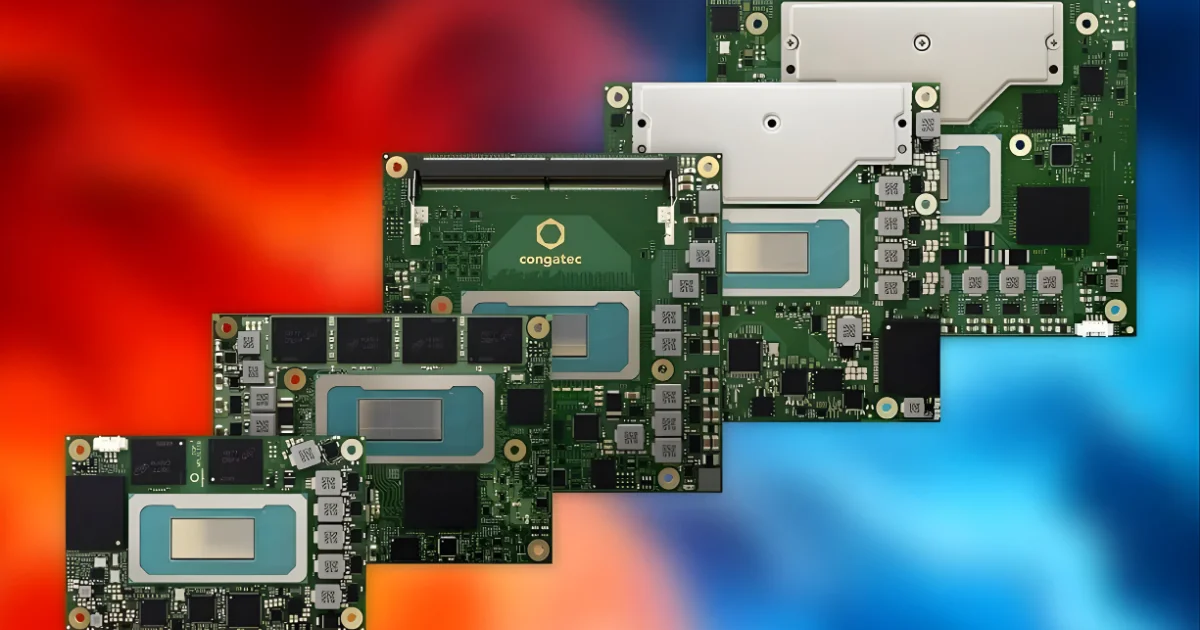
 congatec has expanded its Intel Core Ultra Series 3 Computer-on-Module family with variants rated for the extended industrial temperature range of -40 °C to +85 °C. The move brings its latest embedded AI platform into applications where temperature swings, vibration, and long operating life are just as important as raw compute performance. A lot of edge AI hardware sounds impressive on paper, but deploying it in real environments is often a different challenge entirely. Systems used in industrial automation, transportation, energy infrastructure, robotics, and outdoor installations often need local processing close to the machine or sensor, but they also have to keep running in conditions that are far less forgiving than a controlled indoor cabinet. This pushes modern AI-capable compute into harsher settings where reliability matters just as much as processing power.
A Rugged Version of an Existing AI Platform
The underlying platform is already aimed at high-performance embedded and edge workloads, with congatec quoting up to 180 TOPS across CPU, NPU, and graphics resources. Rather than introducing a completely new module family, this announcement extends that existing platform into the industrial temperature range for more demanding deployments.
The lineup spans several form factors, including COM-HPC Mini, COM-HPC Client, COM Express Mini, and COM Express Compact, which gives developers options for both new systems and upgrades to existing designs. congatec is also positioning certain variants more clearly for rugged use, including the conga-TC1000r, which uses screw-locked LPCAMM2 memory for applications exposed to shock, vibration, or continuous operating stress.
Why the Temperature Range Matters
The -40 °C to +85 °C rating changes where these modules can realistically be used. Edge systems in railway infrastructure, autonomous and heavy-duty vehicles, smart city equipment, industrial machinery, and energy installations often face wide thermal swings and harsh operating conditions. In those applications, the challenge is not just running AI workloads locally, but doing it with hardware that can survive the environment around it.
congatec is also pairing these modules with ruggedization options such as conformal coating, special component selection, and burn-in testing. This is edge AI hardware aimed at places where standard commercial platforms may struggle.
Useful for New Designs and Upgrades
There is also a practical upgrade angle here. Many OEMs still rely on established COM Express designs that fit the application but need more processing headroom for newer workloads such as machine vision, local analytics, predictive maintenance, and mixed control tasks.
By extending the Series 3 family across multiple COM formats, congatec is offering a path forward that does not automatically force a full system redesign. For industrial developers working around qualification costs, service life expectations, and validated carrier designs, that is often more useful than moving to a completely new architecture.
Bringing AI Closer to the Application
This launch pushes AI compute closer to the point of deployment. Instead of keeping inference hardware sheltered away from the actual environment, congatec is building a case for modules that can live nearer to machinery, vehicles, infrastructure, and field systems where the data is being created.
For engineers building rugged edge platforms, that is the value here. Not just more AI performance, but AI performance packaged for the environments that increasingly need it.
Learn more and read the original announcement at www.congatec.com
Technology Overview
congatec’s rugged Intel Core Ultra Series 3 COMs are embedded Computer-on-Modules designed for AI-capable edge systems operating from -40 °C to +85 °C. The family spans COM-HPC and COM Express form factors and combines CPU, NPU, and graphics resources for local inference, control, and embedded processing.
Frequently Asked Questions
What are congatec’s new rugged COMs used for?
They are designed for embedded edge systems in areas such as industrial automation, robotics, transportation, energy infrastructure, and other applications that need local AI processing in harsh environments.
Why is the -40 °C to +85 °C temperature range important?
It allows the modules to operate in environments with major temperature swings and tougher operating conditions where standard commercial hardware may not be suitable.
Are these modules only for brand-new systems?
No. They can also serve as an upgrade path for existing COM-based designs that need more compute and AI capability.
You may also like