 ROHM has introduced the ML7670 and ML7671 wireless power chipset for compact wearable devices that need charging without a wired connector or a conventional Qi charging coil. The chipset pairs the ML7670 receiver IC with the ML7671 transmitter IC and uses NFC-based wireless power transfer at 13.56 MHz, allowing smaller antenna structures for devices such as smart rings, smart bands, smart pens, wireless earphones, and other compact electronics. The ML7670 and ML7671 are NFC wireless power ICs used for proximity-based charging in small wearable devices where board area, antenna size, and mechanical design leave little room for standard charging approaches. In a smart ring, the receiver sits inside the wearable device while the transmitter is placed in the charging accessory, transferring power across a short NFC coupling distance.
NFC Charging For Small Wearable Form Factors
Smart rings create an awkward charging problem because the device has very limited internal volume and a curved mechanical structure. Wired charging is difficult to package cleanly, while Qi-based wireless charging can be hard to fit because of the coil size normally required. ROHM is using NFC wireless charging as the basis for the ML7670 and ML7671, taking advantage of the 13.56 MHz operating band to support antenna miniaturization in smaller devices.
The new chipset follows ROHM’s earlier ML7660 and ML7661 1 W solution, but steps down to a 250 mW power class for smaller products. That lower power level is better aligned with compact wearables that do not need smartphone-class charging power, but still need a practical way to charge small batteries without adding exposed contacts.
Receiver Efficiency and Integrated Charging Support
The ML7670 receiver supports 250 mW power reception and reaches a maximum power transfer efficiency of 45% in that output range. ROHM says this is achieved through optimization of coil matching, rectifier circuitry, and reduced switching device losses. The receiver IC is supplied by the voltage generated from the antenna’s magnetic field, while the ML7671 transmitter operates from a 5.0 V supply.
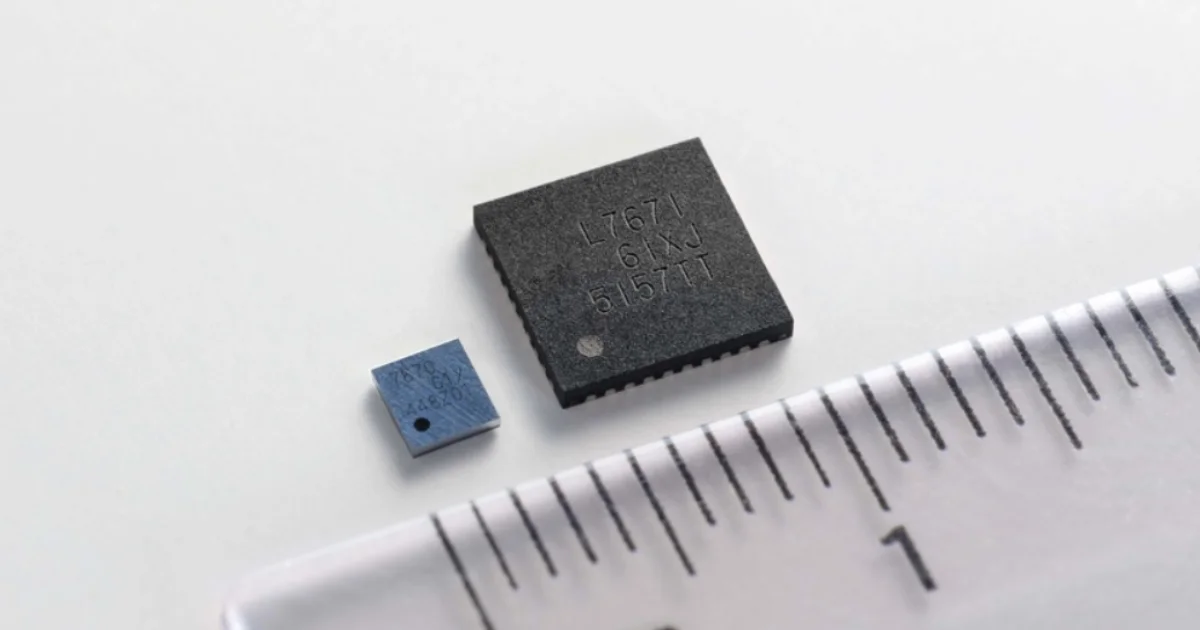
ROHM has also integrated peripheral components such as the switching MOSFETs needed to supply power to the charging IC. That matters in small boards because the supporting circuitry around the charging path can become just as restrictive as the IC footprint itself. The ML7670 receiver is supplied in a 30-pin WL-CSP package measuring 2.28 × 2.56 × 0.48 mm, while the ML7671 transmitter uses a 40-pin WQFN package measuring 6.0 × 6.0 × 0.8 mm.
Embedded Firmware and NFC Forum Support
All firmware required for wireless power delivery is embedded directly inside the IC, removing the need for a host MCU to manage the charging function. That reduces the amount of control circuitry needed around the wireless power stage and can simplify development for small wearable designs.
Both devices include a single-channel I2C target serial host interface and a 10-bit ADC. The ML7670 receiver is compliant with NFC Forum WLC 2.0 and supports NFC Forum Type F, also known as FeliCa. The ML7671 transmitter also supports NFC Forum Type F. The operating temperature range for the chipset is -40°C to +85°C, which covers typical wearable and compact accessory environments.
Smart Ring Adoption And Wearable Use Cases
The chipset is already in mass production and has been adopted in the SOXAI RING 2, a Japanese smart ring designed for sleep management and health monitoring. The ring includes optical vital sensing, temperature sensing, an accelerometer, Bluetooth Low Energy communication, and NFC wireless charging.
For engineers designing small rechargeable products, the ML7670 and ML7671 sit in a useful middle ground between contact charging and larger wireless charging systems. The chipset does not try to deliver high charging power. It gives compact wearables a way to add NFC-based wireless power with a small receiver package, embedded charging firmware, and a transmitter IC designed around the same ecosystem.
Learn more and read the original announcement at www.rohm.com
Technology Overview
The ROHM ML7670 and ML7671 chipset provides NFC-based wireless power transfer for compact wearable devices. The ML7670 receiver supports 250 mW power reception, 45% maximum transfer efficiency, NFC Forum WLC 2.0 compliance, and a 2.28 × 2.56 × 0.48 mm WL-CSP package, while the ML7671 transmitter operates from a 5.0 V supply in a 6.0 × 6.0 × 0.8 mm WQFN package.
View the ML7670 datasheet and ML7671 datasheet
Frequently Asked Questions
What are the ROHM ML7670 and ML7671 used for?
The ML7670 and ML7671 are used for NFC-based wireless charging in compact wearable devices such as smart rings, smart bands, smart pens, wireless earphones, and other small electronics.
How much power does the ML7670 receiver support?
The ML7670 receiver supports 250 mW power reception and reaches a maximum power transfer efficiency of 45% in the low-output range.
Does the ROHM ML7670 need a host MCU for wireless power control?
No. ROHM states that the firmware required for wireless power delivery is embedded directly inside the IC, reducing the need for a host MCU.
You may also like