
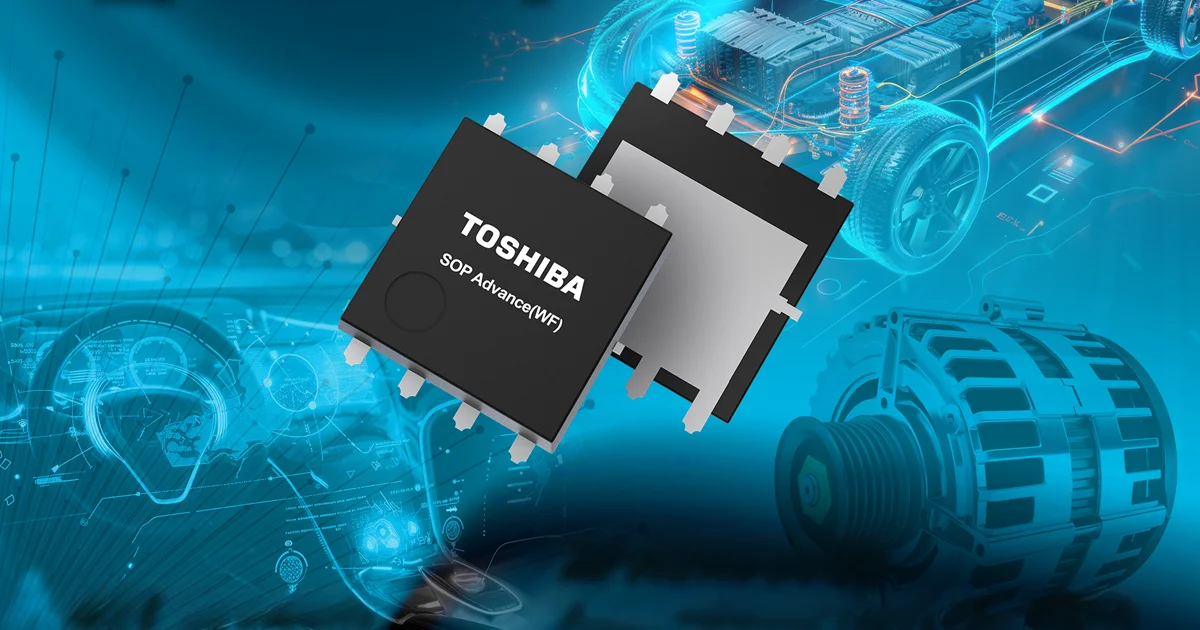
 Toshiba has added two 80V N-channel MOSFETs to its automotive power semiconductor lineup, with the XPH2R608QB and XPH3R908QB aimed at 48V vehicle systems as well as existing 28V automotive designs. Both devices are AEC-Q101 compliant and are the first Toshiba U-MOSX-H MOSFETs to be offered in the SOP Advance (WF) package with wettable flanks.
The XPH2R608QB and XPH3R908QB are 80V automotive N-channel MOSFETs used for switching and power control in BLDC motor drives, non-isolated DC-DC buck converters, switching power supplies, and load switch circuits. They sit in the power stage, where low conduction loss, switching behavior, package resistance, and solder inspection all affect how reliable the final board can be.
80V MOSFETs For 48V Vehicle Power Rails
48V automotive systems place different demands on MOSFET selection than lower-voltage auxiliary rails. Designers need enough voltage margin for the power architecture, but they still need low losses because these systems often sit close to motor drives, converters, and other high-current functions.
Toshiba’s U-MOSX-H process is used here to reduce on-resistance. The XPH2R608QB has a maximum RDS(ON) of 2.55mΩ with a typical total gate charge of 95nC. The XPH3R908QB has a maximum RDS(ON) of 3.9mΩ with a typical total gate charge of 63nC. Both figures are specified at a gate-to-source voltage of 10V.
That gives designers two options within the same general 80V class. One device pushes lower conduction loss, while the other offers a lower gate charge figure that may be useful where switching behavior and drive losses need closer attention.
SOP Advance Package Reduces Resistance
The devices are housed in Toshiba’s SOP Advance (WF) package, which uses a copper connector structure to reduce package resistance. In a MOSFET, package resistance can eat into the gains made at the silicon level, especially in low-RDS(ON) devices where the package becomes a more visible part of the total conduction path. Lower package resistance can help improve efficiency and heat dissipation. That becomes useful in automotive boards where space is tight and thermal design is often shaped by enclosure limits, nearby components, and operating temperature requirements rather than by the MOSFET alone.
The package choice is also relevant for systems that need repeatable assembly quality. These parts are not just about the electrical performance of the die. Toshiba is also using the package to address inspection and mounting reliability.
Wettable Flanks Support AOI Inspection
The SOP Advance (WF) package includes wettable flanks, which improve the visibility of solder fillets after mounting. This allows automated optical inspection equipment to verify solder conditions more easily on production boards. That detail is useful in automotive manufacturing, where hidden or difficult-to-inspect solder joints can complicate process control. Wettable flanks give production teams a clearer visual indication of the solder joint, supporting board-level reliability without relying only on electrical testing or more complex inspection methods.
The XPH2R608QB and XPH3R908QB are intended for N-channel BLDC motor drive circuits and non-isolated DC-DC buck converter circuits. Toshiba also lists motor drives, switching power supplies, and load switches among the target applications. The company’s wider 80V U-MOSX-H automotive MOSFET lineup also includes the XPQR8308QB in the high-heat-dissipation L-TOGL package.
View the XPH2R608QB datasheet View the XPH3R908QB datasheet
Learn more and read the original announcement at www.toshiba.semicon-storage.com
Technology Overview
The Toshiba XPH2R608QB and XPH3R908QB are AEC-Q101 compliant 80V N-channel MOSFETs based on the company’s U-MOSX-H process for 48V and 28V automotive systems. XPH2R608QB offers 2.55mΩ maximum RDS(ON) and 95nC typical Qg, while XPH3R908QB offers 3.9mΩ maximum RDS(ON) and 63nC typical Qg at VGS = 10V. Both devices use the SOP Advance (WF) package with wettable flanks for AOI solder inspection.
Frequently Asked Questions
What are Toshiba’s XPH2R608QB and XPH3R908QB MOSFETs used for?
They are used in automotive BLDC motor drive circuits, non-isolated DC-DC buck converters, switching power supplies, and load switch circuits.
Are the XPH2R608QB and XPH3R908QB suitable for automotive systems?
Yes. Both devices are AEC-Q101 compliant and are designed to support 48V and 28V automotive systems.
Why do these MOSFETs use wettable flanks?
Wettable flanks improve solder fillet visibility, allowing automated optical inspection equipment to check board mounting conditions more easily.
You may also like