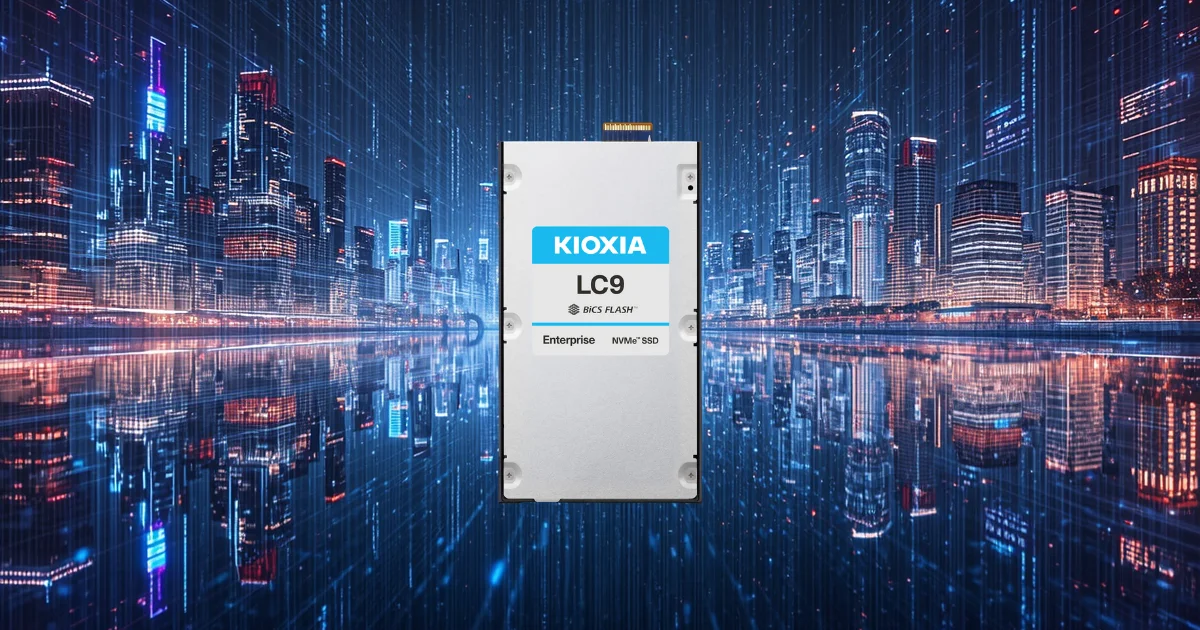
 Kioxia and Dell Technologies have demonstrated a high-density storage configuration that pushes a 2U server to nearly 10 PB of flash capacity using 40 KIOXIA LC9 Series 245.76 TB NVMe SSDs. Built around the Dell PowerEdge R7725xd platform with AMD EPYC processors, the system is aimed at AI infrastructure, large-scale data lakes, and enterprise environments where storage density is starting to become as important as raw compute performance.
The configuration combines Dell’s storage-focused PowerEdge platform with Kioxia’s LC9 Series enterprise SSDs in the E3.L form factor. KIOXIA LC9 Series SSDs are PCIe 5.0 NVMe drives designed for high-capacity enterprise storage deployments and AI data infrastructure. In this setup, forty drives fit inside a single 2U chassis while remaining air cooled. That density changes the physical scale of storage deployment fairly quickly. According to Kioxia, building the same 9.8 PB capacity using more common 30.72 TB SSDs would require an additional seven servers and roughly 280 more drives.
245.76 TB SSDs Push Storage Density Higher
The center of the announcement is the LC9 Series SSD itself. At 245.76 TB, the drive sits well beyond the capacities typically seen in mainstream enterprise NVMe deployments, where 15 TB and 30 TB class drives are still far more common. The LC9 family supports PCIe 5.0 and is available in multiple form factors including 2.5-inch, E3.S, and E3.L variants. The Dell configuration uses the longer E3.L format, which has increasingly become associated with dense front-loaded storage systems where airflow and thermal management still need to remain practical inside standard rack hardware.
In large AI clusters, storage infrastructure is starting to consume more rack space simply because datasets continue to grow faster than individual drive capacities. That becomes particularly noticeable in retrieval systems, model training pipelines, and large ingestion platforms where storage nodes can multiply quickly across a deployment.
Reducing the number of physical drives also changes the surrounding infrastructure. Fewer SSDs means fewer drive bays, fewer power delivery paths, less cabling, and fewer cooling points across the rack.
Built Around Dell’s PowerEdge R7725xd Platform
The PowerEdge R7725xd platform is positioned as a storage-dense server for data-centric workloads, pairing AMD EPYC processors with high-bandwidth networking and large flash pools.
Dell says the system supports up to five 400 Gbps network interface cards, allowing large datasets to move through storage and compute pipelines at significantly higher rates than older enterprise storage platforms. In practical terms, that matters most in environments where storage nodes are feeding GPU clusters or distributed AI training systems that continuously move large volumes of data between compute and storage layers.
The system remains air cooled despite the density increase, which avoids some of the infrastructure complexity associated with liquid-cooled AI hardware deployments.
Consolidating Rack Space and Power Consumption
One of the more interesting parts of the announcement is less about raw capacity and more about consolidation. A single 2U server carrying almost 10 PB of flash storage changes how many storage nodes need to exist physically inside a rack.
Kioxia claims an equivalent deployment based on 30.72 TB SSDs would consume roughly eight times more power while occupying substantially more rack space. Even allowing for marketing optimism around those comparisons, the reduction in hardware count alone has practical effects on cooling layout, airflow management, maintenance access, and cabling density inside larger installations.
For hyperscale and enterprise operators building AI infrastructure, storage density is starting to become a floor-planning problem as much as a performance problem. Higher-capacity SSDs don’t just reduce server count. They reduce the physical overhead that comes with every additional chassis.
Learn more and read the original announcement at www.kioxia.com
Technology Overview
The KIOXIA LC9 Series is a PCIe 5.0 NVMe enterprise SSD family available in capacities up to 245.76 TB. The drives are offered in 2.5-inch, E3.S, and E3.L form factors for high-density server and storage deployments. In the Dell PowerEdge R7725xd configuration, forty E3.L SSDs provide up to 9.8 PB of flash storage inside a 2U air-cooled server platform.
Frequently Asked Questions
What form factor is used in the 9.8 PB Dell server configuration?
The system uses KIOXIA LC9 Series E3.L NVMe SSDs inside the Dell PowerEdge R7725xd platform.
What interface does the KIOXIA LC9 Series support?
The LC9 Series supports PCIe 5.0 with NVMe connectivity for enterprise and AI storage workloads.
What types of workloads is this storage platform targeting?
Kioxia and Dell position the platform for AI infrastructure, large-scale data lakes, enterprise storage systems, and data-intensive compute environments.
You may also like