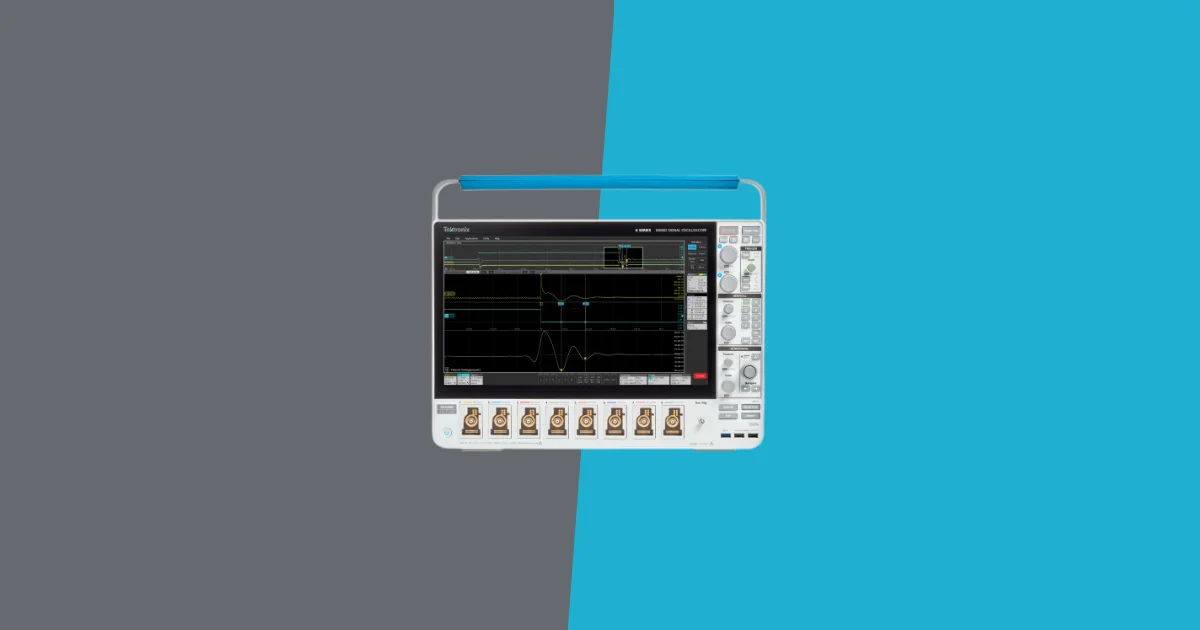
 Tektronix has introduced Power Distribution Network (PDN) Analysis Software for its 4 Series B, 5 Series B, and 6 Series B Mixed Signal Oscilloscopes. The software brings Stability Evaluation for Power Integrity Analysis (SEPIA) directly into the oscilloscope, allowing engineers to evaluate power supply and voltage regulator behavior under real load-transient conditions without breaking control loops or modifying the board.
The release reflects the growing challenge of validating modern power distribution networks in AI servers, high-performance computing systems, and automotive electronics, where rapid load changes and tighter voltage tolerances mean power integrity and signal integrity increasingly influence one another.
Stability Analysis Under Real Load Conditions
Power distribution network stability has traditionally been evaluated using frequency-domain measurements on vector network analyzers. While suitable for small-signal measurements, those methods cannot capture behavior during active load transients and often require access to voltage regulator feedback loops.
Tektronix has instead embedded the SEPIA methodology, developed by Picotest, into the oscilloscope environment. According to the company, this allows large-signal transient stability analysis from a typical high-speed step load response in as little as 500 μs, without modifying the design under test.
The software extracts measurements including phase margin, damping characteristics, and equivalent circuit models directly from the transient response.
Bringing Power and Signal Integrity Together
Beyond stability analysis, the software combines several power integrity measurements within a single oscilloscope workflow. These include automated two-port shunt-through impedance measurements from 10 Hz to 50 MHz using the oscilloscope's internal function generator, together with noise spectrum analysis, automated power supply rejection ratio (PSRR) measurements, and correlation between power rail noise and timing jitter on high-speed serial interfaces.
Rather than treating power integrity and signal integrity as separate validation tasks, the software allows engineers to investigate how power rail behavior influences signal performance using the same instrument.
The PDN Analysis Software is available immediately as either an instrument option or an application bundle upgrade for Tektronix 4 Series B, 5 Series B, and 6 Series B Mixed Signal Oscilloscopes.
Learn more and read the original announcement at the Tektronix website.
Technology Overview
Tektronix PDN Analysis Software extends the company's 4 Series B, 5 Series B, and 6 Series B Mixed Signal Oscilloscopes with integrated power integrity analysis. By embedding the SEPIA methodology alongside impedance, PSRR, noise spectrum, and jitter correlation measurements, the software enables engineers to evaluate power distribution networks under real transient operating conditions from within a single instrument.
Frequently Asked Questions
Which oscilloscopes support Tektronix PDN Analysis Software?
The software is available for Tektronix 4 Series B, 5 Series B, and 6 Series B Mixed Signal Oscilloscopes.
What is SEPIA?
SEPIA, or Stability Evaluation for Power Integrity Analysis, is a methodology developed by Picotest for evaluating power supply and voltage regulator stability from large-signal load-transient responses.
What measurements does the software include?
The software supports SEPIA stability analysis, two-port shunt-through impedance measurements, power-supply-induced jitter correlation, noise spectrum analysis, and automated PSRR measurements.
You may also like