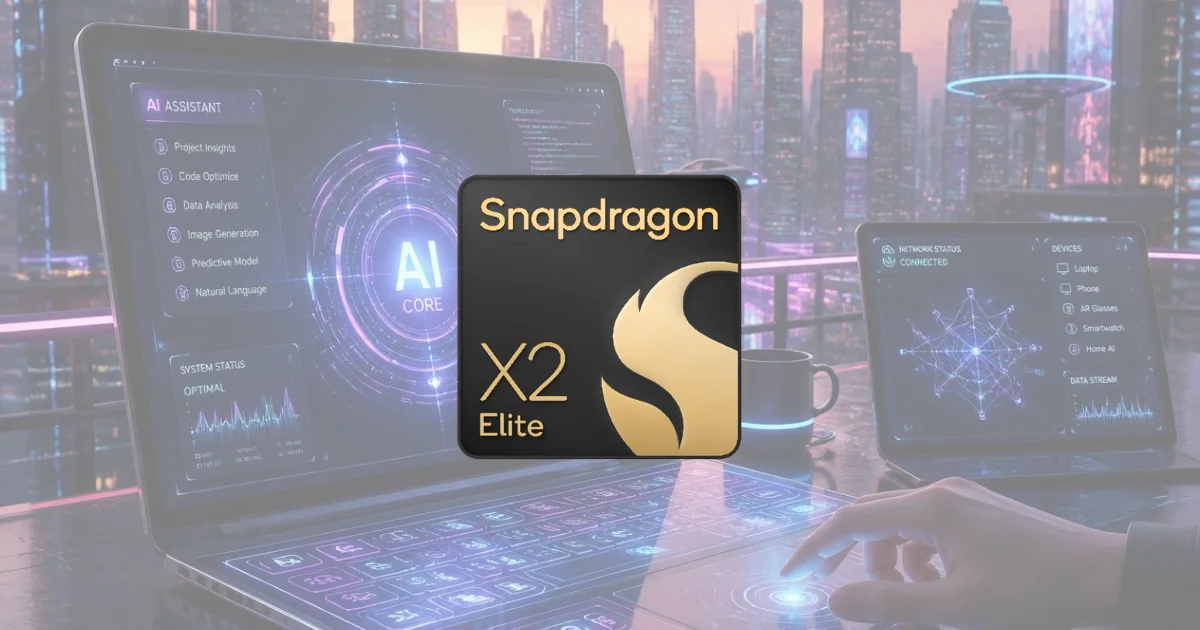
 HUMAIN has unveiled its Horizon Ultra AI PC, built around Qualcomm’s Snapdragon X2 Elite platform and an 18-core Oryon CPU. On its own, another AI PC launch might not sound particularly significant. Almost every major PC manufacturer now has something with AI attached to the name.
What makes Horizon Ultra more interesting is the architecture behind it and the way HUMAIN intends to use it.
Alongside the Oryon CPU, Snapdragon X2 Elite provides Adreno GPU and Hexagon NPU processing, giving the system three different compute engines for handling workloads locally. Horizon Ultra will initially ship with Microsoft Windows, before HUMAIN plans to introduce its own operating system in 2027.
It is another example of a change already taking place across personal computing. AI isn't simply being added to software running on the PC. Hardware is increasingly being designed around running at least some of those workloads locally.
Why Put AI on the PC at All?
Most people's experience of generative AI still involves sending something somewhere else. Ask an AI assistant a question, generate an image or analyse a document and much of the processing can take place in a data centre containing considerably more computing power than anything sitting on a desk.
That model isn't going away. There are AI workloads that simply require more compute, memory or access to cloud services than a personal device can provide. But it doesn't follow that every AI workload needs to make the same journey.
Horizon Ultra is designed around a hybrid approach. AI models and workloads can run locally using the Snapdragon platform's CPU, GPU and NPU, while tasks requiring greater resources can still be passed to the cloud. There are some fairly practical reasons for doing this.
Processing locally removes the network trip for workloads that can be handled by the device. It can also keep selected data on the PC rather than sending it to remote infrastructure, which becomes particularly relevant for enterprise systems handling commercially sensitive information.
Connectivity is another consideration. A useful AI feature becomes considerably less useful if it stops working whenever a reliable cloud connection isn't available. None of these points mean that the PC is about to replace the data centre. What they do suggest is that the boundary between endpoint and cloud computing is becoming less rigid.
The NPU Is Becoming Part of the PC Architecture
Perhaps the more important hardware change is the arrival of the NPU as a standard part of the computing platform. For decades, the CPU was the obvious centre of the PC. GPUs subsequently became increasingly important, first for graphics and then for highly parallel workloads including AI. Now another specialised processor is becoming part of that mix.
The Hexagon NPU in Snapdragon X2 Elite is specifically intended to accelerate AI workloads. Instead of asking the CPU to handle everything, software can distribute different tasks between the CPU, GPU and NPU according to the type of processing required.
That matters because raw performance isn't the only consideration in a personal computer. Power consumption, thermals and battery life matter too, particularly when AI processes may be running continuously in the background.
An intelligent agent that periodically uses AI is one thing. A system expected to understand context, process voice or images and assist the user throughout the working day creates a very different computing requirement.
Dedicated AI hardware gives PC designers another way of handling those workloads without simply demanding more from the CPU.
Qualcomm Is Also Challenging What Sits Inside a Windows PC
There is another interesting part of the Horizon Ultra announcement that has relatively little to do with the words “AI PC.” It runs Windows on Qualcomm silicon.
The first Horizon Ultra uses Snapdragon X2 Elite and its 18-core Oryon CPU rather than the x86 processors that have traditionally dominated Windows PCs.
Qualcomm has spent several years trying to establish Snapdragon as a serious PC platform, particularly where performance and power efficiency need to coexist. AI gives the company another opportunity to differentiate that architecture. If more workloads are divided between CPU, GPU and NPU rather than being centred almost entirely around the CPU, the definition of PC performance starts to change with them.
Processor choice still matters enormously, but buyers may increasingly have to consider how effectively a platform handles several different forms of compute rather than simply comparing conventional CPU performance.
For engineers developing the hardware and software around these systems, that changes the optimisation problem as well.
From AI Feature to AI Architecture
HUMAIN describes the PC as becoming an “intelligence platform.” There is inevitably some marketing language wrapped around that idea, but underneath it is a genuine architectural shift.
Horizon Ultra is expected to go on sale to enterprise customers from September 20, initially running Windows. HUMAIN then plans to introduce HUMAIN OS to the platform in 2027, with deeper integration between the operating system, local AI capabilities and its wider cloud infrastructure.
Whether users ultimately want an AI-first operating system is another question entirely. But the hardware direction is becoming clearer.
AI processing is moving closer to the endpoint. CPUs are increasingly being joined by dedicated NPUs. GPUs are taking on compute roles far beyond graphics. Meanwhile, cloud infrastructure remains available for the workloads that can't sensibly be handled locally.
The interesting part of the AI PC may therefore turn out not to be the AI applications manufacturers demonstrate at launch. It may be the change happening underneath them. Horizon Ultra is one example of a PC being designed from the outset around CPU, GPU and NPU compute, rather than treating AI acceleration as something sitting on top of an otherwise conventional machine.
If that approach sticks, the question in a few years may not be whether a PC is an “AI PC” at all. Dedicated AI processing could simply become another expected part of the architecture.
You may also like