
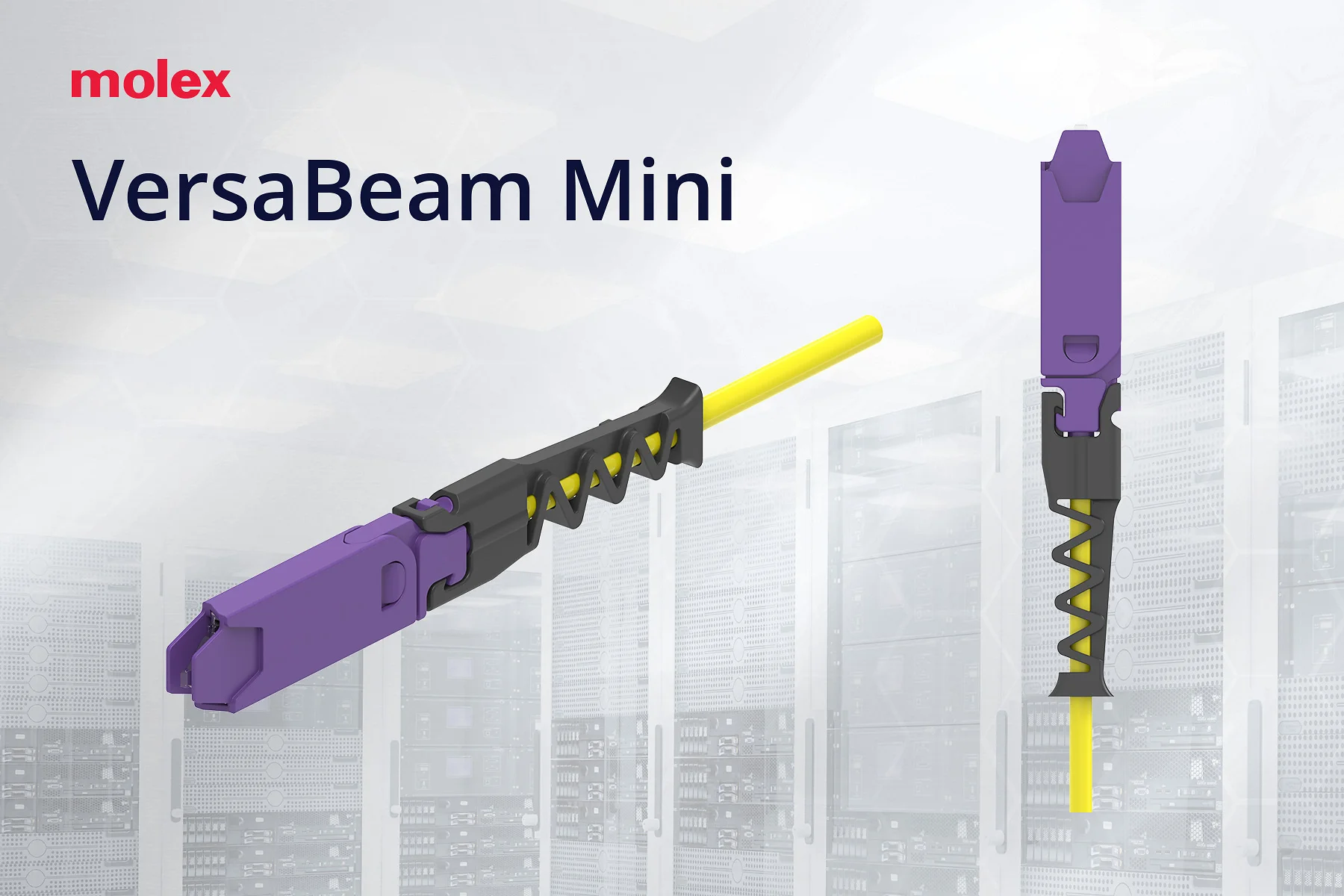
 Molex has introduced VersaBeam Mini, a 16-fiber expanded-beam optical connector designed to increase fiber density in AI data centers and hyperscale networks without sacrificing individual connection serviceability.
The new connector packs 16 fibers into a 3.5 × 9 mm footprint, three times the density of Molex's existing VersaBeam 16 connectivity. That allows up to 3,456 fibers to be installed in a standard 1RU panel, while each VersaBeam Mini connection remains a separate 16-fiber unit.
Molex developed the smaller format for co-packaged optics (CPO), optical backbones and front-panel switch applications, where growing fiber counts are putting more pressure on the limited space available around switches and inside chassis.
More Fibers Without Losing 16-Fiber Serviceability
Packing more fibers into the same rack space is only part of the problem. The way those connections are grouped also affects what happens when a link needs to be isolated, rerouted or replaced.
VersaBeam Mini retains 16-fiber granularity rather than concentrating a much larger number of fibers into a single serviceable connection. Molex describes this as reducing the "blast radius" by nine times, since a technician can disconnect or hot-swap an individual 16-channel link without disturbing the surrounding connections.
That granularity does not mean every connector has to be installed individually. For initial rack deployment, an optional mass-insertion system can engage nine VersaBeam Mini connectors with a single push, connecting 144 fibers at once. Once installed, those connections remain individually serviceable in groups of 16 fibers.
The approach gives designers two different levels of access: larger groups during assembly and deployment, followed by smaller individual connections when the system is in service.
Expanded-Beam Optics Tackle the Maintenance Problem
Higher connector counts also mean more optical interfaces that potentially need to be inspected and kept clean. VersaBeam Mini uses the groove-based 3M Expanded Beam Optical ferrule already used within the wider VersaBeam family.
Instead of relying on a conventional physical-contact fiber interface, the ferrule expands the optical beam across the connection. This makes the interface less sensitive to dust and debris, with Molex claiming its zero-touch EBO approach can reduce inspection, cleaning and maintenance overhead by up to 85 percent.
The ferrule does not require guide pins and holes, which also makes the design suitable for automated cable assembly using robotic pick-and-place equipment. Molex has incorporated inherent laser eye safety for technicians working around disconnected optical links.
VersaBeam Mini is designed for front-panel and optical backplane integration, bringing the expanded-beam approach into a smaller format as fiber counts increase in AI and hyperscale networking hardware.
Limited customer sampling is due to begin in Q4 2026, followed by general production in the first half of 2027.
Learn more and read the original announcement at molex.com.
Technology Overview
Molex VersaBeam Mini is a 16-fiber expanded-beam optical connector designed for high-density data center connectivity. The 3.5 × 9 mm connector uses a 3M Expanded Beam Optical ferrule and supports individual 16-fiber serviceability, with an optional mass-insertion system for connecting up to nine connectors at once.
FAQs
What is Molex VersaBeam Mini?
VersaBeam Mini is a 16-fiber expanded-beam optical connector measuring 3.5 × 9 mm. Molex designed it for high-density applications including co-packaged optics, optical backbones, optical backplanes and front-panel switch connectivity.
How many fibers can VersaBeam Mini support in a 1RU panel?
Molex says the connector's smaller footprint allows up to 3,456 fibers in a standard 1RU panel, while retaining individual 16-fiber connections for servicing.
Why does VersaBeam Mini use expanded-beam optics?
The 3M EBO ferrule expands the optical beam across the connection, reducing sensitivity to dust and debris compared with a physical-contact interface. Molex says its zero-touch EBO approach can reduce inspection, cleaning and maintenance overhead by up to 85 percent.
You may also like