
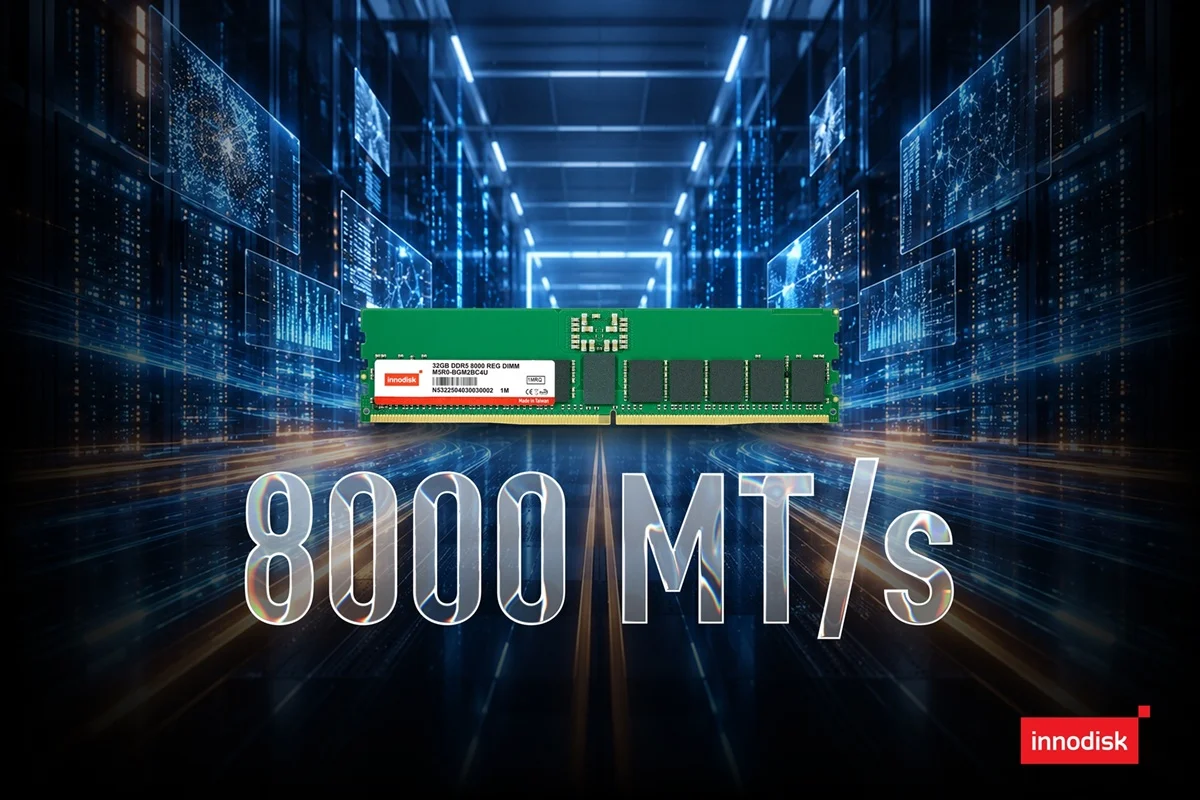
 Innodisk has launched an industrial-grade DDR5-8000 RDIMM, increasing memory transfer speeds to 8000 MT/s while adding protection features for edge AI, high-performance computing and enterprise server systems.
The new module is 11.1% faster than Innodisk's previous generation and is available in capacities from 16 GB to 64 GB. It uses registered ECC architecture to improve signal quality and error correction, but Innodisk has also put some emphasis on how the memory behaves outside ideal operating conditions.
Integrated TVS diodes and eFuse protection are included to deal with voltage fluctuations and abnormal power conditions, while 30 μin gold fingers and anti-sulfuration protection target contact durability and corrosion resistance.
More Bandwidth for AI and Server Workloads
The move to DDR5-8000 comes as increasingly demanding workloads place more pressure on the movement of data between memory and processing hardware.
Innodisk is targeting the module at edge AI and enterprise servers, where the 8000 MT/s transfer rate increases the memory bandwidth available to compute-intensive applications. The company also identifies large language models, generative AI and digital twins among the workloads that can make use of the higher data throughput.
Registered ECC architecture sits alongside that increase in speed, giving the module the signal quality and error correction required for systems where large amounts of data are being processed continuously.
But the new RDIMM isn't only about pushing DDR5 to a higher transfer rate. Innodisk has developed the module as part of its industrial memory range, which brings another set of requirements into the design.
Protecting the Memory in Industrial Systems
Power conditions are one of those considerations. The integrated TVS diodes provide protection against voltage transients, while the eFuse addresses abnormal power conditions that could otherwise cause a system failure. Innodisk has taken a similar approach to the physical connection. The DDR5-8000 RDIMM uses 30 μin gold fingers alongside anti-sulfuration protection, improving contact durability and resistance to corrosion during prolonged industrial use.
Together, those features make the module more than a straightforward bandwidth update to Innodisk's DDR5 range. The 8000 MT/s transfer rate addresses the performance side of newer compute-intensive systems, while the electrical protection and construction are aimed at maintaining that memory in industrial environments.
The DDR5-8000 range will expand further in the first quarter of 2027, when Innodisk plans to add CUDIMM, CSODIMM, ECC CUDIMM and ECC CSODIMM modules.
Learn more and read the original announcement at innodisk.com.
Technology Overview
Innodisk’s industrial DDR5-8000 RDIMM increases data transfer speeds to 8000 MT/s, 11.1% higher than the company’s previous generation, with capacities ranging from 16 GB to 64 GB. The module uses registered ECC architecture and adds TVS diodes, eFuse protection, 30 μin gold fingers and anti-sulfuration protection for industrial, edge AI and server systems.
FAQs
What speed does the Innodisk DDR5-8000 RDIMM support?
The module delivers data transfer speeds of 8000 MT/s, which Innodisk states is 11.1% higher than its previous generation.
What protection features are built into the DDR5-8000 RDIMM?
Innodisk integrates TVS diodes and eFuse protection to mitigate voltage fluctuations and abnormal power conditions. The module also uses 30 μin gold fingers and anti-sulfuration protection for improved contact durability and corrosion resistance.
Where is the Innodisk DDR5-8000 RDIMM intended to be used?
The module targets compute-intensive applications including edge AI and enterprise servers. Innodisk also identifies workloads such as large language models, generative AI and digital twins.
You may also like