
Infineon Introduces OptiMOS 7 Automotive MOSFETs with 0.24 mΩ On-Resistance
New 40 V, 80 V and 100 V MOSFETs combine OptiMOS 7 technology with clip-based interconnection to reduce conduction and switching losses in a 10 × 12 mm TOLL package.
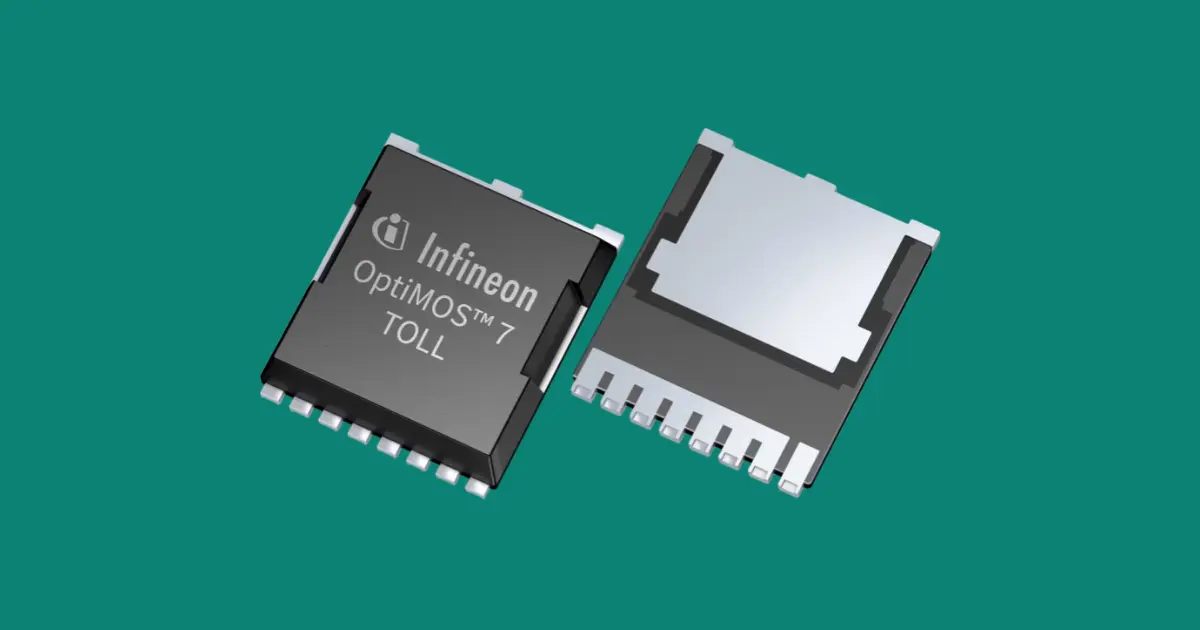
Infineon Technologies has expanded its OptiMOS 7 automotive MOSFET range with three new devices designed for high-current 12 V and 48 V power systems. The latest products achieve substantially lower on-resistance than previous-generation OptiMOS TOLL devices while retaining the established 10 × 12 mm package footprint.
The new MOSFETs are available in 40 V, 80 V and 100 V versions, with on-resistance values of 0.24 mΩ, 0.57 mΩ and 0.88 mΩ respectively. These represent reductions of 65%, 48% and 37% compared with the referenced previous-generation products.
By combining OptiMOS 7 semiconductor technology with a clip-based interconnection concept, Infineon has reduced conduction losses without moving to a larger package. The devices target applications including electric power steering, battery-disconnect switches, motor drives and high-voltage to low-voltage DC-DC converters.
Lower Conduction and Switching Losses
The reduction in on-resistance is particularly relevant to automotive power stages handling high currents, where conduction losses contribute directly to heat generation and overall system efficiency.
Alongside the lower RDS(on), the combination of OptiMOS 7 technology and clip-based interconnection improves capacitance and gate-charge characteristics, reducing switching losses as well as conduction losses.
The devices also feature a tighter gate-threshold-voltage range, which supports more balanced current sharing when multiple MOSFETs are connected in parallel. This reduces the risk of individual devices carrying excessive current, an important consideration in high-power applications that use several MOSFETs to handle the required load.
Higher Current Capability in an Existing TOLL Footprint
The new MOSFETs retain the established 10 × 12 mm² TOLL package, allowing automotive designers to use the improved electrical performance without changing to a larger package architecture.
Depending on the application, the lower RDS(on) can be used to reduce conduction losses and heat generation, increase current capability or reduce the number of parallel MOSFETs needed in a power stage.
The devices are intended for automotive power distribution and conversion systems operating at 12 V and 48 V, including electric power steering and battery-disconnect circuits where high current handling and thermal performance are important design considerations.
Infineon's new OptiMOS 7 TOLL MOSFETs are available now.
Learn more and read the original announcement at infineon.com
Technology Overview
Infineon's OptiMOS 7 automotive MOSFETs use clip-based interconnection and the established 10 × 12 mm TOLL package to achieve low on-resistance in high-current 12 V and 48 V applications. The 40 V, 80 V and 100 V devices offer RDS(on) values of 0.24 mΩ, 0.57 mΩ and 0.88 mΩ respectively, representing reductions of 65%, 48% and 37% compared with referenced previous-generation OptiMOS TOLL products. The devices also feature improved gate-charge and capacitance characteristics to reduce switching losses, alongside a tighter gate-threshold-voltage range for more balanced current sharing in parallel MOSFET configurations.
FAQs
What are the on-resistance values of Infineon's new OptiMOS 7 TOLL MOSFETs?
The 40 V MOSFET has an RDS(on) of 0.24 mΩ, the 80 V version achieves 0.57 mΩ and the 100 V version achieves 0.88 mΩ. These represent reductions of 65%, 48% and 37% respectively compared with referenced previous-generation OptiMOS TOLL devices.
Why is the tighter gate-threshold-voltage range important for parallel MOSFETs?
A narrower gate-threshold-voltage range supports more balanced current sharing between MOSFETs connected in parallel. This can reduce the risk of an individual device carrying excessive current in high-power automotive circuits.
Which automotive applications are the OptiMOS 7 TOLL MOSFETs designed for?
The devices target high-current 12 V and 48 V automotive systems, including electric power steering, battery-disconnect switches, motor drives and high-voltage to low-voltage DC-DC converters. Their low on-resistance is particularly relevant where conduction losses and thermal management are important.
Related news
Keep up with the components and technology shaping electronics.
Join the club for member features, engineering discussion and easier access to the latest Component Club content.