
Microchip Launches Radiation-Tolerant 20 A GaN POL Converter
Microchip launches the POL-05-20S-T radiation-tolerant GaN point-of-load converter, delivering 20 A with 50 krad TID tolerance for FPGA, MCU and ASIC power rails.
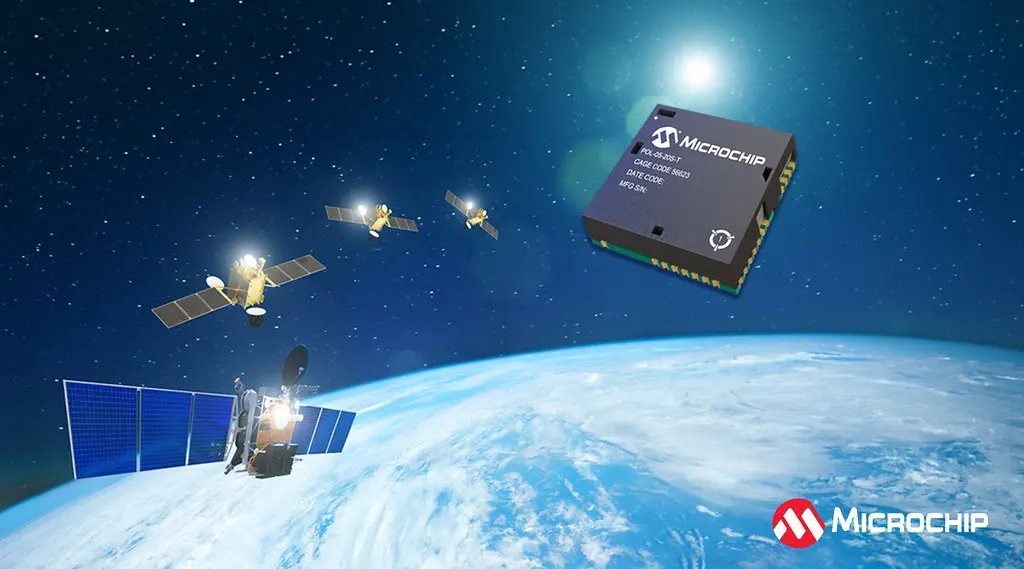
The new device uses GaN power transistors to deliver up to 20 A of continuous output current from a compact 25 g surface-mount package measuring 1.51 × 1.51 × 0.45 inches. Microchip is targeting core voltage rails for FPGAs, microcontrollers, ASICs and other processing-intensive loads where high current, fast transient response and radiation tolerance are required.
The converter uses a synchronous buck topology with current-mode control and supports input voltages from 4.75 V to 13.2 V. Its output can be adjusted from 0.7 V to 5 V, giving designers flexibility across multiple low-voltage rails within the same system.
Built for High-Current Digital Loads
The POL-05-20S-T is designed for loads that can change current quickly as processing activity rises and falls. Microchip has combined synchronous buck conversion with current-mode control to support fast current transients while maintaining stable operation.
Remote sensing is included to compensate for voltage drops between the converter and the load, while output droop regulation can be used to help manage high-current rails. Other built-in functions include undervoltage and overvoltage protection, soft start, an enable input and a power-good indication pin.
The combination of 20 A continuous current and an adjustable low-voltage output makes the device suited to supplying modern onboard processors directly at the point of load, rather than stepping down through additional stages closer to the digital devices.
Radiation Tolerance for Space Environments
Microchip has specified the converter before and after exposure to a Total Ionizing Dose of up to 50 krad. The device is also characterized for Single Event Effects up to a Linear Energy Transfer of 43 MeV·cm²/mg.
Those radiation figures sit alongside a full-load operating temperature range of -55°C to +100°C, allowing the converter to operate across the temperature extremes expected in space systems.
The use of GaN also supports the high power density Microchip is targeting with the device. In the POL-05-20S-T, that means combining a 20 A output with a relatively small surface-mount package rather than using a larger discrete power stage.
The POL-05-20S-T is available now in production quantities.
Learn more and read the original announcement at microchip.com.
Technology Overview
The Microchip POL-05-20S-T is a radiation-tolerant GaN point-of-load converter for space electronics. It delivers up to 20 A continuously, operates from a 4.75 V to 13.2 V input, provides an adjustable 0.7 V to 5 V output, and is specified to 50 krad TID with SEE characterization to 43 MeV·cm²/mg.
FAQs
What is the output capability of the POL-05-20S-T?
The converter delivers up to 20 A of continuous output current, with an adjustable output voltage from 0.7 V to 5 V.
What radiation tolerance does the device provide?
Microchip specifies the POL-05-20S-T before and after exposure to 50 krad Total Ionizing Dose and characterizes it for Single Event Effects up to 43 MeV·cm²/mg LET.
What applications is the converter intended for?
The device is designed for high-current digital loads in space systems, including FPGA, MCU and ASIC core voltage rails and other processing-intensive electronics.
Related news
Keep up with the components and technology shaping electronics.
Join the club for member features, engineering discussion and easier access to the latest Component Club content.