
Researchers Develop Single-Motor Drone That Uses Its Own Rotation to Navigate
Researchers at the University of Hong Kong have developed a single-motor drone that uses its own rotation to scan its surroundings.
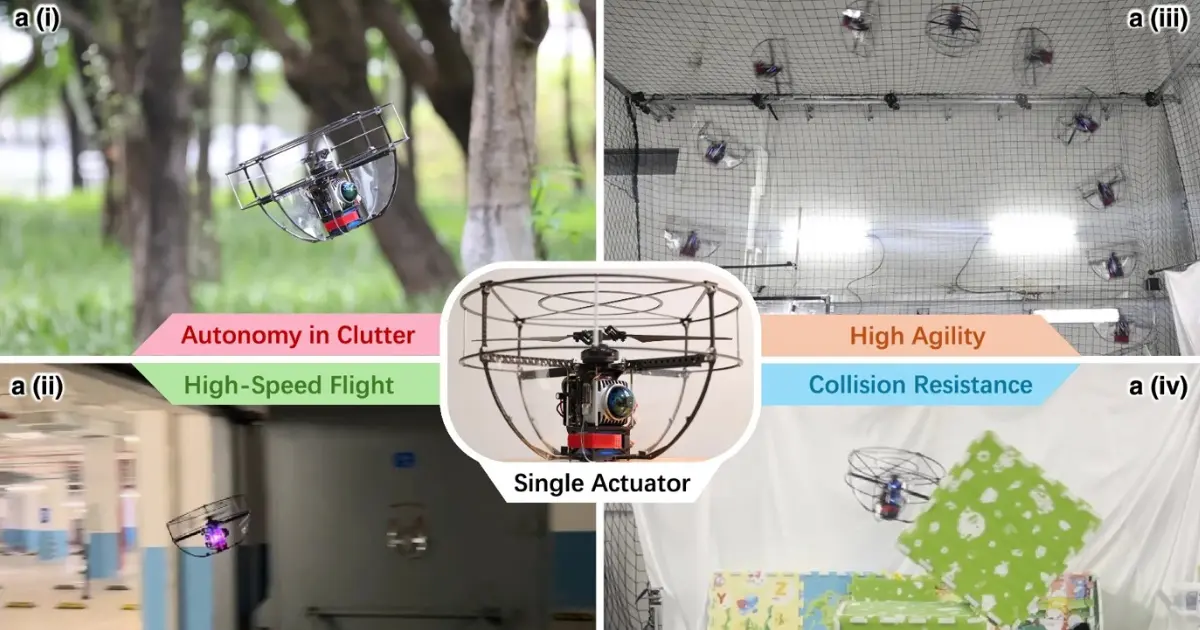
Researchers at the University of Hong Kong have developed an autonomous drone that flies using just one motor, and rather unusually, its entire body spins continuously during operation. Known as PULSAR II, the drone takes advantage of this movement to scan its surroundings using a single LiDAR sensor, removing the need for additional sensors or a separate rotating mechanism.
While a constantly spinning drone might sound difficult to control, the researchers have demonstrated that the aircraft can navigate complicated environments without GPS or external tracking equipment. The results suggest that an unusual approach to propulsion could also provide some useful advantages for autonomous navigation.
Researchers Use Drone Rotation to Improve Environmental Sensing
The research, announced by the University of Hong Kong on November 17, describes how the team developed a single-propeller aircraft using a swashplateless control mechanism.
Conventional quadcopters use four motors to control their flight, but PULSAR II uses one motor connected to two propeller blades. By varying the motor speed during each revolution, the mechanism changes the pitch of the blades, allowing the aircraft to produce the forces needed to steer.
However, this arrangement also causes the drone's body to rotate continuously, something that would ordinarily present problems for equipment mounted to the aircraft. Instead of trying to eliminate the rotation, the researchers decided to make use of it.
The team mounted a LiDAR sensor vertically on the drone, allowing it to observe areas above, below and around the aircraft as the body spins. To demonstrate the difference this makes, the researchers compared 3D maps produced before takeoff with those collected during flight.
When stationary, the sensor could only observe part of its surroundings, leaving several areas hidden from view. Once the aircraft began rotating, these blind spots were significantly reduced, producing a much more complete picture of the environment. This also meant that PULSAR II could examine obstacles in different directions without having to move from its hovering position.
Controlling such an aircraft presented another challenge. The team developed a flight-control system that accounts for the behaviour of the single-motor propulsion mechanism, while an onboard computer handles mapping, navigation and obstacle avoidance.
The researchers also fitted a lightweight carbon-fibre protective frame around the drone and tested its response to collisions. During one experiment, a soft ball was dropped onto the aircraft while it hovered. Other tests involved deliberately flying it into obstacles, with PULSAR II maintaining controlled flight despite the disturbances.
But perhaps the most convincing demonstration came when the team took the drone outside the laboratory.
PULSAR II successfully navigated through dense forests and underground parking garages, avoiding branches, pillars, doorways and overhead pipes. It reached speeds exceeding 6 metres per second, with the navigation and flight control running entirely onboard rather than relying on an external computer.
The prototype weighs approximately 1.12 kg and achieved a hovering time of 15 minutes and 50 seconds.
What Could This Mean for Autonomous Drones?
One of the biggest challenges with autonomous drones is navigating safely through environments where there is limited room to manoeuvre and GPS signals are unavailable.
For example, an inspection drone travelling through an underground tunnel may encounter cables, pipes and structural supports, while an aircraft exploring a damaged building could face debris and unexpected obstacles.
Such environments often require sensors capable of observing a large area around the aircraft. Additional cameras or LiDAR units can provide this coverage, but they also add weight, increase power requirements and take up valuable space.
This is where the approach taken by the Hong Kong researchers could prove useful. A single sensor with a wide view of the surroundings may be particularly well suited to certain inspection, mapping and search-and-rescue applications.
The drone's ability to tolerate collisions is also worth considering. An aircraft entering an unfamiliar or damaged environment may occasionally make contact with obstacles, particularly when travelling through confined spaces. Being able to withstand minor impacts and continue operating could be valuable in situations where recovering a damaged drone would be difficult.
There are, however, some disadvantages to the design.
Conventional quadcopters can maintain a fixed orientation, making them useful for photography, surveillance and carrying equipment that needs to point in a particular direction. A continuously rotating aircraft would require additional arrangements to perform these tasks.
The researchers also acknowledge that the drone can struggle to determine its position in large open spaces where there are few nearby surfaces for the LiDAR to measure. Future versions may incorporate GPS and compass sensors to improve navigation in these environments.
And although the aircraft only requires one motor, much of the work needed to make it practical has gone into developing its flight-control software. A simpler propulsion arrangement doesn't necessarily mean the entire system is less complicated.
Still, the results are impressive. Single-motor drones aren't a new idea, but demonstrating one that can navigate challenging environments autonomously is a considerable achievement.
It also raises an interesting possibility for future robotic designs. There may be situations where engineers can make better use of a machine's existing movement instead of introducing additional mechanisms to achieve the same result.
Whether PULSAR II eventually finds a commercial application remains to be seen. For now, the researchers have demonstrated an aircraft that can do considerably more than hover, and whose unconventional design may prove particularly useful in environments where more familiar drone configurations face difficulties.
Related news
Keep up with the components and technology shaping electronics.
Join the club for member features, engineering discussion and easier access to the latest Component Club content.