
Toshiba Introduces TLX9909 Photocoupler with Adjustable MOSFET Turn-Off Time
The new automotive device offers a minimum open-circuit output voltage of 13.5 V and 3,750 Vrms isolation for solid-state relay applications.
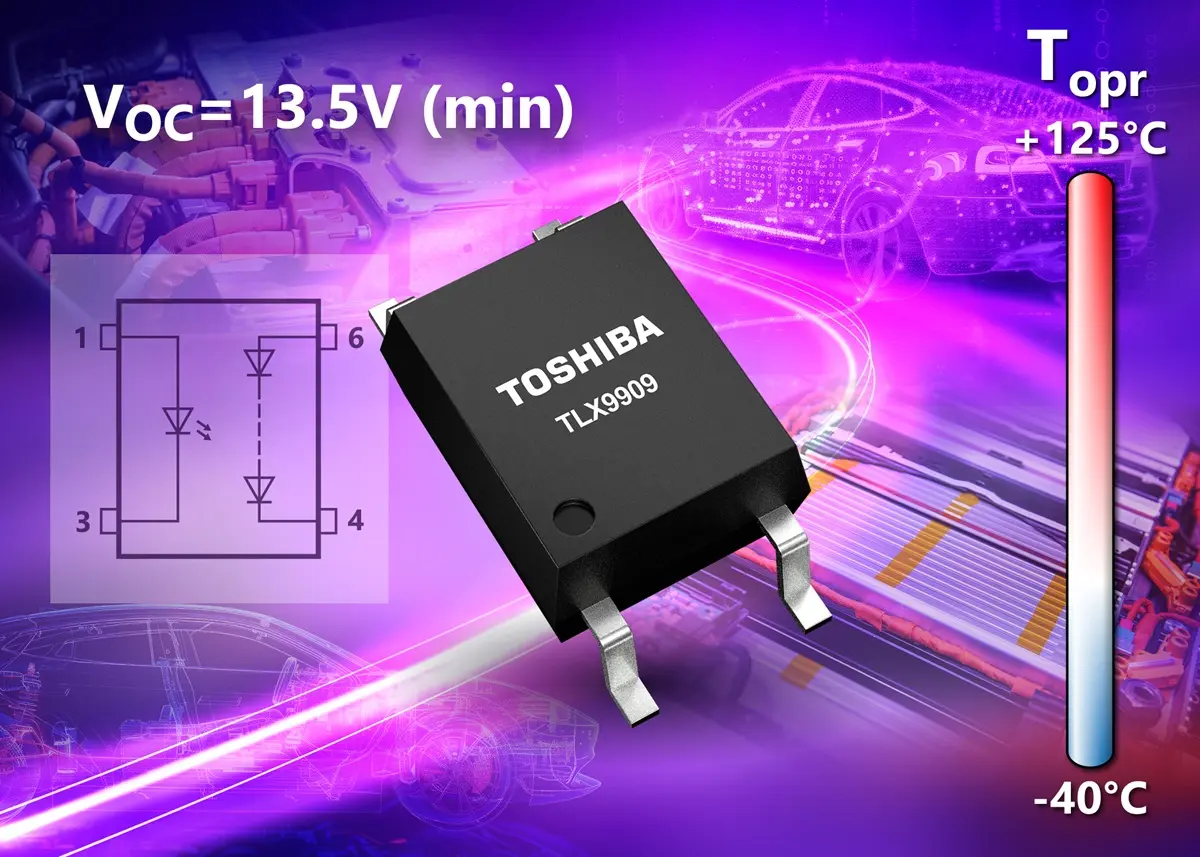
Toshiba Electronics Europe has introduced the TLX9909, a photovoltaic-output photocoupler that enables engineers to adjust the turn-off time of external high-voltage power MOSFETs. The new device is designed for automotive solid-state relay (SSR) applications, including battery management systems (BMS), on-board chargers (OBC) and inverter units.
The TLX9909 uses a photodiode array to generate the voltage required to drive an external MOSFET gate from light emitted by its input-side LED. This eliminates the need for a separate secondary-side power supply or charge-pump circuit, helping reduce component count and system size.
Automotive solid-state relays use semiconductor switching devices instead of mechanical contacts, avoiding the wear associated with conventional relays. When paired with an external high-voltage power MOSFET, the TLX9909 can be used in high-voltage, high-current switching circuits that may be difficult to implement using photorelays with integrated MOSFETs.
Adjustable MOSFET Turn-Off Control
Unlike Toshiba's existing TLX9910, which incorporates a gate discharge control circuit, the TLX9909 allows engineers to configure an external discharge circuit and adjust the MOSFET turn-off time to suit the application.
The TLX9909 has no internal shunt resistor, leaving the gate discharge arrangement to the external circuit. This gives designers greater control over the switching characteristics when selecting a high-voltage MOSFET for an automotive SSR.
The two devices offer different approaches to gate control. The TLX9909 is intended for applications requiring externally configurable discharge characteristics, while the TLX9910 incorporates the discharge control circuit to reduce the need for external components.
Output Characteristics and Automotive Ratings
The TLX9909 offers a minimum open-circuit output voltage (VOC) of 13.5 V at an input forward current of 10 mA and an ambient temperature of 25°C, matching that of the TLX9910.
This is higher than the 7 V minimum offered by Toshiba's TLX9905 and TLX9906, extending the range of high-voltage power MOSFETs that can be driven. The TLX9909 also provides a minimum short-circuit output current of 8 µA under the same conditions.
The AEC-Q101-compliant device operates over a temperature range of −40°C to +125°C and provides a minimum isolation voltage of 3,750 Vrms. It is housed in a 4-pin SO6 package measuring 3.7 × 7.0 × 2.1 mm (typical).
Volume shipments of the TLX9909 began on November 19, 2026.
Learn more at toshiba.semicon-storage.com.
Technology Overview
The Toshiba TLX9909 is an automotive photovoltaic-output photocoupler for driving external high-voltage power MOSFETs in solid-state relay circuits. It generates gate-drive voltage using an input-side LED and photodiode array, without requiring a secondary-side power supply. Unlike the TLX9910, it uses an externally configured gate discharge circuit for adjustable MOSFET turn-off time. The device offers 13.5 V minimum open-circuit output voltage, 8 µA minimum short-circuit output current, 3,750 Vrms isolation and AEC-Q101 compliance.
FAQs
How does the TLX9909 drive an external MOSFET?
The TLX9909 uses a photodiode array to generate voltage from light emitted by its input-side LED. This voltage drives the MOSFET gate without a separate secondary-side power supply or charge-pump circuit.
What is the difference between the TLX9909 and TLX9910?
The TLX9910 has an integrated gate discharge control circuit, while the TLX9909 allows an external discharge circuit to be configured. Engineers can adjust the MOSFET turn-off time according to their switching requirements.
What are the TLX9909's main electrical specifications?
The device offers a minimum open-circuit output voltage of 13.5 V and minimum short-circuit output current of 8 µA at 10 mA input forward current and 25°C. It also provides 3,750 Vrms minimum isolation voltage and operates from −40°C to +125°C.
Related news
Keep up with the components and technology shaping electronics.
Join the club for member features, engineering discussion and easier access to the latest Component Club content.