
u-blox Introduces ALMA-W1 Wi-Fi 6/6E Modules for IoT Devices
Based on Nordic Semiconductor's nRF71 series, the compact modules offer multiple wireless technologies, configurable antennas and software, and optional Edge AI processing.
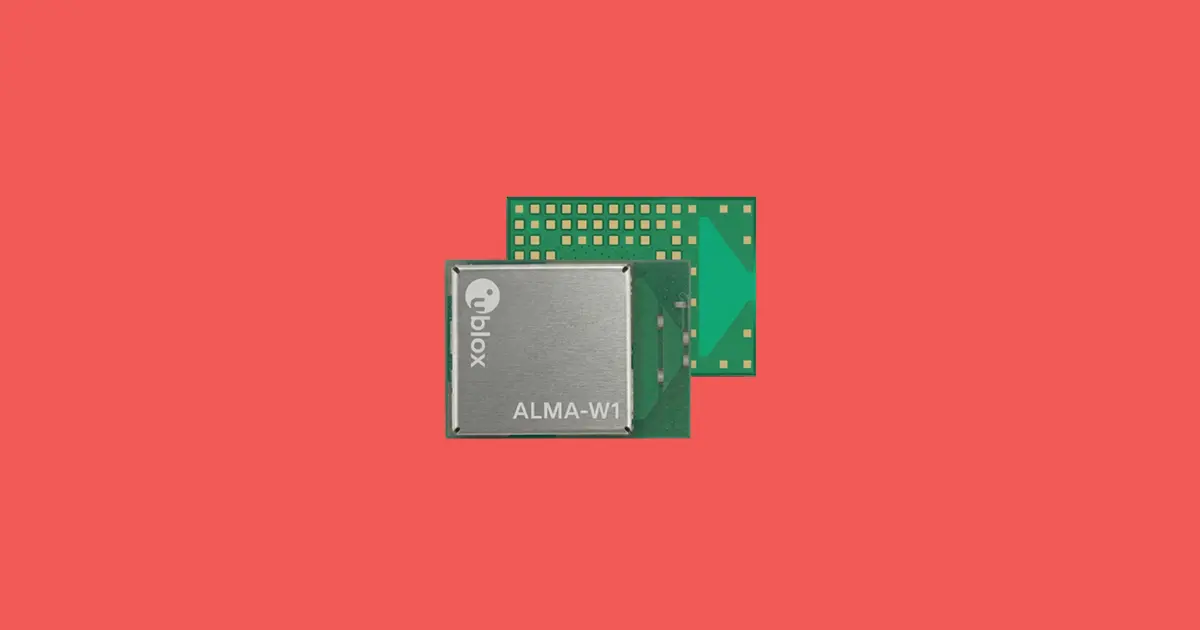
u-blox has introduced the ALMA-W1 series of compact Wi-Fi 6/6E modules based on Nordic Semiconductor's nRF7120 and nRF7120E system-on-chips. Designed for battery-powered and space-constrained IoT devices, the new family combines Wi-Fi, Bluetooth Low Energy and IEEE 802.15.4 connectivity, with different antenna, memory and software configurations.
The modules are intended for applications including medical equipment, smart-home devices, access control, industrial automation, asset tracking and robotics. Developers can choose between wireless MCU operation and a network processor configuration using u-blox's u-connectXpress software.
Wi-Fi 6/6E Connectivity and Module Configurations
The ALMA-W1 series supports dual-band or tri-band Wi-Fi, with internal PCB trace or external antenna options. Embedded-antenna variants measure 10.4 × 14.3 mm, while external-antenna versions measure 10.4 × 11.2 × 1.9 mm.
The modules also support Bluetooth LE, with provision for features including Bluetooth Channel Sounding. Additional configuration options include extended flash memory, 63 configurable GPIOs and multiple peripheral interfaces.
The different wireless and hardware configurations allow the ALMA-W1 to be used in connected products ranging from battery-operated smart-home equipment to industrial monitoring and control systems.
Wireless MCU, Network Processor and Edge AI Options
The ALMA-W1 can operate as a wireless MCU for applications requiring advanced customization, or as a network processor with u-connectXpress software. In network processor configurations, u-connectXpress provides pre-flashed, AT-command-based connectivity software, including the Wi-Fi driver, Bluetooth stack, communication protocols and security libraries.
Selected ALMA-W1 versions also feature a dedicated Axon Neural Processing Unit (NPU) for local Edge AI processing. According to u-blox, the NPU can deliver performance improvements of up to 15 times over equivalent workloads running on the CPU, with lower energy consumption.
The series retains the ALMA module form factor for migration between generations and technologies. u-blox also offers globally certified module configurations to support product integration across international markets.
Initial ALMA-W1 samples are available to selected customers, with the sampling program expected to expand. The modules will be showcased at electronica 2026 in Munich.
Learn more and read the original announcement at u-blox.com.
Technology Overview
The u-blox ALMA-W1 is a compact wireless module series based on Nordic Semiconductor's nRF7120 and nRF7120E SoCs. It combines Wi-Fi 6/6E, Bluetooth LE and IEEE 802.15.4 connectivity with dual-band or tri-band configurations, internal or external antennas and optional additional flash memory. Wireless MCU and u-connectXpress network processor versions support different embedded architectures, while selected models incorporate an Axon NPU for local Edge AI processing.
FAQs
What wireless technologies does the u-blox ALMA-W1 support?
The ALMA-W1 series supports Wi-Fi 6/6E, Bluetooth Low Energy and IEEE 802.15.4. Depending on the variant, developers can select dual-band or tri-band Wi-Fi and internal or external antenna configurations.
What is the difference between wireless MCU and network processor operation?
Wireless MCU configurations support customized application software running on the module. Network processor versions use pre-flashed u-connectXpress software, providing wireless connectivity through AT commands with integrated drivers, protocols and security libraries.
Does every ALMA-W1 module support Edge AI?
No. Selected versions incorporate a dedicated Axon Neural Processing Unit. u-blox reports potential performance improvements of up to 15 times compared with running equivalent AI workloads on the CPU.
Related news
Keep up with the components and technology shaping electronics.
Join the club for member features, engineering discussion and easier access to the latest Component Club content.