 Electrification is no longer limited to premium passenger cars. Compact EVs, two-wheelers, and even hybrid systems now require power electronics that are both efficient and rugged. The challenge for engineers is that these systems are becoming more demanding at every level. HVLV DC/DC converters, which step down from traction batteries to supply low-voltage electronics, need components that minimise conduction losses while operating reliably under thermal stress. Traction inverters for smaller vehicles face the same issue, but in an even tighter space envelope.
Designers are being asked to cut system cost, shrink board area, and still deliver high efficiency. That combination has pushed the need for MOSFETs that can handle high current with low losses while also fitting into mechanically efficient packages.
OptiMOS 6 in the 150 V Class
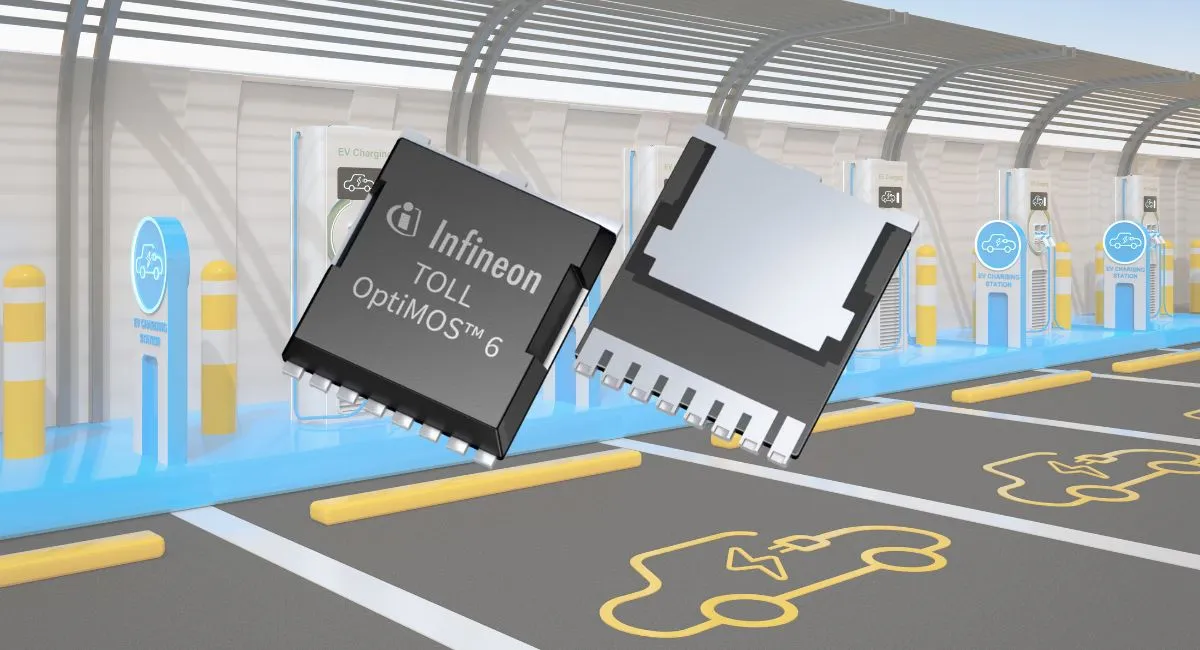
Infineon has expanded its OptiMOS 6 family with a new set of 150 V MOSFETs aimed directly at these challenges. The devices are rated for the automotive environment and offered in three packages: TOLL, TOLG, and TOLT. Together, they give engineers a range of options for balancing size, robustness, and thermal behaviour.
At the core is Infineon’s sixth-generation OptiMOS technology. The new parts deliver RDS(on) values down to 2.5 mΩ, the lowest in their voltage class. That directly translates into reduced conduction losses and higher overall system efficiency. A narrow gate threshold distribution supports consistent switching when devices are paralleled, an important factor in converters and inverters that use multiple MOSFETs in high-power stages. Switching losses are kept low at high frequencies, opening the door to faster converter designs. That is especially useful for DC/DC converters where engineers want smaller magnetics without sacrificing efficiency.
Thermal and Mechanical Considerations
Efficiency on paper does not mean much if the device cannot shed heat. Thermal resistance for the new MOSFETs is specified as low as 0.4 K/W, which eases system-level cooling requirements. Less reliance on large heatsinks or aggressive cooling design can free up both cost and board space.
Packaging also plays a central role.
- TOLL (10 × 12 mm²): standard TO-Leadless footprint that enables compact designs.
- TOLG (10 × 12 mm²): footprint-compatible but with gullwing leads, giving better resistance to thermal cycling and mechanical stress.
- TOLT (10 × 15 mm²): a larger footprint that introduces top-side cooling, allowing direct thermal paths into system-level cooling plates.
For engineers, these options mean the same silicon can be applied across different platforms, from compact DC/DC converters to traction inverters in thermally challenging environments.
Reliability and Standards
The family is qualified to Infineon’s automotive quality standards, which go beyond AEC-Q101. PPAP capability ensures the devices can be integrated smoothly into automotive production flows. This is essential for OEMs that need supply chain confidence as well as electrical performance.
Implications for System Designers
The arrival of 150 V MOSFETs in these packages reflects the growing demand for efficient, cost-effective solutions below the 400 V and 800 V traction levels dominated by SiC. Not every design needs wide bandgap devices. For auxiliary converters and two-wheeler traction inverters, high-performance silicon MOSFETs remain a strong choice.
Infineon’s approach gives engineers flexibility: low RDS(on) for efficiency, thermal options for cooling management, and packaging variations to fit different mechanical constraints. This flexibility can reduce design time, simplify qualification, and provide predictable performance across multiple applications.
Conclusion
Electrification continues to push power electronics into new territory. Engineers are expected to deliver higher current handling, better efficiency, and tighter thermal performance without increasing size or cost. Infineon’s expansion of the OptiMOS 6 line addresses these pressures with a set of 150 V automotive MOSFETs that combine strong electrical performance with packaging options tuned for real-world integration.
For designers of DC/DC converters, traction inverters, and auxiliary systems, the new family offers practical building blocks to balance efficiency, reliability, and manufacturability in the next generation of electrified vehicles.
Learn more and read the original article on www.infineon.com
You may also like