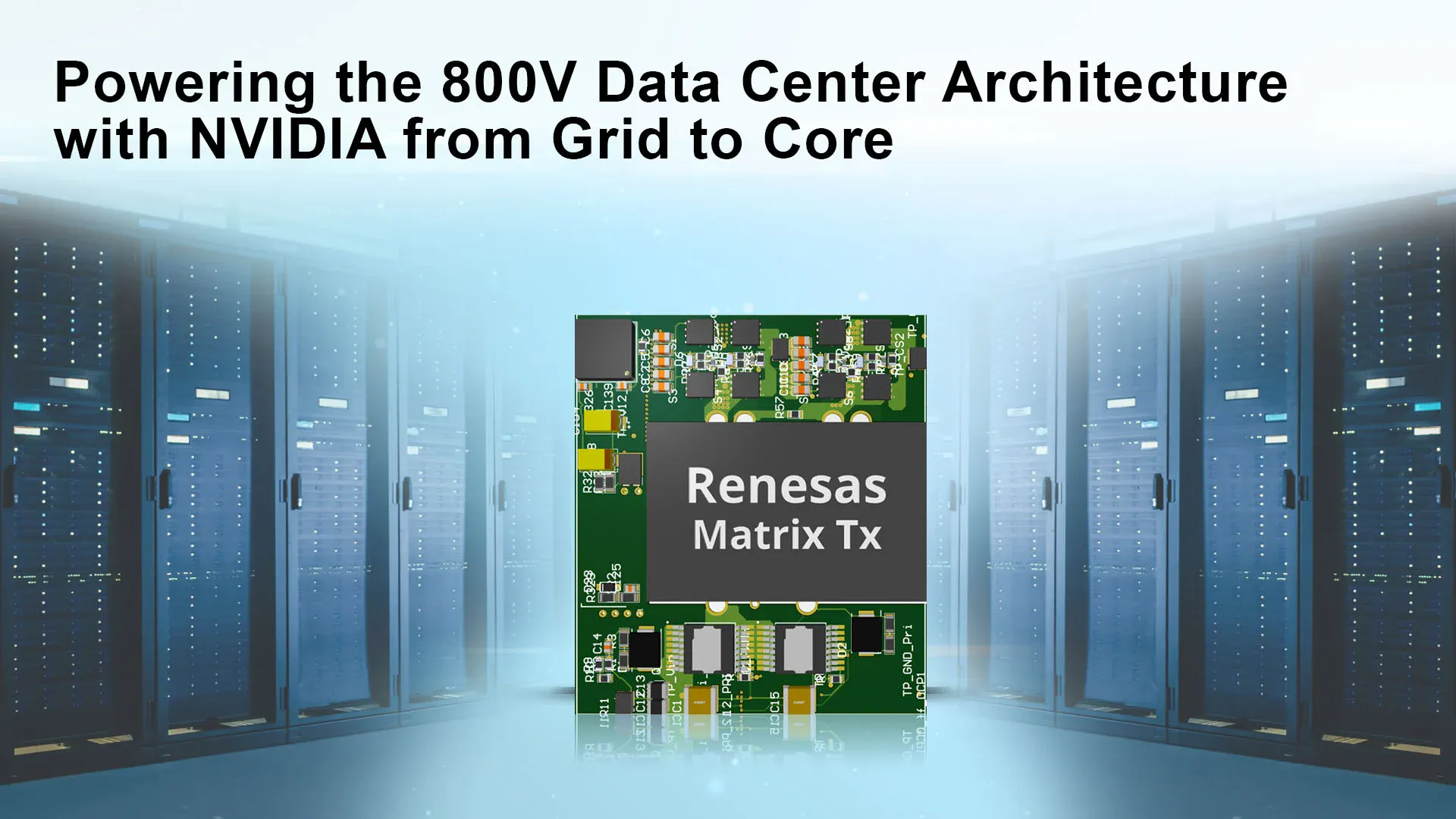
 AI data centres are growing fast, but so is their appetite for power. As racks fill with GPUs and accelerators, total power demand is now reaching hundreds of megawatts per site. Traditional 48-volt distribution systems are beginning to struggle with efficiency losses at that scale. The next step is moving toward 800-volt direct current (DC) architectures, and Renesas Electronics is helping to make that transition possible with a new generation of GaN-based power semiconductors.
Meeting the Demands of AI Power Infrastructure
AI hardware consumes energy in bursts. Every model training cycle or inference run creates sudden spikes in load that stress existing power networks. Higher-voltage DC distribution reduces these losses by transmitting energy more efficiently across the rack, allowing thinner cables and smaller bus bars without sacrificing performance.
Renesas is supporting this 800-volt approach with GaN FET switches, MOSFETs, and drivers built for high-density, low-loss power conversion. The company’s GaN devices operate from 48 V up to 400 V and can be stacked to reach 800 V. Based on an LLC Direct Current Transformer (LLC DCX) topology, the converters achieve efficiencies approaching 98 percent. That kind of performance directly translates into lower heat, smaller cooling requirements, and higher energy utilisation across the data hall.
Renesas has published a white paper that explores the topology of its devices supporting 800V power distribution in AI infrastructure.
Wide Bandgap Devices Take the Lead
Wide bandgap materials such as gallium nitride (GaN) and silicon carbide (SiC) are transforming power electronics. Their faster switching speeds and lower losses make them ideal for the kind of rapid power cycling seen in GPU clusters. In the new Renesas architecture, bi-directional GaN switches also simplify the front-end rectifier design, reducing component count while increasing power density.
The use of wide bandgap semiconductors at both the AC/DC and DC/DC stages enables more flexible system designs. Data centres can run high-voltage distribution buses but still retain compatibility with existing 48-volt components through compact DC/DC step-down converters. It’s an incremental way to evolve without replacing entire racks.
Efficiency and Scalability
Renesas’ approach to 800 V power management is not just about efficiency but also scalability. Each building block, GaN FET, driver, or controller, is designed to fit into modular power shelves that can scale as AI compute demand increases. This aligns closely with the pooled resource architecture now emerging in hyperscale systems, where power, cooling, and compute can be expanded independently.
In practice, that means the same Renesas technology used in one AI training rack could be replicated hundreds of times across a facility, maintaining consistent performance and predictable efficiency.
Why It Matters
AI development is advancing faster than traditional data-centre power systems can handle. Moving to high-voltage DC distribution is a practical way to cut losses, reduce cable bulk, and prepare for the multi-megawatt installations that future AI workloads will require. With its portfolio of GaN FETs, MOSFETs, controllers, and drivers, Renesas is positioning itself as one of the key enablers of this transition.
Learn more and read the original article on www.renesas.com
You may also like