 Electric vehicles and high density computing systems continue to push power architectures into higher voltage and harsher environments. Designers working with traction inverters, on board chargers or 48 V AI servers need switching devices that can deliver efficiency without sacrificing silicon’s proven robustness. Wide bandgap technologies offer strong performance, but silicon MOSFETs remain attractive where cost, short circuit ruggedness and mature supply chains are priorities. Automotive qualification can be a barrier for new technologies entering these applications.
What the Product Does
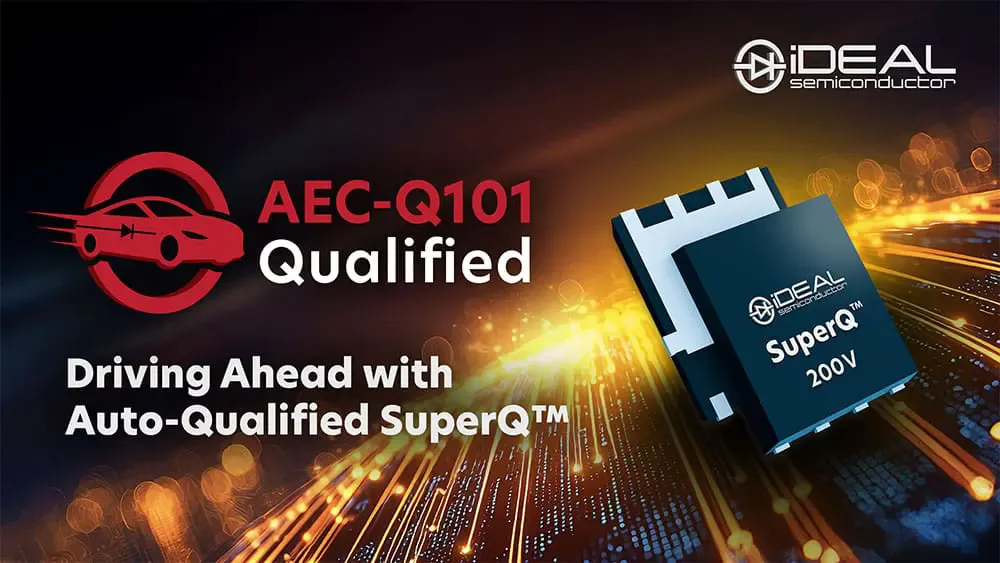
iDEAL Semiconductor has achieved AEC Q101 automotive qualification for its SuperQ technology. The first product released under this qualification is the iS20M028S1CQ, a 200 V MOSFET designed to support high reliability systems found in EV power electronics and ADAS domain controllers. The device targets applications where designers want improved switching behaviour while retaining the familiarity and design infrastructure of silicon.
Key Technical Details
The iS20M028S1CQ offers a 25 milliohm RDS(on) rating and a maximum junction temperature of 175 degrees Celsius. According to iDEAL, SuperQ reduces switching losses and improves conduction efficiency compared with conventional silicon MOSFET implementations. The part uses a compact PDFN 5 by 6 millimetre package, allowing higher power density where board space is constrained. iDEAL reports performance improvements of up to 1.7 times over competing devices in the same class, supporting lower heat generation and reduced cooling overhead.
These characteristics are useful in environments where loads change quickly and components are exposed to mechanical and thermal stress. Certification to automotive standards indicates that the device has been evaluated against qualification tests for thermal cycling, gate stress, power cycling and reliability under fault conditions.
Integration and Design Considerations
For automotive designers, compatibility with existing high volume system manufacturing flows is key to managing risk as platforms scale. The PDFN package format supports automated assembly and efficient heat extraction in power stages. At 200 V, the MOSFET aligns with common battery protection and 48 to 200 V conversion stages used across EV and industrial power topologies. The combination of thermal performance and strong short circuit behaviour gives engineers a choice where wide bandgap may bring cost or fault tolerance trade offs.
Beyond automotive, the device is positioned for use in industrial motor drives, data centre power modules and solar applications where efficiency improvements add direct operating value.
Why It Matters
As more systems move into higher voltage operation and tighter thermal envelopes, silicon still has a role when reliability, ruggedness and cost are dominant requirements. The automotive qualification of SuperQ indicates that innovation within silicon power technology can continue to push performance without forcing system redesign. Designers working on EV powertrains and ADAS can apply this device with confidence that it meets established qualification standards.
Learn more and read the original announcement on www.idealsemi.com
You may also like