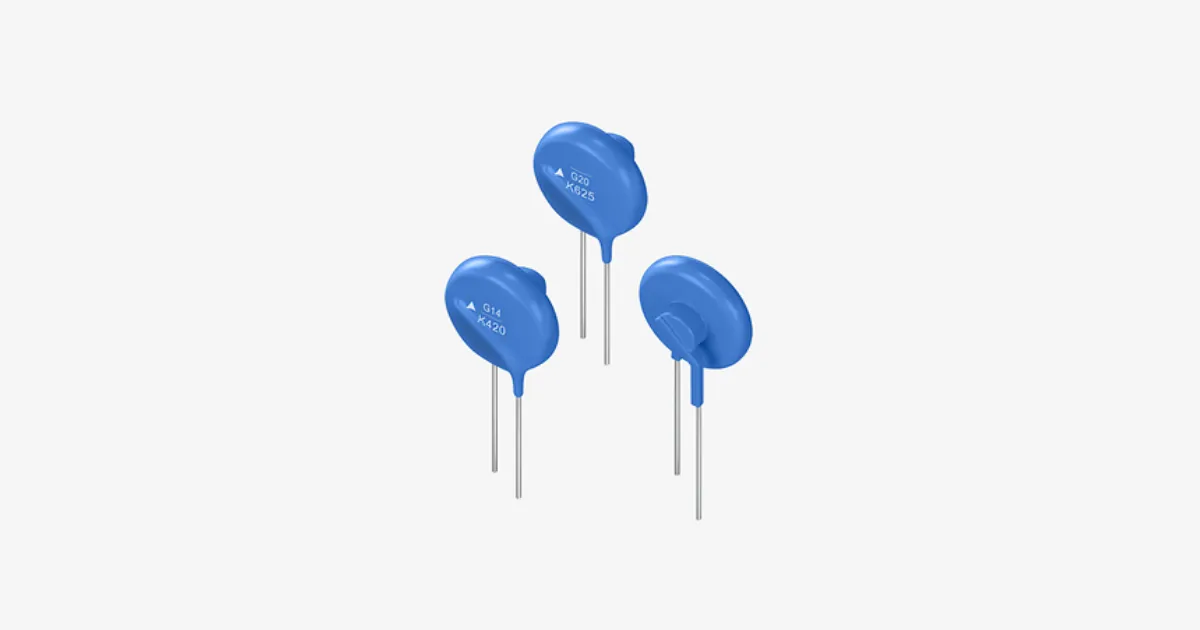
 Protecting AC lines from fast transients and high energy surges often forces engineers into a compromise. MOVs respond quickly but leak current and degrade over time, while GDTs handle large pulses but need a clamping element behind them and introduce design complexity. In many consumer and industrial systems these trade offs shape board layout, thermal behaviour and long term reliability. TDK’s new G Series aims to simplify that balance by integrating a GDT and MOV in a single device arranged in series to eliminate leakage and extend protection lifetime.
Why Surge Protection Still Challenges Designers
Standby leakage is one of the persistent issues with MOV based designs. Even small microamp levels contribute to thermal drift and long term stress, which accelerates ageing and shifts clamping characteristics. For equipment that sits permanently on the mains, such as smart meters or appliance power supplies, this unwanted current also adds up across fleets. Designers often add a GDT in front of a MOV to improve robustness, but using two discrete devices increases board space and still allows leakage through the MOV during normal operation. By placing the GDT ahead of the MOV and isolating it completely during standby, TDK’s hybrid approach removes this current path entirely. The result is a protection stage that behaves predictably, even after repeated surge events.
How The Hybrid Series Design Works
In normal conditions the GDT acts as an open circuit. The MOV sits behind it but is not electrically engaged, so it experiences no continuous stress. During a surge the GDT fires once its breakdown voltage is exceeded and becomes low resistive within microseconds. This shunts the majority of the surge energy away from the downstream circuitry. As the transient continues, the MOV clamps the remaining voltage and absorbs the residual energy to prevent the GDT from reigniting. This division of labour reduces MOV wear, improves consistency across repeated events and offers a more controlled response than either element used on its own.
Key Electrical Performance Characteristics
The series comes in two leaded versions. The G14 uses a 14 mm MOV disk and supports AC voltages from 50 V to 680 V, while the G20 extends the range to 750 V using a 20 mm disk. Surge current capability for a single 8/20 µs pulse reaches 6 kA for the G14 and 10 kA for the G20. Energy absorption ratings climb to 200 J and 490 J respectively, placing the devices comfortably within the demands of power supplies, surge protectors and larger appliances. Both versions operate between minus forty and plus one hundred and five degrees Celsius and use a flame retardant epoxy coating rated to UL 94 V 0. In practice these figures allow the component to handle repetitive transients that would quickly wear down a traditional MOV only solution.
System Applications and Integration
The hybrid stage is relevant to any system connected directly to AC mains or exposed to equipment level surge events. Power supplies, white goods and surge protection devices are obvious fits, but the zero leakage behaviour also benefits communication equipment and smart metering where efficiency and long term stability matter. Industrial drives and motor control units that experience electrical noise from switching elements will also find the reduced MOV stress valuable. Integrating both elements into one package simplifies design reviews, reduces BOM uncertainty and frees space for thermal or filtering improvements.
Implications For Future Designs
Lower standby loss and extended MOV lifetime point to a gradual shift toward more efficient protection stages in always on systems. As energy regulations tighten across appliances and industrial electronics, devices like the TDK G Series give designers a way to improve surge robustness without trading away efficiency. The hybrid series approach also hints at future protection components that combine multiple functions into compact stages to simplify layout and improve predictability under real world surges. For engineers, the takeaway is that protection design can become more robust without increasing complexity.
Learn more and read the original announcement at www.tdk-electronics.tdk.com
You may also like