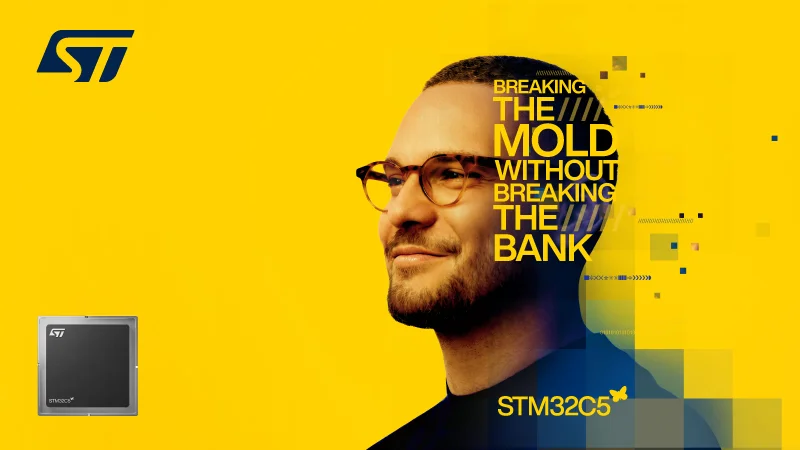
 Small microcontrollers used to live fairly quiet lives. A few sensors. Maybe a PWM output. Sometimes a serial port talking to a bigger processor somewhere else on the board. That boundary has been fading for years. Now the same device that reads a temperature sensor might also handle network traffic, secure firmware updates, and some lightweight signal processing. The problem is that entry-level MCUs were never really designed for that workload. Memory runs out quickly. CPU cycles disappear into communication stacks. STMicroelectronics’ STM32C5 appears in that uncomfortable middle ground where a “simple” control MCU is no longer doing simple work.
Cortex-M33 Appears In The Entry Tier
The STM32C5 family is built around Arm’s Cortex-M33 core, which normally sits a little higher in the microcontroller hierarchy. In this case ST has pushed it into what is essentially the entry segment of the STM32 portfolio. That shift changes the baseline capability of the device immediately. Cortex-M33 carries stronger arithmetic performance and built-in security mechanisms compared with older cores that traditionally filled this tier.
The MCU integrates four processing cores running at speeds that reach roughly 320 MHz. Two of those cores can operate in lockstep mode. Automotive and safety-oriented designs rely on that arrangement to verify execution results in real time. If instructions diverge between the paired cores, the system can detect the fault quickly rather than discovering it later when something behaves incorrectly.
Flash memory density climbs well beyond what engineers expect from entry devices. The smallest configurations begin at around 128 KB while larger variants stretch upward toward the 1 MB range. That detail quietly matters because modern firmware stacks have grown heavy. Network libraries, secure boot processes, update managers, diagnostics. A decade ago that kind of software would have forced a move to a larger microcontroller family.
40 nm Silicon And The Quiet Memory Expansion
ST manufactures the STM32C5 using its proprietary 40 nm embedded process. Process nodes rarely get much attention in microcontroller announcements, yet they often explain how certain specifications become possible. Shrinking the geometry does two things at once. Flash density increases, which helps explain why a device positioned at the lower end of the STM32 lineup can now carry large memory blocks. Power consumption also tends to drop when the architecture is designed carefully around the process.
That combination is noticeable in systems that spend most of their time waiting for events. Industrial sensors, smart thermostats, door locks, battery monitoring nodes. Devices like these wake briefly, process data, and then disappear back into low power modes. Small improvements in power behavior start adding up over long deployments.
Security And Networking In Small Control Nodes
Embedded control nodes used to live on isolated networks. A local CAN bus, perhaps a simple serial interface. Today those nodes increasingly connect to external infrastructure, and that brings security expectations that were once reserved for larger processors.
The STM32C5 targets PSA Level 3 and SESIP3 security levels. Achieving those certifications involves several hardware mechanisms operating together. Memory protection units isolate sensitive code. Cryptographic engines accelerate operations such as AES encryption and hashing. Tamper detection mechanisms help guard secure keys stored inside the device.
Networking capabilities also reflect the changing role of small controllers. Modern vehicles and industrial systems no longer rely exclusively on older bus standards. Data rates increase. Network topologies shift. Control nodes now sit inside architectures that expect stronger communication capabilities.
Packages And System Integration Realities
Physically the devices span a wide packaging range. Some configurations arrive in compact UFQFPN packages measuring roughly 3 mm by 3 mm. Others extend into larger LQFP variants that expose significantly more I/O pins. That range matters when these MCUs land on real boards. Small sensor nodes or wearable devices rarely tolerate large packages. Industrial controllers, on the other hand, often benefit from extra pins for communication interfaces or external peripherals.
Temperature tolerance also hints at the environments the devices are expected to survive. Operation stretches across a wide ambient range, down toward negative forty degrees Celsius and upward beyond typical room temperature conditions. Systems deployed in industrial enclosures or outdoor equipment tend to push components toward those limits sooner than designers expect.
Entry Microcontrollers Are Quietly Changing
For many years entry-level microcontrollers existed mainly as simple control elements. They read inputs, drove outputs, and handed complicated tasks to larger processors somewhere else in the system.
The STM32C5 suggests that boundary is moving. When a low cost MCU carries a modern core, large memory blocks, hardware security features, and networking capability, the definition of “entry level” begins to shift. In practice engineers will probably notice it first when firmware stops fitting into older devices. Instead of moving immediately to a much larger MCU family, the next step might simply be another device in the same class that quietly does a lot more.
Learn more and read the original announcement at www.st.com
You may also like