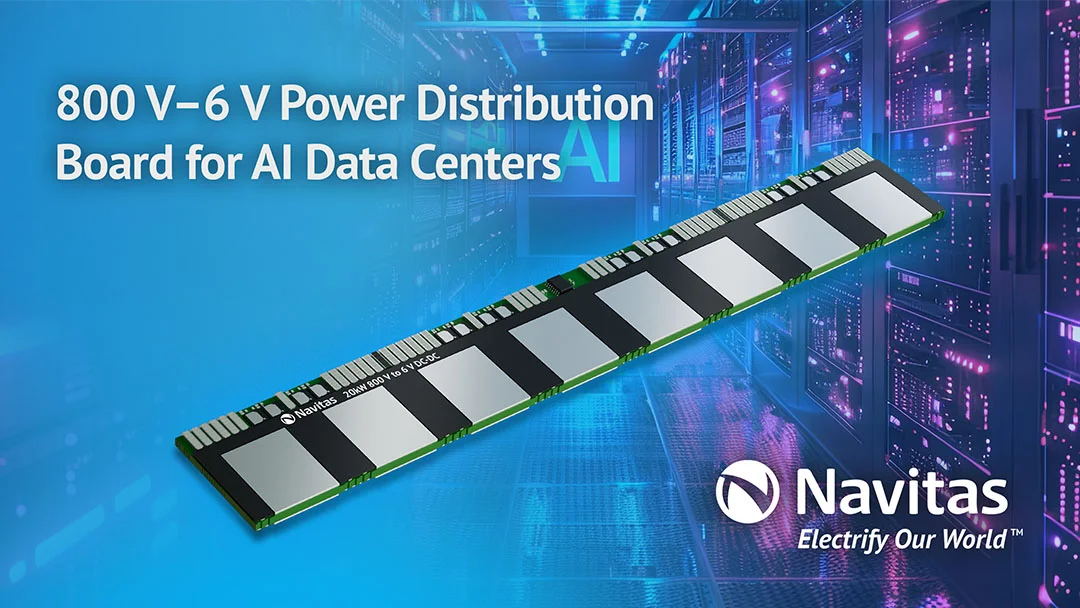
 Power delivery inside AI servers is starting to move away from incremental improvements and toward structural changes in how energy is handled. For years, intermediate rails like 48 V or 54 V acted as a buffer between high-voltage distribution and low-voltage compute loads. That structure kept current manageable and made layout more forgiving, but it also introduced multiple conversion steps that quietly accumulated loss and complexity.
Navitas is moving in a different direction with its 800 VDC to 6 V power delivery board, built around NVIDIA’s evolving reference architecture. The Navitas 800 V to 6 V DC-DC power delivery board is a single-stage converter used to translate high-voltage rack-level power directly into the voltage domain feeding downstream regulators. In a typical AI server tray, that removes the intermediate bus entirely, meaning power no longer steps through a 48 V or 50 V stage before reaching the local conversion hardware.
When the Intermediate Bus Disappears
Intermediate rails were never just a legacy decision. They acted as a way to distribute power without forcing extreme current through every part of the system. Once that layer is removed, the behavior of the entire power path changes. Instead of spreading current across multiple stages, the conversion ratio becomes much larger in a single step, and the electrical stress concentrates in one place.
That shift is not subtle. Moving directly from 800 V down to 6 V means the converter is handling both high voltage and high current dynamics at once, something that was previously divided across separate stages. The benefit is fewer conversion losses and less infrastructure, but the cost shows up in how tightly the system now has to be controlled.
What Changes at the Board Level
Once the intermediate stage is gone, layout and parasitics start to matter more than they used to. Current paths shorten, but the density of that current increases, and small variations in routing or component placement can have a larger impact on performance. Switching behavior becomes more sensitive because there is less electrical distance to absorb noise and transient events.
The board itself reflects that shift. The platform operates at high switching frequency, which reduces the size of magnetics and passives, but also pushes more activity into a smaller physical space. Thermal distribution becomes less uniform, and heat tends to concentrate around the active power stages instead of being spread across multiple conversion points.
GaN Enables the Shift, but Does Not Simplify It
The use of GaN devices is what allows this kind of conversion ratio to be practical at all. Higher switching speeds and lower losses make it possible to handle both the voltage step and the power density within a single stage. But that does not make the system easier to design. If anything, it compresses multiple design challenges into one location. Switching losses, EMI behavior, thermal management, and control stability all start interacting more directly. Problems that would have been isolated in different stages now appear together, and solving one can easily influence another.
AI Power Architectures Are Losing Their Middle Layer
The direction here is becoming clearer across the industry. Intermediate rails are starting to disappear, not because they stopped working, but because they no longer scale well with the demands of modern AI infrastructure. Removing that layer reduces conversion overhead and frees space for compute, but it also changes how engineers need to think about power delivery.
What used to be a distributed problem is becoming a localized one. The system still has to handle the same energy, but now it does so in a tighter space with fewer opportunities to absorb error. That trade-off is not always obvious at first, but it tends to show up quickly once the system is pushed toward its limits.
Learn more and read the original announcement at www.navitassemi.com
Technology Overview
Navitas has introduced an 800 VDC to 6 V DC-DC power delivery board that performs direct single-stage conversion from high-voltage rack distribution to a low-voltage intermediate rail. This approach removes the traditional 48 V or 50 V intermediate bus stage and supports high-density AI server power architectures.
Frequently Asked Questions
What is the Navitas 800 V to 6 V power delivery board used for?
It is used in AI data centers to convert high-voltage rack-level DC power directly to a low-voltage rail for GPU power systems.
Does this architecture include an intermediate bus stage?
No, the design removes the traditional 48 V or 50 V intermediate bus and performs conversion in a single stage.
You may also like