
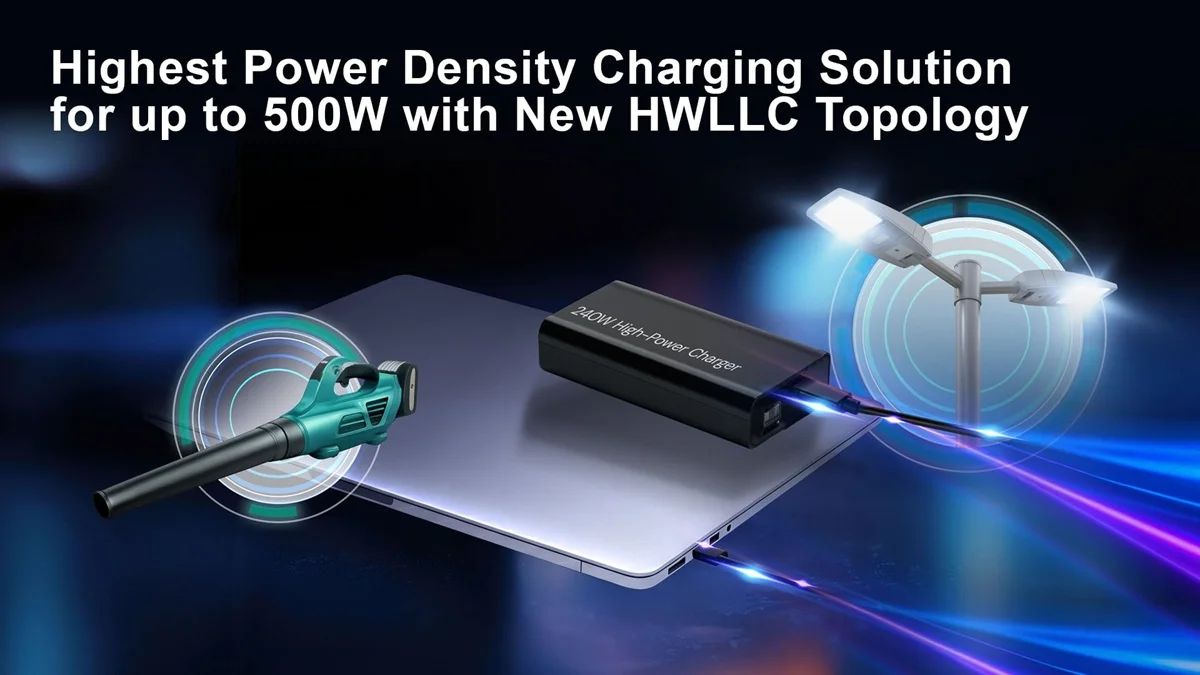
 Fast chargers have been getting pulled in two directions for a while now. Users want more power, more flexibility, and less brick, while the hardware underneath still has to deal with heat, EMI, standby limits, and a power stage that does not become awkward the moment the output range widens. Past a certain point, just scaling an older topology upward starts looking inefficient in every sense of the word.
Renesas is taking that on with its new HWLLC platform. The RRW11011 is an interleaved PFC and half-wave LLC combo controller used in GaN-based AC/DC charging designs for compact high-power adapters and industrial power supplies. In a typical USB EPR adapter, power tool charger, or e-bike charger, this kind of controller sits at the center of the front-end conversion path, coordinating power-factor correction and resonant conversion while the rest of the design tries to stay small enough to be worth building.
What gives this release some weight is that it is not only another GaN charger announcement. The more interesting part is the topology choice. Renesas is using half-wave LLC to stretch a compact AC/DC architecture from the 100 W class toward 500 W and above, which is exactly the point where thermal and magnetic penalties usually start making the charger feel bigger than anyone wanted.
Half-Wave LLC Starts Looking Useful Above The Usual Adapter Range
Most of the charger conversation around GaN has been centered on small and mid-power adapters, but the harder question is what happens when the same design pressure moves upward. Once you are trying to support wide output ranges, higher wattage, and tighter packaging, the magnetics and switching stage begin arguing with each other more loudly.
That is where Renesas is placing the HWLLC approach. The platform uses the RRW11011 combo controller alongside the RRW30120 USB Power Delivery and closed-loop controller, the RRW40120 half-bridge GaN gate driver, and the RRW43110 intelligent synchronous rectifier controller. In the 240 W USB EPR adapter design Renesas is highlighting, the company says the solution reaches 3 W/cc power density and 96.5 percent peak efficiency. Those are good numbers, but the more useful point is what they imply. Renesas is clearly trying to reduce the size and thermal penalty that normally come with moving beyond lower-power USB-C style charging. At 240 W, and certainly if the architecture scales toward 500 W, you stop getting away with lazy conversion stages.
The Topology Is Doing Some Of The Heavy Lifting
Renesas says the half-wave LLC approach reduces transformer winding and cuts component count compared with traditional LLC implementations. That part matters because once a charger gets physically larger, the penalty is not just enclosure size. It starts showing up in BOM complexity, magnetic design, heat distribution, and how easy the platform is to reuse across different products. The platform is also meant to cover a wide output range from 5 V to 48 V, which is useful in charging systems that need more than one familiar fixed rail. USB Extended Power Range is the obvious application, but this also opens the door to higher-power tools, e-bikes, lighting, and other equipment that does not fit neatly inside the older USB adapter world.
Renesas is also leaning on interleaved PFC with phase-shift control to reduce ripple, balance current, and shrink supporting components. That combination makes sense in a charger architecture where density is already high and the front end cannot afford to waste volume on oversized magnetics and filtering.
GaN Is Moving Into Less Convenient Power Levels
The wider story here is that GaN is no longer being used only to make phone and laptop chargers look sleek. It is being pushed into power levels where the topology, not just the switch technology, starts deciding whether the whole thing still makes sense.
That is what makes this platform worth watching. It is aimed at the point where charger design stops being about shaving a few cubic centimeters and starts becoming a serious AC/DC architecture problem. Once the output range broadens and the power target climbs toward 500 W, the converter either stays compact because the topology deserves to, or it does not. Renesas is betting that half-wave LLC, backed by GaN, can keep that argument going a bit further.
Learn more and read the original announcement at www.renesas.com
Technology Overview
Renesas’ HWLLC platform is a GaN-based AC/DC charging solution built around the RRW11011 interleaved PFC and half-wave LLC combo controller, together with the RRW30120, RRW40120, and RRW43110 companion devices. It is designed for compact high-efficiency chargers and power supplies from around 100 W up to 500 W or higher, with a 240 W USB EPR design reaching 96.5 percent peak efficiency. The platform supports wide output operation from 5 V to 48 V.
Frequently Asked Questions
What is the Renesas HWLLC platform used for?
It is used in high-power AC/DC charging and adapter designs for applications such as power tools, e-bikes, industrial equipment, and USB EPR power adapters.
What output range does the Renesas HWLLC solution support?
Renesas states that the solution supports a wide output range from 5 V to 48 V.
You may also like