 I²C is used everywhere from small sensor boards to industrial control hardware, but it becomes harder to manage once signals need to cross between different voltage domains or noisy parts of a system. Würth Elektronik has added the WPME-CDI2C family to its digital isolator range, bringing 2-channel isolation to I²C interfaces with bidirectional data transmission up to 2 MHz.
The WPME-CDI2C is a digital isolator family for galvanic isolation of I²C communication lines. It is intended for systems where the I²C bus needs to move data between circuits while reducing the risk of ground potential differences, communication errors, or unwanted noise coupling into sensitive electronics.
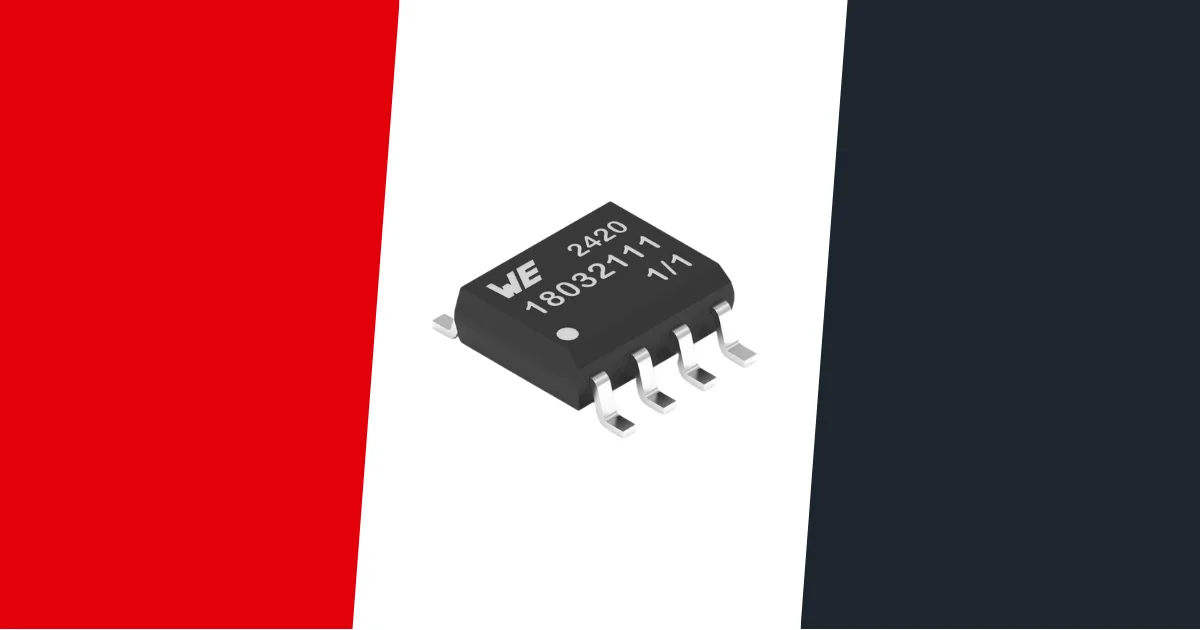
Würth Elektronik supplies the devices in an SOIC-8NB package that is pin-compatible with common standard I²C isolators already used in the market.
Bidirectional Channels For I²C Buses
I²C is a simple interface in terms of wiring, but the bus itself is not always simple to isolate. The SDA line has to work in both directions, and the clock path can vary depending on how the bus is arranged. Würth Elektronik has split the WPME-CDI2C into two stock variants. One handles both SDA and SCL as bidirectional lines. The other keeps SDA bidirectional while using a one-way SCL channel. That keeps the selection fairly practical for designs where the clock line does not need the same behavior as the data line.
3750 VRMS Isolation And High CMTI
The WPME-CDI2C supports data rates up to 2 MHz, which puts it in range for most I²C communication applications. Isolation is rated up to 3750 VRMS under UL 1577. The part also has a basic insulation rating to IEC 60747-17, listed by Würth Elektronik with the VDE 0884-17 reference.
The common-mode transient immunity figure is ±150 kV/µs. That is a strong number for an I²C isolator, especially where the bus is running near power conversion, motor control, or long sensor wiring. In those systems, the isolation barrier has to deal with more than steady voltage separation.
Where The WPME-CDI2C Fits
The target applications are broad because I²C itself is broad. Würth Elektronik points to IoT and consumer electronics, including sensors and displays, as well as industrial automation systems such as sensor networks, monitoring systems, and motor controls.
The automotive examples include battery management, engine management, and sensor interfaces. Many of Würth Elektronik’s own sensor products also support I²C communication, so the isolator fits naturally alongside those parts when designs need isolated signal transfer. The WPME-CDI2C devices are available from stock now.
Learn more and read the original announcement at www.we-online.com
Technology Overview
The WPME-CDI2C family consists of 2-channel digital isolators for galvanic isolation of I²C communication interfaces. The devices support bidirectional data transmission up to 2 MHz and are supplied in an SOIC-8NB package.
The isolators provide up to 3750 VRMS isolation according to UL 1577 and include a basic insulation rating according to IEC 60747-17. Würth Elektronik specifies common-mode transient immunity of ±150 kV/µs.
Frequently Asked Questions
What is the WPME-CDI2C used for?
The WPME-CDI2C is used to provide galvanic isolation for I²C communication interfaces in systems such as sensors, displays, industrial automation equipment, monitoring systems, and automotive electronics.
What data rate does the WPME-CDI2C support?
The isolator supports I²C data transmission at up to 2 MHz.
What isolation rating does the WPME-CDI2C provide?
The device provides isolation voltage up to 3750 VRMS according to UL 1577 and has a basic insulation rating according to IEC 60747-17.
You may also like