As HBM stacks continue increasing in bandwidth and layer count, thermal management is becoming one of the larger constraints around AI accelerator performance. SK hynix is addressing that problem with a new packaging approach called iHBM, which embeds integrated cooling elements directly inside the HBM package structure rather than relying entirely on conventional heat extraction paths.
The iHBM solution is designed for next-generation HBM products including HBM5. Instead of removing heat indirectly through the core die, SK hynix places cooling structures directly into the Die-to-Die Physical Layer (D2D PHY), which is one of the highest heat concentration regions inside the package.
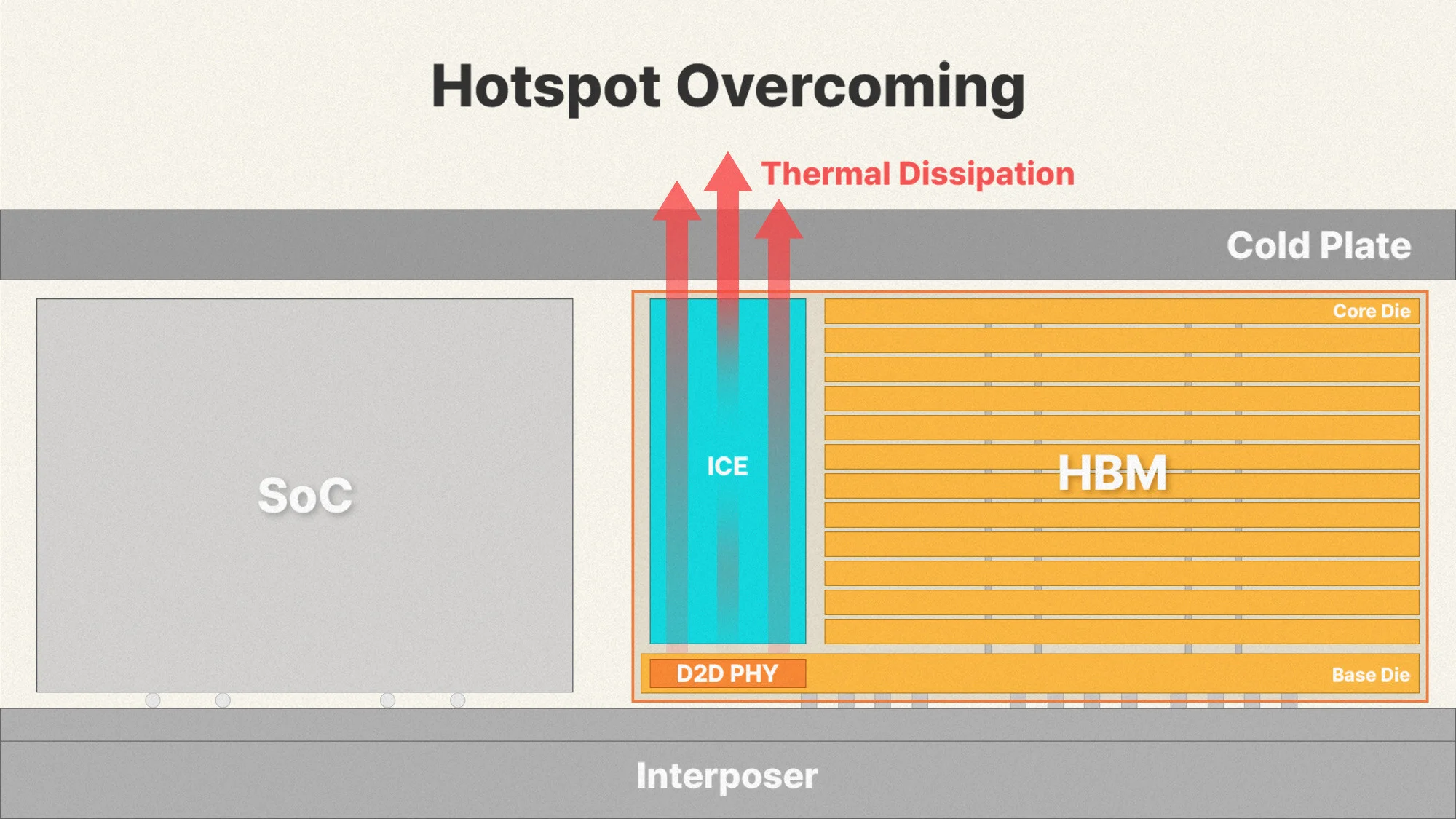 Image credit: SK hynix
SK hynix says the approach reduces thermal resistance by roughly 30 percent while helping maintain stable operation in high-temperature and high-pressure AI environments.
Direct Cooling Inside The HBM Package
One of the more difficult thermal issues in modern HBM devices is the concentration of heat around the interface between the HBM stack and the AI accelerator itself. As bandwidth increases, the D2D PHY region handling communication between the HBM base die and GPU becomes increasingly power-dense. Existing cooling approaches mainly pull heat away indirectly through the wider package structure, but that becomes less effective as stacking density and transfer speeds continue increasing.
The iHBM approach adds what SK hynix describes as an additional thermal path by placing integrated cooling elements directly near the D2D PHY region.The ICE structures themselves use electrically non-conductive silicon-based thermal material designed to move heat away from the package without interfering with surrounding circuitry.
Built Around Existing HBM Manufacturing
Part of the announcement is also about manufacturability rather than just cooling performance. SK hynix says the iHBM structure is compatible with its existing Wafer Level Packaging process and builds on the company’s established MR-MUF stacking technology already used in current HBM manufacturing. That matters because new thermal structures are not particularly useful if they require major packaging redesigns or low-yield production processes before deployment at scale.
The company also says the solution maintains strong compatibility with existing System-in-Package architectures, reducing the amount of redesign work required for integration into future AI accelerator platforms.
Thermal Density Continues To Shape AI Hardware
The wider trend here is that AI accelerator development is increasingly becoming constrained by thermal density as much as raw compute capability. Higher bandwidth memory stacks move enormous amounts of data, but the power density generated around the memory interface is now becoming one of the limiting factors around scaling performance further. By embedding thermal structures directly into the HBM package itself, SK hynix is trying to push some of that cooling challenge deeper into the packaging layer rather than relying only on external heatsinks or system-level airflow improvements.
The iHBM solution is planned for deployment in future HBM products including HBM5.
Learn more and read the original announcement at www.skhynix.com
Technology Overview
The iHBM solution from SK hynix integrates cooling elements directly into the HBM package structure to improve thermal handling in AI accelerator memory systems. The cooling structures are positioned near the D2D PHY interface between the HBM base die and GPU.
According to SK hynix, the approach reduces thermal resistance by approximately 30 percent while supporting operation in high-temperature and high-pressure AI computing environments. The technology is designed for future HBM products including HBM5.
Frequently Asked Questions
What is the purpose of the iHBM solution?
The iHBM structure is designed to improve heat dissipation inside high-bandwidth memory packages used in AI accelerators and HPC systems.
Where are the integrated cooling elements placed?
The cooling elements are placed near the D2D PHY region between the HBM base die and GPU, where heat density is particularly high.
Which future memory products will use iHBM?
SK hynix says the technology is planned for next-generation HBM products including HBM5.
You may also like