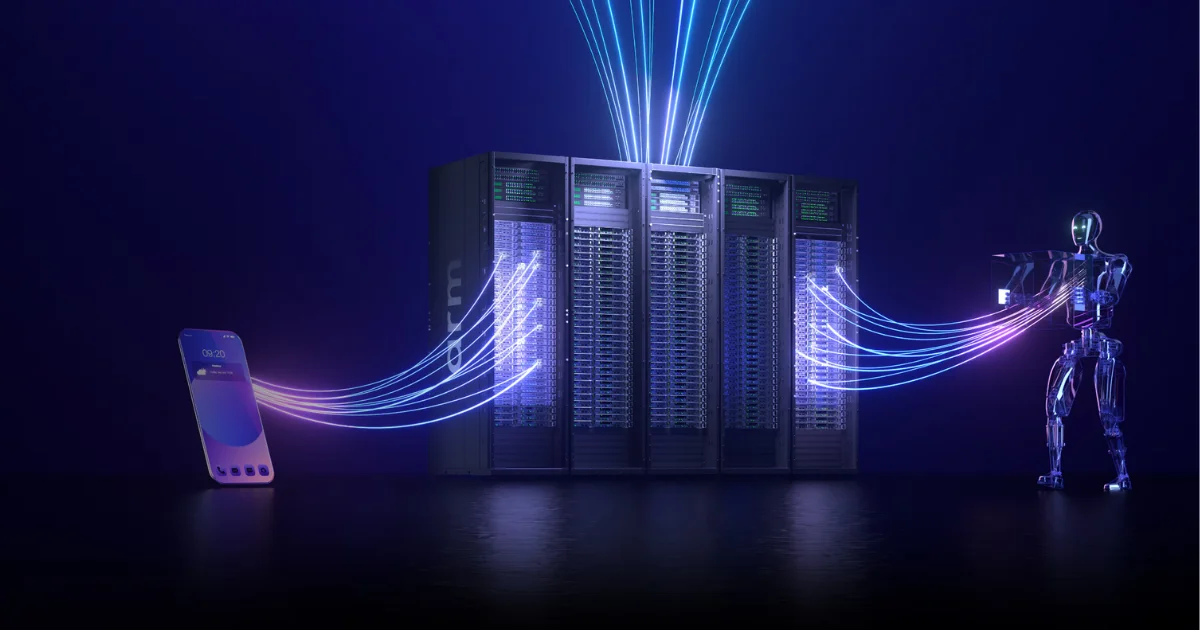
 Image credit: Arm - https://newsroom.arm.com/news/arm-agi-cpu-neoverse-css-n4-agentic-ai
A data centre AI server, a smartphone and a humanoid robot don't appear to have much in common. One can draw kilowatts of power and sit alongside racks of accelerators and memory. Another has to fit into your pocket and survive all day on a battery. The third may need to process cameras and sensors while controlling physical movement in real time.
Yet Arm increasingly wants all three to share something important: the computing foundation underneath them.
A series of announcements from Arm last week covered new infrastructure CPUs, mobile processors and GPUs, robotics, physical AI and developer software. Taken separately, there is a lot of new technology to digest. Together, they reveal something more interesting about where Arm thinks AI computing is heading.
The question is whether a common architecture really makes sense when the systems running AI are becoming so different.
AI Does Not Have One Computing Requirement
Much of the attention around AI hardware remains concentrated on the data centre, where the challenge is feeding enormous workloads across CPUs, GPUs, accelerators and memory. Power matters here too, but the available envelope is completely different from a smartphone or embedded system.
Move AI onto a mobile device and performance has to coexist with battery life and a tight thermal budget. Move it into a robot and another set of problems appears. Cameras and other sensors need to be processed locally, decisions may have to happen quickly, and the computing system ultimately has to interact with motors and other hardware in the physical world.
Arm is not proposing that identical processors should handle all of this. Its latest technology suggests something subtler: the hardware can change considerably while retaining a common architectural and software foundation. That distinction becomes clearer when you look at what Arm has actually announced.
Arm Is Moving Further Into the Data Centre
At the infrastructure end, Arm has expanded its options with the AGI CPU and Neoverse CSS N4. Neoverse CSS N4 can scale to 128 cores per die, with support for LPDDR6 memory and PCIe Gen 7. Arm claims up to twice the performance, 1.25 times the performance per watt and 1.75 times the memory bandwidth of Neoverse CSS N3.
More significant than the specifications is how far Arm is moving into the finished system. Compute Subsystems give chipmakers more than individual CPU cores, packaging together pre-integrated and validated technology that can form a larger part of the eventual silicon design. AGI CPU goes further again by giving customers production-ready Arm silicon.
That is quite a shift for a company traditionally associated with licensing processor architectures and IP to semiconductor manufacturers.
It also shows why a common architecture does not mean a common chip. Data centres need processors built around high core counts, memory bandwidth and high-speed interfaces, particularly when CPUs are coordinating with large numbers of AI accelerators.
A smartphone has almost the opposite problem.
Mobile AI Has to Fit Inside a Few Watts
The ARM CSS for Mobile 2 combines the C2 CPU cluster, Mali G2-Ultra NX GPU, system IP and software into a platform aimed at future mobile devices.
The Mali G2-Ultra NX is particularly interesting because Arm has integrated dedicated neural accelerators directly into the GPU shader cores. Rather than treating AI and graphics as entirely separate workloads, the GPU is designed to use neural processing within increasingly complex graphics pipelines.
That is a very different engineering response to AI than adding more server-class compute. Smartphones need local AI performance without allowing power consumption, memory traffic or heat to grow unchecked.
The actual silicon therefore changes, but much of what sits around it does not have to. Arm can offer different CPU and GPU configurations while developers continue working within a familiar architecture and software environment.
And that becomes even more important when the computer starts moving.
Robots Make the Problem Harder Again
Physical AI is one of the industry's favourite new terms, but underneath it sits a fairly practical problem. A robot has to connect AI processing with the physical world.
That can involve cameras, microphones and other sensors feeding perception systems, AI models interpreting what is happening, and real-time control hardware translating decisions into movement. Safety, latency and deterministic behaviour can matter just as much as raw inference performance.
The response from Arm is not simply another processor. The company has expanded Arm Total Design into physical AI, bringing together more than 80 companies spanning areas including compute hardware, sensors, AI models, software, virtual platforms and digital twins.
One of the first projects is a Robotics Capability Framework, intended to establish a common language for defining robotic capabilities.
That says something about the problem Arm is trying to solve. Robotics remains fragmented, with different hardware platforms, software stacks and specialised technologies needing to work together. The value of a common computing foundation may therefore have less to do with using the same processor and more to do with reducing how much has to change as software moves between platforms.
The Common Layer Might Matter More Than the Processor
This is where the broader Arm strategy starts to make sense.
A 128-core Neoverse system and a mobile SoC clearly are not the same piece of hardware. Neither is necessarily going to resemble the computing architecture inside an industrial robot.
What can potentially remain consistent is everything developers build around them.
The new Arm AI Portal pushes further in that direction, bringing together optimised models, performance information, code examples and deployment workflows for Arm-based platforms.
In other words, Arm is not really trying to make AI hardware look the same everywhere. The goal is to make developing for that hardware increasingly familiar everywhere.
That could become increasingly valuable as AI moves away from a relatively concentrated collection of data centres and into far more varied devices. Models may be developed or trained using cloud infrastructure, adapted for local execution on edge hardware and eventually deployed into machines interacting with the physical world.
There will still be enormous differences between those systems. Memory architectures, accelerators, interfaces, power budgets and real-time requirements are not suddenly going to converge because the processors share an instruction set.
But perhaps they do not need to.
So, Can One Architecture Really Run AI Everywhere?
Not if "one architecture" means putting essentially the same hardware into a server, phone and robot. The engineering requirements are simply too different.
The latest announcements from Arm point towards a different interpretation. At one end, Neoverse and AGI CPU are pushing further into AI infrastructure. At another, CSS for Mobile 2 is combining CPU, GPU and neural processing within the constraints of mobile computing. Physical AI then extends the ecosystem into systems that have to sense and act on the real world.
The processors change. The surrounding ecosystem does not necessarily have to.
If Arm can maintain a common architecture, software environment and development path across those increasingly different machines, its position in AI may ultimately depend on something broader than any individual CPU or GPU.
The interesting question is not whether the same Arm processor can run AI everywhere. It cannot, and it does not need to. It is whether increasingly different processors can still feel like parts of the same computing platform.
You may also like