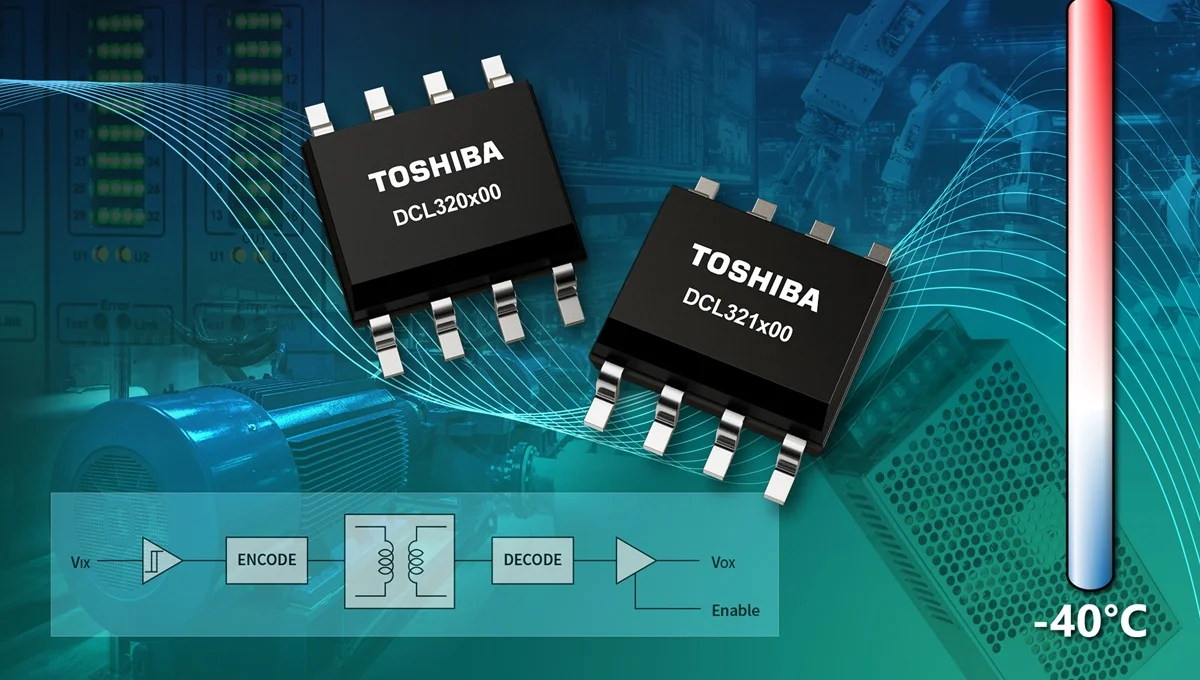
 Toshiba has launched four dual-channel digital isolators for industrial control and power-conversion systems, expanding its low-power digital isolator range with devices that consume 0.2 mA per channel at a 1 Mbps data rate.
The new DCL32xx00 series supports data transmission at up to 25 Mbps and provides a minimum isolation voltage of 3,000 Vrms for 60 seconds. Toshiba is targeting applications including PLCs, I/O interfaces, sensors, actuators, motor-control systems, inverters and switching power supplies.
The devices use Toshiba’s magnetic-coupling isolation technology together with new circuitry in the isolation signal-transmission section. Alongside the low operating current, the series provides 30 kV/µs minimum common-mode transient immunity for signal transmission in environments with rapid common-mode voltage changes.
Low-Power Isolation Across a Wide Supply Range
The DCL32xx00 devices operate from 2.25 V to 5.5 V, allowing them to work with a range of industrial logic and control circuits.
Their 0.2 mA typical current consumption is specified per channel at a 1 Mbps data rate, while the maximum supported data rate extends to 25 Mbps. Toshiba has paired this with a -40°C to 125°C operating temperature range and the 3,000 Vrms minimum isolation rating.
All four devices are supplied in an SOIC8-N package, giving designers an industry-standard footprint for dual-channel isolation.
The 30 kV/µs minimum CMTI is intended to maintain stable data transmission where fast voltage transitions are present, including motor-control and power-conversion equipment.
Two Channel Configurations and Selectable Default States
Toshiba has split the DCL32xx00 family across two channel-direction configurations.
The DCL320C00 and DCL320D00 provide two forward channels, allowing two digital signals to pass across the isolation barrier in the same direction. The DCL321C00 and DCL321D00 instead provide one forward and one reverse channel for interfaces requiring signals to travel in opposite directions, such as UART communications.
The C00 and D00 variants also differ in the output logic state used when the input is undefined, including after power-on or when an input is floating. Designers can therefore select either a default-low or default-high output behavior depending on the requirements of the system.
Together, the four devices give designers a choice of signal direction and default output state while retaining the same low-power operation, isolation performance and 25 Mbps data rate.
Learn more at toshiba.semicon-storage.com.
Technology Overview
Toshiba’s DCL32xx00 series comprises four dual-channel digital isolators with 0.2 mA typical current consumption per channel at 1 Mbps. The devices support data rates up to 25 Mbps, 3,000 Vrms minimum isolation, 30 kV/µs minimum CMTI and operation from 2.25 V to 5.5 V.
FAQs
How much current do the DCL32xx00 digital isolators consume?
Toshiba specifies typical operating current of 0.2 mA per channel at a 1 Mbps data rate.
What isolation performance do the devices provide?
The series is rated for a minimum isolation voltage of 3,000 Vrms for 60 seconds and provides at least 30 kV/µs common-mode transient immunity.
What is the difference between the four DCL32xx00 devices?
The DCL320C00 and DCL320D00 provide two forward channels, while the DCL321C00 and DCL321D00 provide one forward and one reverse channel. The C00 and D00 versions also offer different default output logic states when the input is undefined.
You may also like