
Navitas Introduces 2300 V SiC Power Module with 8 mΩ On-Resistance
Navitas introduces the G4H08MT23GB4 2300 V SiC power module with 8 mΩ on-resistance, AlN substrate, isolation above 5 kV and improved thermal construction for solid-state transformers, energy storage and grid infrastructure.
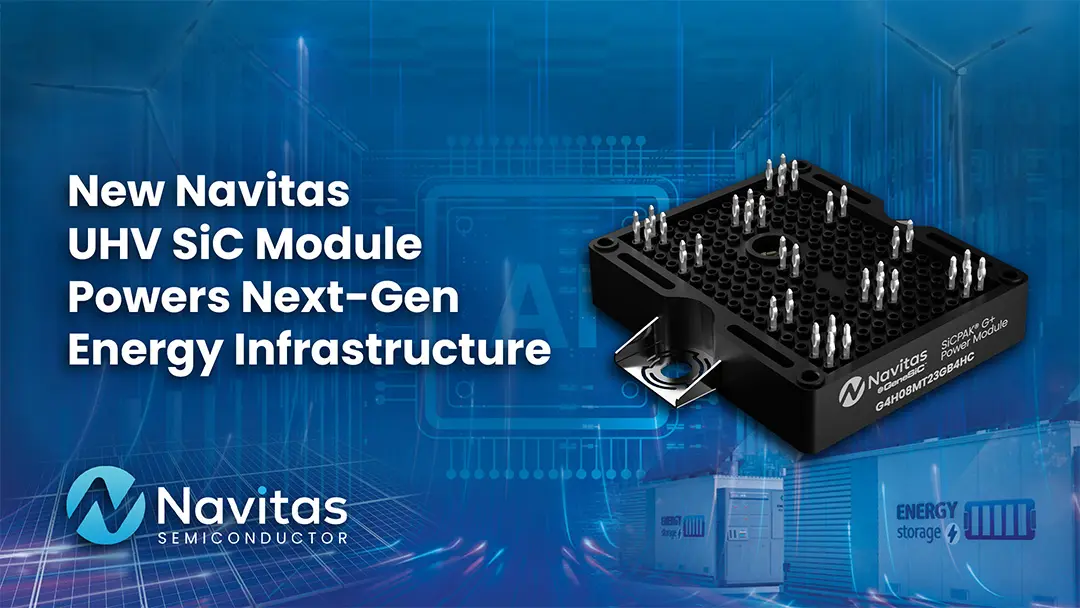
Navitas Semiconductor has introduced the G4H08MT23GB4 full-bridge SiC power module family, combining its fourth-generation GeneSiC Trench-Assisted Planar (TAP) technology with the industry-standard SiCPAK G form factor.
The new 2300 V module has an on-resistance of 8 mΩ, which Navitas claims is the lowest available in the SiCPAK form factor. It extends the company's 2300 V and 3300 V ultra-high-voltage SiC portfolio and is aimed at improving efficiency and power density in high-power conversion systems.
Applications include solid-state transformers, grid-scale battery energy storage systems, solar inverters and EV megawatt charging infrastructure. Navitas is also targeting high-voltage DC-DC conversion, industrial motor drives and power supplies, including grid-connected power systems for AI data centers.
Fourth-Generation SiC Technology in a Full-Bridge Module
The G4H08MT23GB4 uses Navitas' fourth-generation GeneSiC TAP architecture to achieve its 8 mΩ on-resistance at 2300 V. The low conduction resistance is intended to reduce losses in high-current power conversion, particularly in solid-state transformers and energy storage systems.
Alongside the electrical performance, Navitas has made several changes to the module construction. An aluminum nitride (AlN) active-metal-braze substrate improves heat spreading and provides an isolation capability exceeding 5 kV.
The module also uses epoxy-resin potting instead of conventional silicone gel. According to Navitas, the epoxy construction reduces internal stress, limits moisture and contaminant ingress, and offers 10 times the thermal conductivity of silicone gel.
High-current versions are available with press-fit pins rated for twice the current-carrying capability per pin of standard press-fit connections. Navitas also offers optional pre-applied thermal interface material to simplify heatsink assembly.
Extended Reliability Testing for Grid Applications
The new module family is planned for qualification under Navitas' AEC-Plus reliability benchmark, which extends beyond standard AEC-Q101 and JEDEC test requirements.
The program includes dynamic reverse bias and dynamic gate switching tests intended to represent fast-switching operating conditions. Navitas also specifies more than three times the standard duration for static high-temperature, high-voltage testing, together with extended power cycling, temperature cycling and high-voltage humidity testing.
AEC-Plus is Navitas' internal qualification standard, and the company has not yet stated that qualification of the new modules is complete.
Samples of the G4H08MT23GB4 family are available now in four configurations. Standard and high-current press-fit versions are offered with or without pre-applied thermal interface material.
Navitas also provides the EVB-UHVSIC-GB-E-DPT-1 double-pulse test system on request, allowing engineers to evaluate the module's switching performance.
Learn more and read the original announcement from Navitas Semiconductor.
Technology Overview
The Navitas G4H08MT23GB4 is a 2300 V full-bridge SiC power module family based on fourth-generation GeneSiC Trench-Assisted Planar technology. It offers 8 mΩ on-resistance in the SiCPAK G form factor, with an AlN active-metal-braze substrate providing isolation above 5 kV. The modules feature epoxy-resin encapsulation, optional high-current press-fit pins and pre-applied thermal interface material. Applications include solid-state transformers, battery energy storage systems, solar inverters and megawatt EV charging infrastructure.
FAQs
What are the voltage and on-resistance ratings of the G4H08MT23GB4?
The module is rated at 2300 V with an on-resistance of 8 mΩ. It uses Navitas' fourth-generation GeneSiC TAP SiC MOSFET technology in a full-bridge configuration.
What thermal and isolation features does the module include?
The module uses an aluminum nitride active-metal-braze substrate with isolation above 5 kV. Navitas also specifies epoxy-resin potting with 10 times the thermal conductivity of silicone gel.
Which G4H08MT23GB4 variants are available?
Four versions are sampling: G4H08MT23GB4, G4H08MT23GB4-T, G4H08MT23GB4HC and G4H08MT23GB4HC-T. The HC versions use high-current press-fit pins, while the -T versions include pre-applied thermal interface material.
Related news
Keep up with the components and technology shaping electronics.
Join the club for member features, engineering discussion and easier access to the latest Component Club content.