
Synaptics Launches Astra SR200 Edge AI Processors with Integrated DRAM and Coral NPU
Synaptics introduces Astra SR200 edge AI processors with 200–400 GOPS performance, integrated DRAM scalable to hundreds of megabytes, Arm Cortex-M85/M52 cores and Google Coral NPU acceleration for multimodal devices.
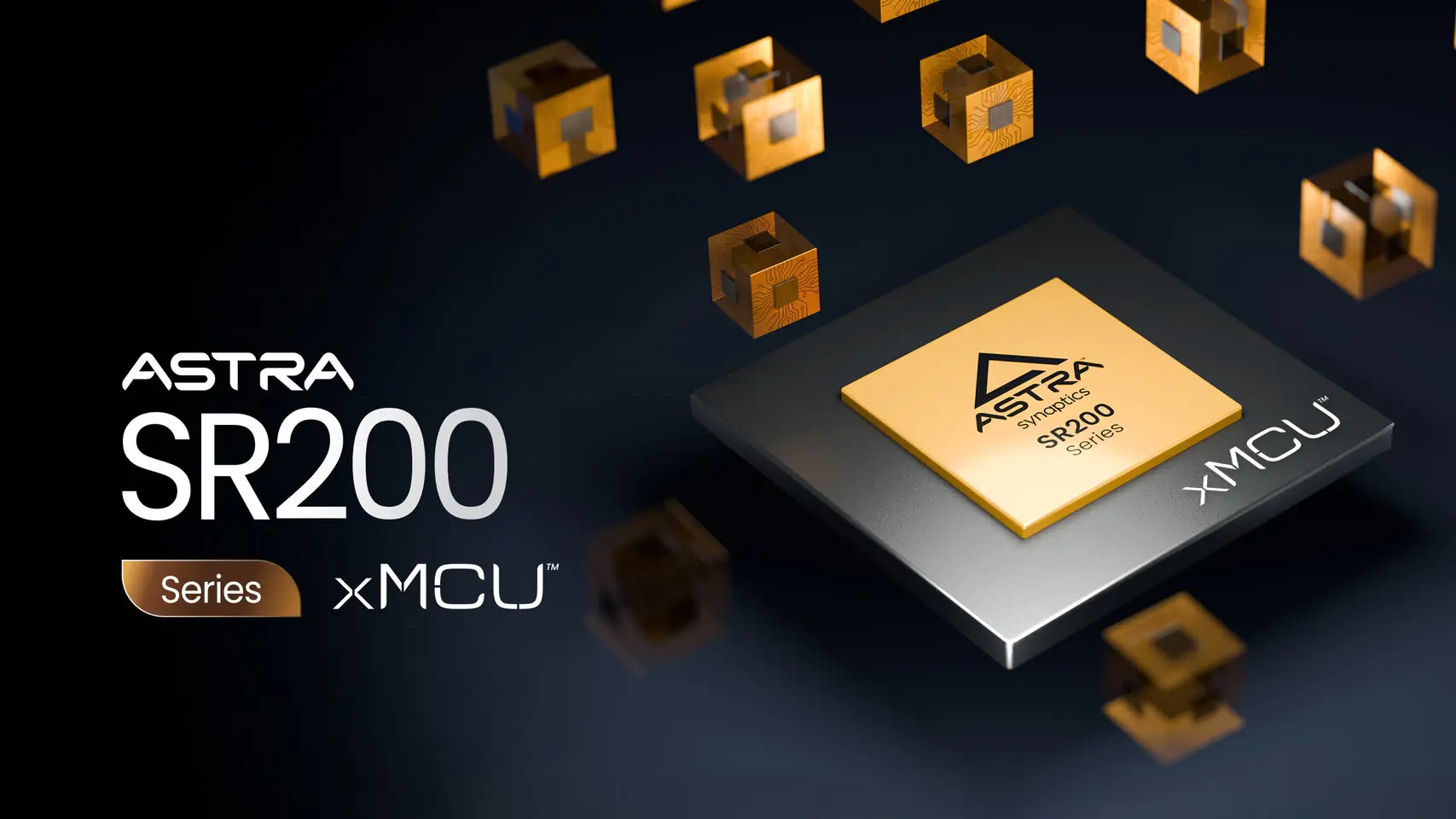
The new Astra SR200 series combines Arm Cortex-M85 and Cortex-M52 cores with dedicated AI acceleration and high-bandwidth memory, targeting multimodal processing in wearables, connected cameras and industrial devices.
Synaptics has introduced three pin-compatible processors under its new xMCU designation: the SR210, SR230 and SR250. The family brings together heterogeneous computing, integrated vision and audio capabilities, and hardware-rooted security, with AI performance ranging from 200 to 400 GOPS.
A central feature is the memory architecture. Where conventional microcontrollers can be limited by the amount of memory available for AI models, the SR200 series pairs up to 8 MB of SRAM with custom DRAM that can scale to hundreds of megabytes. Synaptics says this arrangement allows larger AI models and multimodal workloads to run directly on the device without requiring external system memory in most applications.
Integrated Memory for Larger Edge AI Models
The SR200 uses a tiered memory architecture designed around the different latency, retention and power requirements of edge AI workloads. According to Synaptics, its custom DRAM operates at approximately one-third the power of typical system DRAM, reducing the memory power requirement for applications that need more capacity than conventional MCU SRAM can provide.
Processing is handled by the Synaptics Torq AI engine, which integrates the Coral NPU developed with Google Research. The accelerator supports convolutional neural networks, transformer models and fully connected networks, with an open-source MLIR/IREE compiler for working with industry-standard machine learning frameworks and model formats.
The processor architecture also separates performance-intensive tasks from continuous background operation. An Arm Cortex-M85 core, scaling to 800 MHz, handles control, multimedia and burst-compute workloads, while the Cortex-M52 efficiency core manages always-on sensing, connectivity and low-power inference. A separate always-on domain supports voice activity detection, timekeeping and wake-up functions.
Three Pin-Compatible Processors from 200 to 400 GOPS
The Astra SR200 family launches with three product lines sharing a common hardware foundation and software development kit.
The SR210 delivers 200 GOPS and is intended for power-optimized voice and sensing applications. The SR230 increases performance to 300 GOPS and adds vision, display and optional audio capabilities, while the SR250 provides 400 GOPS with dual vision and display paths for more demanding multimodal applications.
Synaptics has also included an optional Cadence Tensilica HiFi 5 DSP for audio and acoustic machine learning. The combination of dedicated AI acceleration, separate processing domains and integrated memory is aimed at devices that need to handle continuous sensing alongside more demanding vision, voice and multimedia workloads.
Security and Connectivity for Industrial Edge Systems
The SR200 series includes hardware isolation, cryptographic acceleration, anti-tamper detection, secure boot and device lifecycle management. Synaptics lists PSA Level 3 and CC EAL4+ certification targets for the security implementation.
Peripheral support includes octal SPI, SDIO, eMMC, USB 2.0, I3C, I²C, SPI, UART, PWM and low-power GPIO. Industrial variants add 1 Gb Ethernet with IEEE 1588 TSN support and two CAN-FD interfaces for real-time industrial control and robotics applications.
The processors support Zephyr RTOS and the open-source Torq NPU compiler. Synaptics is targeting the new family at AI wearables, battery-powered sensing devices, connected cameras, industrial vision systems and voice-enabled equipment.
Learn more and read the original announcement at synaptics.com.
Technology Overview
The Synaptics Astra SR200 series is a family of multimodal edge AI processors combining Arm Cortex-M85 and Cortex-M52 cores with the Torq AI engine and Google Research Coral NPU. The SR210, SR230 and SR250 offer 200, 300 and 400 GOPS respectively, with up to 8 MB SRAM and custom high-bandwidth DRAM scalable to hundreds of megabytes. The family supports vision, audio, sensor processing, hardware-rooted security and industrial connectivity, including Ethernet TSN and CAN-FD on selected variants.
FAQs
What is the difference between the Synaptics SR210, SR230 and SR250?
The SR210 provides 200 GOPS for always-on voice and sensing. The SR230 offers 300 GOPS with vision and display capabilities, while the SR250 reaches 400 GOPS and supports dual vision and display paths.
What memory does the Astra SR200 series support?
The processors combine up to 8 MB of SRAM with custom high-bandwidth DRAM scalable to hundreds of megabytes. Synaptics says the memory architecture uses approximately one-third the power of typical system DRAM.
Which AI workloads can the Astra SR200 processors run?
The integrated Coral NPU supports convolutional neural networks, transformer models and fully connected networks. Applications include voice processing, computer vision, sensor fusion and multimodal edge AI.
Related news
Keep up with the components and technology shaping electronics.
Join the club for member features, engineering discussion and easier access to the latest Component Club content.