
Tesla's flying Roadster: Brilliant engineering, but is it practical?
Tesla's new Roadster can drive upside down and use cold-gas thrusters to jump into the air. In this article we examine the engineering behind the demonstration, the safety risks and whether it could ever be approved for public roads.
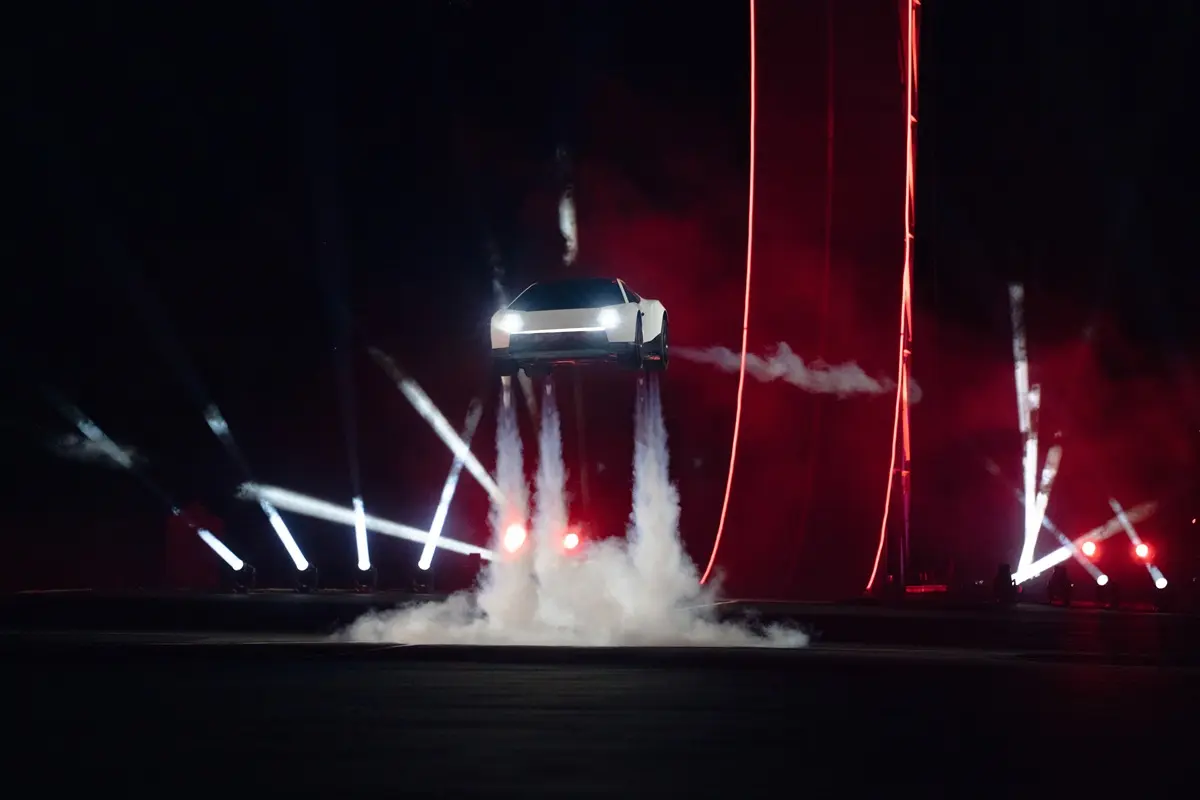
Tesla has demonstrated a Roadster that can drive upside down, jump over other vehicles and control its movement in mid-air using cold-gas thrusters. The technology is seriously impressive, but with reservations now open, how much of it could realistically make its way into a road-legal production car?
On October 15, Tesla demonstrated something that looked more like a scene from a science fiction film than a conventional automotive launch. At SpaceX's testing facility in Texas, the company's new Roadster drove along a curved ramp, continued upside down and then launched into the air before rotating and landing on its wheels. A separate demonstration saw the car jump over several vehicles, while Tesla also reported a 0–60 mph acceleration time of just 0.81 seconds.
It was an extraordinary demonstration, and the engineers at Tesla and SpaceX deserve considerable credit for making it happen. Driving a car upside down is impressive enough, but controlling a vehicle once it has left the ground requires an entirely different approach to propulsion and stability. The demonstration was performed without anyone inside the car, which is understandable given the experimental nature of the technology.
However, Tesla is doing more than showing what its engineers can achieve. The company is now accepting reservations for the Roadster, including a version that uses cold-gas thrusters to improve acceleration. Its more extreme Rocket version, capable of the airborne manoeuvres, is explicitly not approved for public roads.
This raises some interesting questions about what Tesla is actually planning to sell, and whether the technology required to make a car fly has any practical place in an ordinary road vehicle.
How Tesla made a car drive upside down
Fan-assisted downforce isn't a new idea. Brabham experimented with it back in 1978 on its BT46B Formula One car, using a rear-mounted fan to draw air from underneath the chassis. More recently, the McMurtry Spéirling has shown what can be achieved with modern electric fans, so there was already good reason to believe that a car could generate enough suction to drive upside down.
A conventional aerodynamic wing needs airflow to work, which means the downforce it produces changes with speed. A powered fan doesn't have that restriction. By drawing air out from beneath the car, it creates a lower-pressure area under the floor, with atmospheric pressure pushing the vehicle towards the driving surface. The effect can be present even when the wheels aren't turning.
Tesla's system reportedly uses four 20 kW fans, together with movable skirts that help maintain the pressure difference beneath the chassis. According to information released by Tesla's engineering team, the arrangement can generate enough suction to hold the car against an inverted surface.
Interestingly, the pressure difference needed to achieve this isn't necessarily enormous. For a hypothetical 1,700 kg vehicle with an effective suction area of three square metres, supporting its weight upside down would require approximately 5.6 kPa of pressure difference. In other words, the fans would only need to maintain a pressure drop of roughly 5.5% of normal atmospheric pressure, at least under ideal conditions. A moving vehicle would introduce additional forces that this simple calculation doesn't account for.
Achieving that pressure difference is one thing, but keeping it there is another. The ramp used for Tesla's demonstration had a smooth, specially prepared surface that made it relatively easy to maintain the seal beneath the car. Ordinary roads aren't nearly as forgiving, and even a small gap caused by a pothole or loose debris could allow air back underneath the chassis.
A fan failure would be an especially unpleasant problem to deal with during cornering. If the driver has entered a bend relying on the additional grip provided by the suction system, losing that extra downforce could suddenly put the car beyond the available tire grip. Stability control might be able to reduce motor torque or apply individual brakes, but it cannot replace the missing downward force. That's a fairly serious failure condition for engineers to design around, particularly in a car with the performance Tesla is promising.
Of course, these problems aren't unique to Tesla, and fan-assisted downforce has some genuine advantages for high-performance vehicles. It allows engineers to generate additional grip without relying entirely on vehicle speed, which could be particularly useful on a racetrack. But introducing another system that directly affects tire loading also introduces additional failure conditions that need to be considered.
What happens when the Roadster leaves the ground?
The flying demonstration is where things become considerably more unusual.
Tesla has worked with SpaceX to develop a cold-gas propulsion system that uses compressed gas released through nozzles to generate thrust. There is no combustion involved, with the force instead coming from the gas expanding and accelerating out of the nozzle.
According to details provided by Tesla vehicle engineering chief Lars Moravy, the system uses high-pressure storage vessels and multiple thrusters positioned around the vehicle. The standard thrust arrangement provides additional forward acceleration, while the Rocket configuration adds nozzles capable of producing upward and rotational forces.
Tesla reportedly claims that the rear thrusters can produce more than 80 kN of force. For comparison, gravity pulls a 1,700 kg car down with approximately 16.7 kN, so we're talking about a considerable amount of force from a system small enough to fit inside a sports car.
It's also a rather different way of accelerating. An electric motor has to deliver its torque through the tires, with grip eventually becoming the limiting factor. Rear-facing thrusters push directly against the car by expelling gas, so their contribution to acceleration doesn't depend on the contact between the tires and the road. It's easy to see the attraction when Tesla is chasing acceleration figures below one second, although the available thrust is limited by the amount of compressed gas onboard.
Once the Roadster is airborne, the control problem changes completely. Turning the steering wheel does very little when the tires aren't touching anything, and the car must instead adjust its orientation using the thrusters. This means firing different nozzles in a carefully controlled sequence to generate the required rotation without allowing the vehicle to tumble out of control.
The electronics would need to take information from the vehicle's motion sensors, determine its orientation and rotational speed, and command the appropriate valves. Timing is particularly important here, since the controller may have only a brief period to correct the vehicle's attitude before it reaches the ground.
Tesla says the system uses electrically controlled actuators capable of making rapid adjustments, although the company hasn't published enough information to examine the complete control architecture.
There isn't much room for error during one of these manoeuvres. A valve opening too slowly, or one nozzle delivering less thrust than expected, could leave the car rotating faster than intended. The controller would then have to compensate using the remaining thrusters, assuming there was enough pressure and time available to make the correction. With no contact between the tires and the road, the usual steering and braking systems aren't much help until the vehicle lands.
All that compressed gas has to be stored somewhere, and the tanks, regulators, valves and pipework inevitably add weight and take up space. The Rocket version makes that compromise fairly obvious by sacrificing its passenger seat to accommodate the additional hardware. There's also the question of how many times the system can be used before the gas supply needs replenishing. A high-pressure tank might provide enough thrust for a spectacular jump, but every discharge leaves less gas available for the next one.
None of this takes away from the demonstration. Tesla has successfully shown that a car can leave the ground and use controlled thrust to perform movements that would normally be impossible for a road vehicle. However, a short powered jump is very different from sustained flight, and the equipment required to achieve it introduces several problems that conventional cars simply don't have.
Could Tesla actually put this technology on public roads?
Perhaps the most interesting part of Tesla's announcement is that the company is already advertising these technologies as features of the new Roadster.
Its official website lists three versions. The Performance model is described as road-ready and features the suction system and active aerodynamics. The limited-release Thrust version adds rear-mounted cold-gas thrusters, while the invitation-only Rocket version includes the additional hardware needed for airborne movement.
Tesla explicitly states that the Rocket version isn't approved for public road use. The Thrust version, meanwhile, is described as race-ready, with availability subject to local laws. That leaves the road-going future of the thrusters far less certain than the reservation page might initially suggest.
The safety implications are worth considering. Even if the thrusters worked perfectly every time, the exhaust plume would be a problem of its own. A system capable of contributing enough force to accelerate a car to 60 mph in less than a second has to discharge that high-speed gas somewhere, and with rear-mounted thrusters it's directed straight into the space behind the vehicle. Tesla can keep that area clear on a test track, but on a public road there might be another car immediately behind it, or someone standing nearby.
The high-pressure storage vessels also need to withstand the conditions experienced by ordinary vehicles, including collisions. There would need to be safeguards against unintended activation, pressure-system failures and situations where one thruster produces more force than another. With the additional acceleration available, even a relatively small difference in thrust could produce an unwanted turning moment.
These are all problems that engineers can investigate, and there is no reason to assume that suitable safety systems couldn't be developed. But doing so would require extensive testing, particularly when failures could affect people outside the vehicle as well as its occupants.
Then there's the small matter of getting the car approved for road use. In Britain, manufacturers have to demonstrate compliance with the relevant vehicle type-approval requirements, and the assessment would need to account for the unusual propulsion equipment. High-pressure tanks, external gas jets and the possibility of unintended thrust would all need examining. It's one thing to demonstrate that a system can operate safely at a test facility, but rather another to establish how it behaves in traffic, during a collision or when part of the hardware fails.
Tesla hasn't established that its Thrust version meets those requirements, and the company's own description of the Rocket version makes clear that public-road approval isn't part of the current offering. Even the Performance model's description as road-ready shouldn't be confused with formal approval for every market.
This is particularly relevant given that Tesla is already accepting reservations. The second-generation Roadster was originally unveiled in 2017, with production initially expected in 2020. The latest target is now 2028, and Tesla's reservation terms make clear that delivery isn't guaranteed by a particular date.
There is an argument that the Roadster is primarily a demonstration of Tesla's engineering capabilities rather than a vehicle intended to generate substantial sales. Elon Musk has previously acknowledged that it isn't expected to contribute significantly to Tesla's finances, and the extreme performance figures certainly make it an effective showcase for the company.
But that doesn't necessarily make the project pointless. The suction system has clear potential in track-focused vehicles, while the work involved in coordinating high-pressure propulsion and electronic control could have applications beyond the Roadster itself. Engineers have always built experimental machines to explore what can be achieved, even when the results aren't immediately suitable for commercial use.
The Rocket version is still difficult to imagine as something anyone would drive on public roads, and there is little practical advantage in having a car that can jump over traffic. But there is also something rather impressive about Tesla taking an already powerful electric sports car and asking how much further the technology can be pushed.
Whether that eventually leads to a road-approved thruster system remains to be seen. For now, Tesla has demonstrated a remarkable piece of engineering, but it still has to show that the technology can be made safe, reliable and useful outside the carefully controlled conditions of a test facility.
Related news
Keep up with the components and technology shaping electronics.
Join the club for member features, engineering discussion and easier access to the latest Component Club content.