
Nexperia Introduces 400 V and 650 V Ultrafast and Hyperfast Recovery Rectifiers
The 48 new silicon rectifiers cover current ratings from 4 A to 15 A and use a Real-2-Pin DPAK package with increased terminal spacing for high-voltage applications.
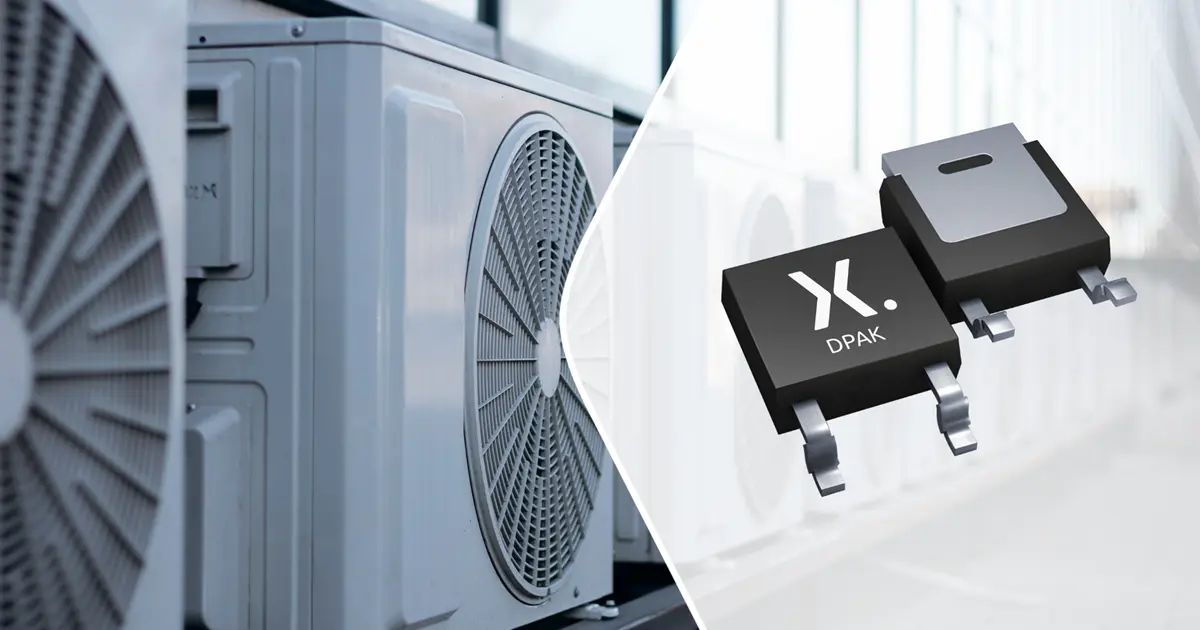
Nexperia has introduced a new series of 400 V and 650 V fast-recovery rectifiers for automotive and industrial power conversion applications. Housed in the DPAK (TO-252) Real-2-Pin (R2P) package, the 48 devices combine low forward voltage drop with smooth ultrafast or hyperfast recovery characteristics.
The new series covers current ratings from 4 A to 15 A, with different recovery options for engineers balancing conduction and switching losses. Applications include boost diodes for power factor correction (PFC) in single-phase automotive on-board chargers, industrial power supplies and air conditioning systems.
Ultrafast and Hyperfast Recovery Options
The portfolio includes ultrafast (PNU) and hyperfast (PNE) rectifiers, providing different trade-offs between forward voltage and reverse-recovery performance.
Among the new devices is the PNU650100EH, a 650 V, 10 A ultrafast recovery rectifier with a typical forward voltage of 1.2 V and reverse-recovery time of 27 ns.
The choice between ultrafast and hyperfast recovery is particularly relevant in switching power converters, where diode conduction losses and reverse-recovery behavior both contribute to overall efficiency. The optimum characteristics depend on the switching conditions and requirements of the application.
The new silicon rectifiers complement Nexperia's existing power diode technologies, including its silicon carbide (SiC) Schottky portfolio. The expanded range covers applications where designers need to balance component cost, forward-voltage losses and switching performance.
Real-2-Pin DPAK Package
Alongside the electrical characteristics, Nexperia has adopted its Real-2-Pin version of the conventional DPAK package.
The R2P design removes the center lead pin, increasing the spacing between the anode and cathode to 3.6 mm. This increases creepage and clearance distances, an important consideration for high-voltage power conversion circuits.
The new rectifiers retain the DPAK (TO-252) surface-mount format while offering the additional terminal spacing. Combined with the range of voltage, current and recovery-speed options, the package extends the available choices for automotive and industrial power designs.
The new PNU and PNE devices are listed in Nexperia's recovery rectifier portfolio, with production status and product information available through the company's website.
Learn more and read the original announcement at nexperia.com.
Technology Overview
Nexperia's 400 V and 650 V fast-recovery rectifier range comprises 48 silicon diodes rated from 4 A to 15 A. The portfolio includes ultrafast (PNU) and hyperfast (PNE) devices with different forward-voltage and reverse-recovery characteristics. The rectifiers use a DPAK Real-2-Pin package with 3.6 mm anode-to-cathode spacing and target PFC circuits in automotive on-board chargers, industrial power supplies and other power conversion equipment.
FAQs
What is the difference between the PNU and PNE rectifiers?
The PNU devices offer ultrafast recovery, while the PNE devices provide hyperfast recovery characteristics. The two families have different forward-voltage and reverse-recovery trade-offs, allowing designers to select according to conduction losses and switching requirements.
What are the specifications of the PNU650100EH?
The PNU650100EH is a 650 V, 10 A ultrafast recovery rectifier with a typical forward voltage of 1.2 V and a typical reverse-recovery time of 27 ns.
What is different about the Real-2-Pin DPAK package?
The Real-2-Pin design removes the conventional DPAK center lead, increasing anode-to-cathode spacing to 3.6 mm. This provides greater creepage and clearance distances for high-voltage applications.
Related news
Keep up with the components and technology shaping electronics.
Join the club for member features, engineering discussion and easier access to the latest Component Club content.