
Researchers Use Shape-Shifting Molecule to Make Semiconductors More Stretchable
A discovery at the University of Toronto could bring stretchable electronics closer to practical use in medical implants, wearable sensors and soft robotics, where semiconductor materials need to withstand movement without losing their electrical properties.
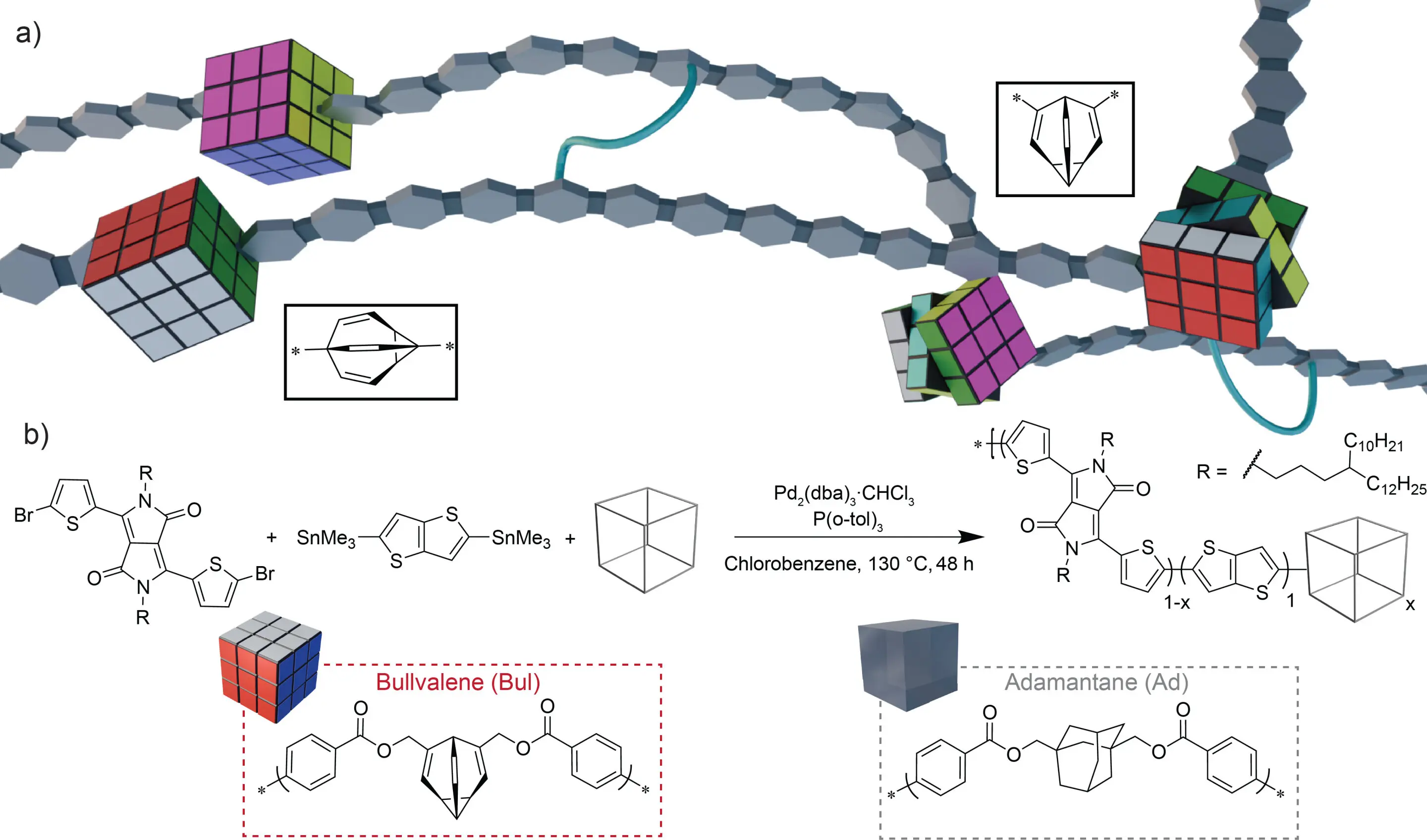
Researchers at the University of Toronto have found a way to make plastic semiconductors stretch more than twice as far before cracking, without significantly affecting their electrical performance. The improvement comes from adding an unusual molecule that constantly rearranges its structure, changing how crystals form inside the material.
The research, carried out by PhD student Shine Huang under Professor Helen Tran, could help in developing electronics that need to stretch and move with the human body, including wearable medical sensors and implantable devices.
Huang experimented with a molecule called bullvalene, which he compares to a Rubik's Cube because of its ability to continually rearrange its chemical bonds. The molecule can adopt more than 1.2 million different configurations, making it an interesting candidate for changing how polymer chains pack together.
He incorporated bullvalene into a conjugated polymer semiconductor known as p(DPP-TT). The addition disrupted the polymer's crystalline structure, producing smaller crystals that could accommodate more movement.
What surprised Huang was that the material still worked well as a semiconductor. He had expected that interfering with the crystalline structure would considerably reduce its ability to transport charge.
"But even though there was a lot of chaos introduced, it still had good electrical properties," Huang said.
More Stretch Without Losing Electrical Performance
The first experiments didn't show much improvement. Without additional crosslinking, the modified polymer films still began cracking at strains of around 20% to 25%.
However, after crosslinking the polymer chains, the researchers saw a considerable difference.
With just 5 mol% bullvalene and 10 wt% crosslinker, the semiconductor could stretch to 50% strain before cracks appeared. The original polymer and a control containing adamantane, a similarly sized but non-shape-shifting molecule, both began cracking at approximately 20% strain.
The comparison with adamantane was particularly interesting. It suggested that bullvalene's ability to rearrange, rather than simply its presence in the polymer, was responsible for the improvement.
Huang took samples to the Canadian Light Source at the University of Saskatchewan to investigate what was happening inside the modified material.
Synchrotron X-ray measurements showed that the bullvalene-containing polymer had smaller crystalline regions, averaging 12.8 nanometers compared with 15.6 nanometers in the original material. The adamantane control had even larger crystallites, averaging 17.4 nanometers.
The crystals hadn't disappeared. They were simply smaller, allowing the crosslinked polymer to stretch further before cracking while retaining the ordering needed for charge transport.
The researchers also tested the material in organic field-effect transistors. Between 10% and 50% strain, charge mobility in the bullvalene-containing semiconductor remained relatively stable, while the two control materials showed a continued decline.
There was a limitation, though. When subjected to repeated stretching at 25% strain, all three materials experienced a decline in charge mobility. Bullvalene helped the semiconductor withstand greater deformation, but it hadn't solved the problem of repeated mechanical stress.
For electronics intended to move with skin or soft tissue, that distinction matters. A semiconductor capable of stretching without immediately cracking could make it easier to incorporate active circuitry into wearable sensors, electronic skin and soft robotic structures, rather than relying entirely on rigid components connected by flexible wiring.
Huang is now exploring whether bullvalene could also change the properties of other plastics, including materials that don't conduct electricity. The unusual molecule may have applications beyond semiconductors, particularly where controlling how polymers form crystals can change their mechanical behavior.
Related news
Keep up with the components and technology shaping electronics.
Join the club for member features, engineering discussion and easier access to the latest Component Club content.