
Vishay Introduces WLMO Wireless Module for Industrial Position Monitoring
The new battery-powered node supports two analog position sensors, with an internal 12-bit ADC and communication range of up to 2 km
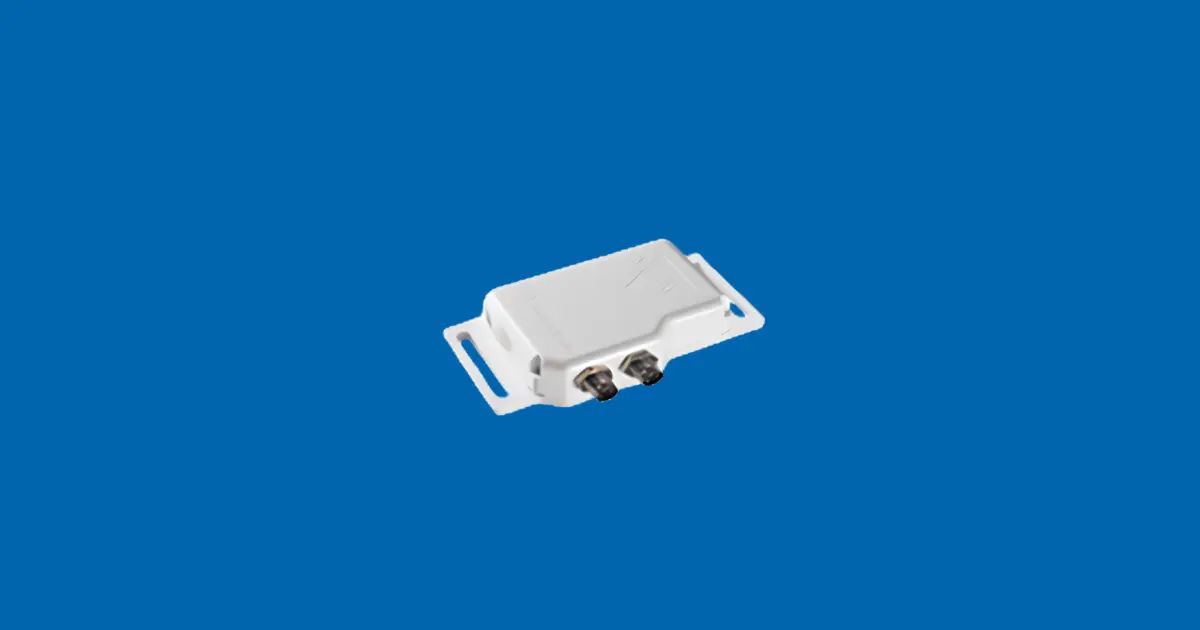
Vishay Intertechnology has introduced the WLMO, a LoRa-based machine-to-machine (M2M) wireless position data transfer module for industrial applications. Operating in the 2.4 GHz ISM band, the Vishay Sfernice node supports long-range communication and battery-powered operation.
The WLMO powers, acquires and wirelessly transmits data from up to two analog position sensors to a receiver or gateway for processing within the host system. It supports potentiometric and contactless sensor technologies, with a 12-bit internal analog-to-digital converter (ADC) and sealed M8 × 1 three-pole connectors.
The module is intended for actuator position monitoring, industrial automation and condition-based maintenance. Other applications include energy metering, precision farming and agricultural equipment.
Private LoRa Network and Gateway Integration
The WLMO operates on a private LoRa network, supporting communication up to 2 km in open-field environments. Vishay specifies a receiver sensitivity of −140 dBm and a transmit power of 7.08 mW (8.5 dBm).
The module uses a proprietary protocol layer over LoRa modulation, which must be implemented within the customer's system and receiving gateways. It also supports bidirectional communication and remote configuration.
The radio architecture provides five selectable frequency bands, with independent transmission and reception channels featuring ±200 kHz bandwidth each. Six configurable spreading factor levels are available, along with duty cycles of up to 10%.
Battery Operation and Industrial Construction
The WLMO supports autonomous battery-powered operation for up to two years on a single battery set. Battery level monitoring is included, while a sealed mechanical switch provides activation and pairing during commissioning.
Measuring 89 × 55.5 × 21.6 mm, the module features an IP67-rated sealed enclosure and UV-resistant housing compliant with ISO 4892-2. The construction is intended for industrial and outdoor installations where position data must be collected remotely.
The RoHS-compliant WLMO is available in sample and production quantities, with lead times of 14 weeks.
Learn more and read the original announcement at vishay.com.
Technology Overview
The Vishay Sfernice WLMO is a wireless position data transfer module for remote monitoring of up to two analog sensors. It integrates a 12-bit ADC and sealed M8 connectors, supporting both potentiometric and contactless sensor technologies. Communication uses LoRa modulation in the 2.4 GHz ISM band with a proprietary protocol, offering up to 2 km open-field range. The battery-powered module has an IP67-rated enclosure and supports operation for up to two years.
FAQs
What sensors can the WLMO connect to?
The WLMO supports up to two potentiometric or contactless analog position sensors. It powers the sensors and acquires readings using an internal 12-bit ADC.
Does the WLMO support standard LoRaWAN gateways?
The module uses a proprietary protocol over LoRa modulation. Customers must implement this protocol in their receiving system or gateway, so standard LoRaWAN compatibility should not be assumed.
What are the WLMO's wireless range and battery life?
Vishay specifies communication distances up to 2 km in open-field environments and battery operation for up to two years on a single battery set.
Related news
Keep up with the components and technology shaping electronics.
Join the club for member features, engineering discussion and easier access to the latest Component Club content.