
SpaceX Just Caught Starship Returning From Orbit
SpaceX has successfully caught a Starship spacecraft returning from orbit for the first time. The achievement is remarkable, but its longer-term significance could be what happens to the cost of getting people and equipment into space.
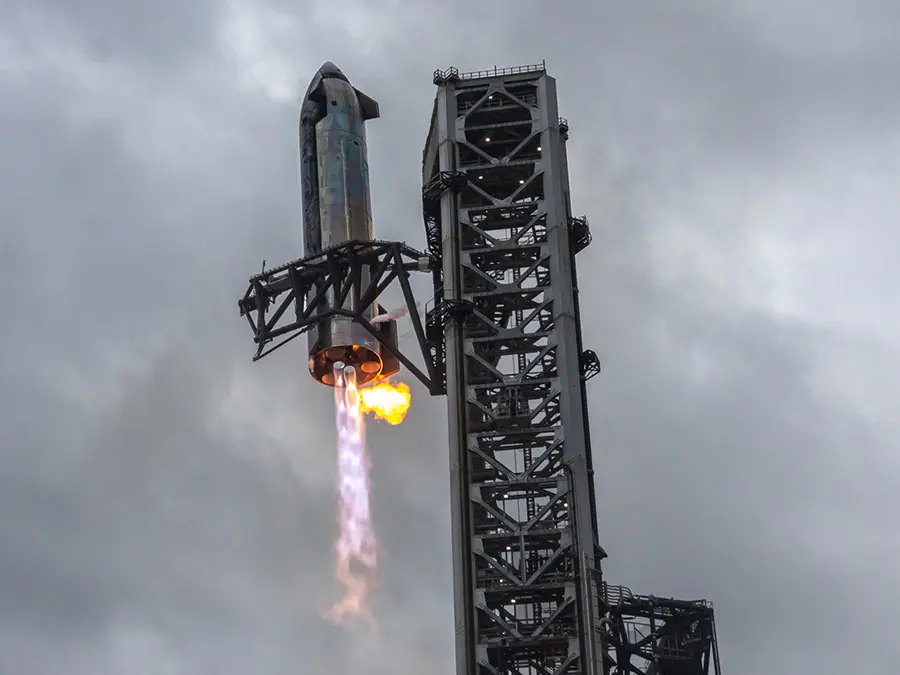
SpaceX has successfully caught a Starship spacecraft returning from orbit, bringing the 50-metre upper stage back to its launch tower in Texas after more than 22 hours in space. The spacecraft completed 14 orbits of Earth, deployed 26 Starlink satellites and survived its journey back through the atmosphere before settling between the tower's enormous mechanical arms.
The recovery took place on November 14, following Starship's 15th flight test from Starbase the previous afternoon. SpaceX had planned to catch both stages of the rocket, but Super Heavy Booster 22 experienced problems during its return and was diverted into the Gulf of Mexico.
It's difficult not to be impressed by what SpaceX has achieved with Ship 42. The spacecraft spent almost an entire day travelling around Earth before returning to the same launch tower it had departed from, eventually being caught by a pair of steel arms rather than landing on its own undercarriage.
SpaceX has already caught and reflown Super Heavy boosters, but this was the first successful recovery of a Starship upper stage after an orbital flight. It also brings the company closer to its ambition of recovering both halves of the vehicle, although Flight 15 showed that getting everything to work during the same mission is still proving difficult.
SpaceX Used Starlink Satellites to Inspect Starship
The November 13 launch carried 26 Starlink V3 satellites, the larger spacecraft SpaceX is developing for its next generation of broadband services. According to the company, the combined capacity of those satellites is equivalent to approximately ten Falcon 9 launches carrying Starlink V2 Mini satellites.
Three of the satellites had been given another job. SpaceX fitted them with additional cameras so that, once deployed, they could photograph Starship's heat shield and send the images back to engineers on Earth.
It's a rather clever use of equipment that was already travelling into space. Instead of relying entirely on cameras mounted on Starship or observations from the ground, SpaceX could examine the exterior of the spacecraft from another vehicle in orbit.
During the deployment sequence, Starship was also manoeuvred to allow the cameras aboard one of the satellites to capture images of its thermal protection system.
The condition of that heat shield was particularly important for Flight 15. SpaceX has encountered problems with its protective tiles during previous tests, and the company has spent considerable time modifying their attachment mechanisms and addressing areas where hot gases could reach the structure beneath them.
For the latest mission, the spacecraft incorporated improvements introduced during earlier flights, including additional retention mechanisms for some of the tiles.
SpaceX wanted to bring Ship 42 all the way back to Starbase, but the return wasn't guaranteed simply because the spacecraft had successfully reached orbit.
The mission plan included alternative landing opportunities over the ocean near Hawaii and Chile. These would allow SpaceX to avoid attempting a tower catch if the available information suggested that the spacecraft wasn't in suitable condition.
Engineers examined images from the Starlink satellites alongside other flight data before clearing Starship for its return to Texas.
It's an interesting development in the Starship programme. Earlier flights were largely about finding out whether the spacecraft could survive launch, reentry and the final landing manoeuvre. Flight 15 introduced the additional challenge of deciding whether the vehicle was fit to return to the launch facility in the first place.
The satellite photographs also provided a different view of the spacecraft during the mission, although the real opportunity for inspection came after the tower catch.
For the first time, SpaceX has recovered an orbital Starship intact. Engineers can now examine the actual condition of the heat shield, the propulsion equipment and other hardware after more than 22 hours in space.
That's something previous flight tests couldn't offer in quite the same way. Cameras and telemetry can reveal an enormous amount about a spacecraft, but being able to inspect the vehicle after it has completed the mission should provide a much clearer picture of how well its components have survived.
Could Reusable Rockets Make Spaceflight Much Cheaper?
The immediate benefit of recovering Ship 42 is that SpaceX gets its spacecraft back. But the longer-term ambition is much more interesting, particularly when considering how expensive it has traditionally been to launch anything into orbit.
SpaceX has already made considerable progress with its Falcon 9 rockets. Their reusable boosters have completed hundreds of flights, allowing the company to launch satellites and other payloads at a frequency that would have been difficult to imagine when the programme began.
However, Falcon 9 still discards its upper stage after every mission. SpaceX recovers the booster, but it must manufacture another upper stage for the next launch.
Starship is intended to change that arrangement by making the entire vehicle reusable. If both stages can be recovered and flown again with relatively little work between missions, the cost of delivering each payload could fall substantially.
This is where Saturday's achievement becomes more than an impressive landing.
Consider the 26 Starlink satellites deployed during Flight 15. SpaceX says they provide roughly as much network capacity as ten Falcon 9 launches carrying the previous generation of satellites. That's an enormous amount of additional communications capacity from a single rocket, even before considering the possibility of flying that rocket again.
It's not difficult to see why SpaceX is investing so much money into Starship. The company operates one of the world's largest satellite networks, and being able to launch more capable spacecraft in greater numbers could have a substantial effect on how quickly that network expands.
But there's another possibility here that's particularly interesting for engineers.
Spacecraft development has always involved difficult compromises over size and weight. Engineers can spend enormous amounts of time trying to reduce the mass of equipment, developing specialised components and complicated mechanisms simply to make everything fit within the limits of a launch vehicle.
If Starship eventually makes launching larger and heavier payloads more affordable, some of those compromises might become less necessary.
A satellite manufacturer could potentially choose a heavier power supply with greater operating margins rather than spending money developing a smaller alternative. Additional redundancy might become easier to justify, while larger antennas and instruments could be designed with fewer restrictions on their physical dimensions.
Of course, weight would still matter. Every spacecraft needs to operate within the performance limits of its launch vehicle, and additional mass isn't free. But the financial argument for spending months removing a few kilograms from a design could look rather different if the launch itself becomes considerably cheaper.
That could have some interesting consequences for the electronics industry. Instead of investing so heavily in making every component as small and light as possible, engineers might have more freedom to concentrate on reliability, performance and the equipment they actually want to put into orbit.
It could also change how new technology is developed. Space hardware is expensive, partly because there are limited opportunities to test it under real operating conditions. If launch opportunities become more frequent and affordable, engineers could potentially test experimental devices in orbit without committing quite so much money to each mission.
There is already a good example of why launch frequency matters in NASA's Artemis programme. The agency's plans for a Starship lunar lander involve multiple tanker flights to transfer propellant into orbit before the landing mission can begin.
That's a considerable amount of launching simply to prepare a spacecraft for its journey to the Moon. The process becomes much more practical if the same vehicles can be recovered, prepared and launched again without extensive rebuilding.
There are still some fairly substantial obstacles to overcome.
SpaceX has caught Ship 42, but it hasn't demonstrated how quickly the spacecraft can be prepared for another flight. The company will need to examine the heat shield, engines and other equipment before establishing how much work is required.
The Super Heavy booster also failed to return during Flight 15, meaning SpaceX has yet to demonstrate recovery of both stages during the same mission. And even with successful recoveries, the economics will depend on refurbishment costs, launch frequency and the reliability of the complete system.
Nevertheless, the achievement deserves considerable recognition. SpaceX has launched an enormous spacecraft into orbit, deployed its payload and brought the upper stage back to be caught by the tower it departed from the previous day.
It's an extraordinary piece of engineering, and the footage of Starship settling between those mechanical arms is unlikely to become any less impressive with repeated viewing.
But perhaps the bigger achievement will come when engineers no longer have to think quite so carefully about whether something is worth launching.
If reusable rockets eventually reduce the cost of reaching orbit by a substantial amount, it could change the economics of spacecraft design, scientific research and commercial satellite development.
The most interesting consequences of Flight 15 might therefore have very little to do with the rocket itself, and much more to do with what engineers can afford to put on top of it.
Related news
Keep up with the components and technology shaping electronics.
Join the club for member features, engineering discussion and easier access to the latest Component Club content.