
Why GE Aerospace Is Adding Electric Motors to Conventional Aircraft Engines
GE Aerospace has successfully demonstrated electric power assisting a gas turbine during aircraft takeoff. The test follows earlier hybrid-electric flights above 30,000 feet, although there are still questions about whether the additional batteries and electronics could make commercial aircraft more efficient.
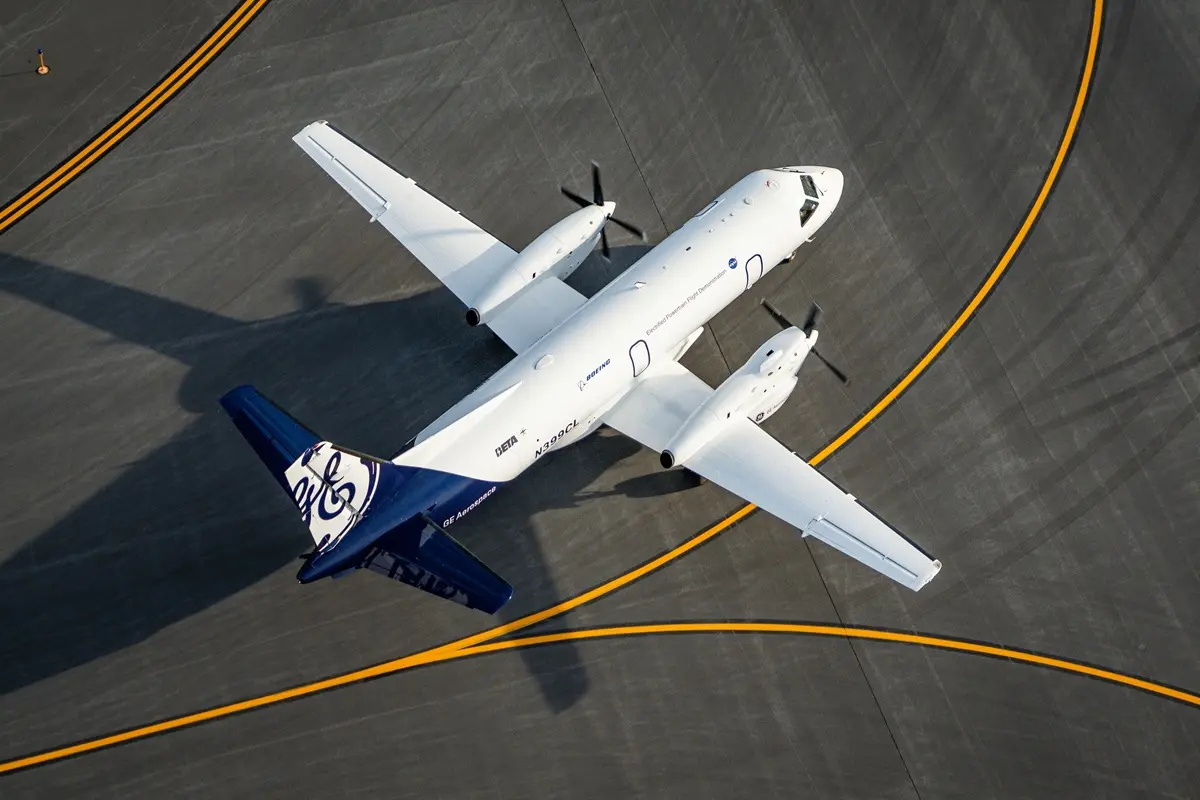
GE Aerospace and BETA Technologies have successfully completed a hybrid-electric assisted takeoff using a modified Saab 340B aircraft. The test took place at BETA's flight facility in Plattsburgh, New York, where an electric motor provided additional propulsion power alongside a conventional gas turbine engine.
According to GE Aerospace's announcement, this is the first hybrid-electric assisted takeoff involving an aircraft designed to operate at commercial airliner altitudes. The Saab was fitted with a conventional GE CT7 turboprop on its left side, while the right-hand engine was modified to incorporate a megawatt-class electric propulsion system.
It's another achievement for a programme that has already taken hybrid-electric propulsion above 30,000 feet. In May, GE, NASA, BETA Technologies and Boeing completed a series of high-altitude flights, including one where the aircraft operated in hybrid-electric mode for more than two hours.
The aircraft was subsequently flown across the Atlantic to the Farnborough International Airshow in July, operating in hybrid mode during each leg of the journey.
The latest test adds takeoff to the list of flight conditions the system has successfully demonstrated. And while GE is interested in reducing fuel consumption and noise, the company isn't attempting to replace the gas turbine with batteries. Instead, it's looking at whether electrical power can be used alongside the engine to improve how the aircraft performs during different stages of flight.
A Turboprop With Two Different Engines
The Saab 340B is a fairly ordinary regional turboprop, originally designed to carry passengers on relatively short routes. There's nothing particularly unusual about the aircraft itself, which makes the changes GE has made to the right-hand engine installation all the more interesting.
The hybrid system combines a GE CT7 gas turbine with electric motor/generators, power converters, inverters and the associated control electronics. Avio Aero developed the gearbox technology, while Dowty supplied the propeller and BAE Systems provided the battery system.
Boeing subsidiary Aurora Flight Sciences was responsible for developing the modified engine nacelle, which houses the additional equipment.
One detail from the earlier high-altitude announcement is that the nacelle had to be installed in an inverted configuration to provide more ventilation.
That's quite an unusual modification to make to an aircraft engine installation, but it gives some indication of the difficulties involved in incorporating megawatt-class electrical equipment into a space originally intended for a gas turbine.
The system operates at multiple kilovolts, with GE developing the motor/generators, power converters, inverters and controllers specifically for the programme. There are also heat exchangers, torque sensors and the electrical harnesses needed to connect everything together.
Managing the heat generated by the additional equipment was clearly an important consideration. GE's engineers also had to account for changes in atmospheric pressure at altitude, where cooling becomes more difficult and the behaviour of high-voltage electrical equipment needs particular attention.
Before moving to flight testing, the propulsion system underwent ground tests through NASA's Electrified Powertrain Flight Demonstration programme. Earlier work at NASA's Electric Aircraft Testbed examined the electrical system under conditions simulating altitudes of up to 45,000 feet.
The 2026 flight campaign then demonstrated that the equipment could operate at the altitudes flown by conventional passenger aircraft.
During those tests, the electric powertrain helped drive the propeller during climb and cruise. The system was also operated in regeneration mode, allowing energy to be returned to the battery during other parts of the flight.
It's worth remembering that this is all taking place inside a conventional turboprop installation. GE has managed to incorporate a high-voltage electrical system, batteries and associated controls into an aircraft that still relies on a gas turbine for much of its propulsion.
The November demonstration adds another demanding condition. Takeoff requires substantial power, and the hybrid engine was able to draw on its batteries to provide additional assistance as the aircraft accelerated and left the runway.
GE also reported that the aircraft appeared quieter during the hybrid-assisted takeoff than when operating with gas turbines alone. Those observations are preliminary, however, and the company hasn't published comparative noise measurements or fuel consumption figures from the latest test.
Nevertheless, the aircraft has now demonstrated electrical assistance during takeoff, climb and cruise, along with battery regeneration in flight. That's a considerable amount of testing for a propulsion system that still looks relatively conventional from the outside.
Is the Battery Worth Carrying?
There is an interesting argument for hybrid-electric propulsion in commercial aviation, particularly when considering the different demands placed on an aircraft engine throughout a flight.
Takeoff and climb require substantially more power than is needed once an aircraft has settled into cruise. A conventional engine still needs to be capable of supplying those higher demands, even though they only occur during relatively short periods.
GE is investigating whether electric assistance could allow future aircraft engines to be designed and operated differently, using battery power when additional propulsion is required.
In theory, this could provide opportunities to improve engine efficiency without requiring batteries large enough to power an entire aircraft.
Of course, the extra equipment comes at a cost.
Aircraft manufacturers already spend considerable effort reducing weight wherever possible, and a hybrid propulsion system introduces batteries, motor/generators, power electronics, cooling equipment and all the additional hardware needed to integrate them safely.
That weight has to be carried throughout the flight, regardless of whether the electric motor is contributing power.
There is also the question of how much energy the battery actually provides. GE describes the system as megawatt-class, but hasn't disclosed the battery capacity or the amount of electrical energy used during the latest takeoff.
Those figures would be particularly interesting when assessing whether the technology could make commercial sense.
Providing electrical assistance for a few minutes is one thing. Demonstrating that it reduces fuel consumption over an entire journey, after accounting for battery charging and the additional weight, is another.
The system's ability to regenerate electrical power during cruise and descent also deserves attention. It gives GE another way to manage energy during flight, but charging the battery using power from the gas turbine still requires fuel. Any efficiency benefit would depend on the complete operating cycle rather than the performance of the electrical equipment alone.
I suspect this is where much of the development work will concentrate as the programme progresses. GE has already shown that the technology works, but the more difficult question is how future engines might be designed to take advantage of it.
An engine developed from the beginning with electrical assistance in mind could be quite different from a conventional turbine that has simply been fitted with additional motors.
There are also some interesting implications for propulsion control. The aircraft now has two sources of mechanical power contributing to the same propulsion system, with the amount available from the battery changing during flight.
Managing that arrangement introduces another layer of complexity, particularly during demanding parts of the flight when the system must respond predictably to changes in power requirements.
The Saab 340B remains a technology demonstrator, so these tests don't establish that hybrid-electric aircraft will be commercially viable. They do, however, provide useful evidence about how the propulsion equipment performs under real flight conditions.
GE is also developing hybrid-electric technology through the CFM RISE programme, alongside work on Open Fan engines and more efficient engine cores. The wider programme is targeting a fuel consumption improvement of more than 20% compared with current commercial engines, although that figure doesn't represent a measured saving from the Saab's hybrid system.
I think there's something quite impressive about the amount of engineering being fitted into what was originally a conventional turboprop.
The aircraft has now crossed the Atlantic, operated in hybrid mode above 30,000 feet and completed an electrically assisted takeoff. These are substantial achievements for a technology that was being tested on the ground only a few years ago.
Whether we'll eventually see similar systems fitted to commercial passenger aircraft is another matter. Airlines will want convincing evidence that the fuel savings justify the extra weight, maintenance and complexity.
For now, GE has demonstrated something that would have been difficult to imagine in a conventional turboprop not very long ago. A gas turbine and a megawatt-class electric motor can share the work of propelling an aircraft through takeoff, with the electrical system continuing to contribute during other parts of the flight.
The next few years should tell us whether that capability offers enough of an advantage to find its way into the aircraft we actually fly on.
Related news
Keep up with the components and technology shaping electronics.
Join the club for member features, engineering discussion and easier access to the latest Component Club content.