
Würth Elektronik Introduces PowerBusbar PF for High-Current PCB Designs
The vertical press-fit busbar adds copper capacity to selected PCB areas, with modular routing options and improved heat dissipation.
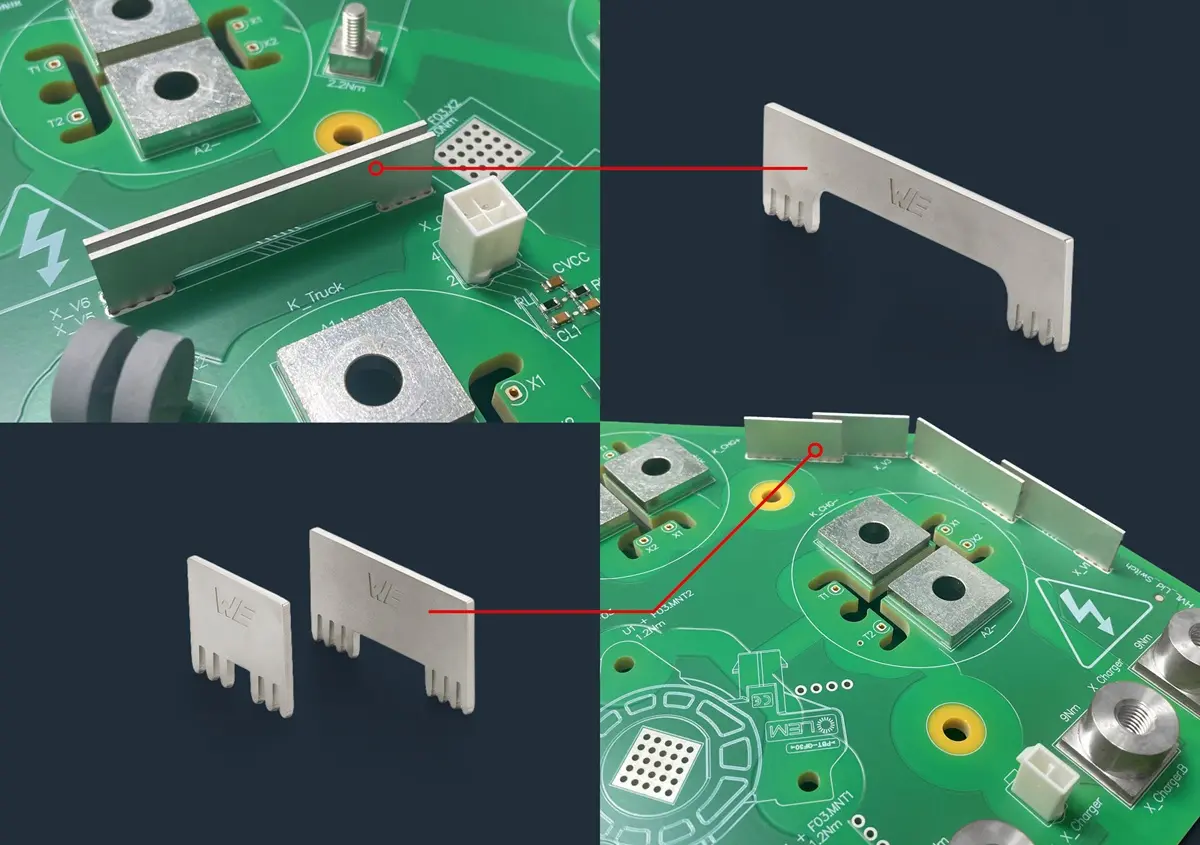
Available in four standard sizes, the PowerBusbar PF measures between 19 and 59 mm in length, with a height of 18.4 mm and a thickness of 1.2 mm. Different lengths can be combined to form current paths, while the busbar can also bridge specific areas of a PCB where direct routing is not possible.
The product is intended for applications including AI data centers, electric mobility, energy storage and industrial automation.
High-Current Routing on Standard PCBs
The PowerBusbar PF provides additional copper cross-sectional area in parts of a PCB subject to high current loads. Rather than using thick copper across the entire board, designers can reinforce existing trace paths only where additional current-carrying capacity is needed.
Its vertical arrangement makes use of the space above the PCB, allowing multiple busbars to be combined into continuous current paths. Where traces need to cross over or the required routing cannot be accommodated directly on the board, individual PowerBusbar PF components can also act as high-current bridges.
This arrangement allows standard FR4 PCBs to be used in many applications that would otherwise require specialized heavy-copper boards.
Thermal Management and Press-Fit Installation
The copper cross-section also contributes to heat dissipation. With its vertical arrangement and increased exposed surface area, the PowerBusbar PF can act as a heat sink, reducing hotspots in high-current sections of the PCB.
Würth Elektronik ICS reports a temperature reduction of up to 53.5 K in measurements carried out at an ambient temperature of 40°C and a current of 185 A.
The busbar is permanently connected to the PCB using press-fit technology, eliminating the need for soldering and avoiding additional thermal stress during assembly.
Würth Elektronik ICS will present the PowerBusbar PF at electronica 2026 in Munich, November 10–13.
Learn more and read the original announcement at we-online.com.
Technology Overview
The Würth Elektronik ICS PowerBusbar PF is a vertical press-fit busbar for high-current PCB applications. Available in four lengths from 19 to 59 mm, it increases the copper cross-sectional area of selected current paths on standard FR4 circuit boards. Multiple busbars can be combined or used as high-current bridges. The vertical arrangement also improves heat dissipation, with Würth Elektronik reporting a temperature reduction of up to 53.5 K at 185 A and 40°C ambient temperature.
FAQs
What is the Würth Elektronik PowerBusbar PF used for?
The PowerBusbar PF increases current-carrying capacity in selected areas of a PCB. It can reinforce existing traces, form continuous high-current paths or bridge areas where direct PCB routing is not possible.
Can PowerBusbar PF be used with standard FR4 PCBs?
Yes. The busbar adds copper cross-sectional area where higher currents need to be carried, allowing standard FR4 boards to replace specialized heavy-copper PCBs or copper-inlay boards in many applications.
How does the PowerBusbar PF help with thermal management?
Its copper construction and vertical arrangement increase the surface area available for heat dissipation. Würth Elektronik ICS reports a temperature reduction of up to 53.5 K under test conditions of 185 A and 40°C ambient temperature.
Related news
Keep up with the components and technology shaping electronics.
Join the club for member features, engineering discussion and easier access to the latest Component Club content.