
Analog Devices and Antmicro Launch Open-Source AutoML Tool for Embedded Edge AI
AutoML for Embedded automates ML model building for edge devices, combining open-source flexibility with ADI hardware support.
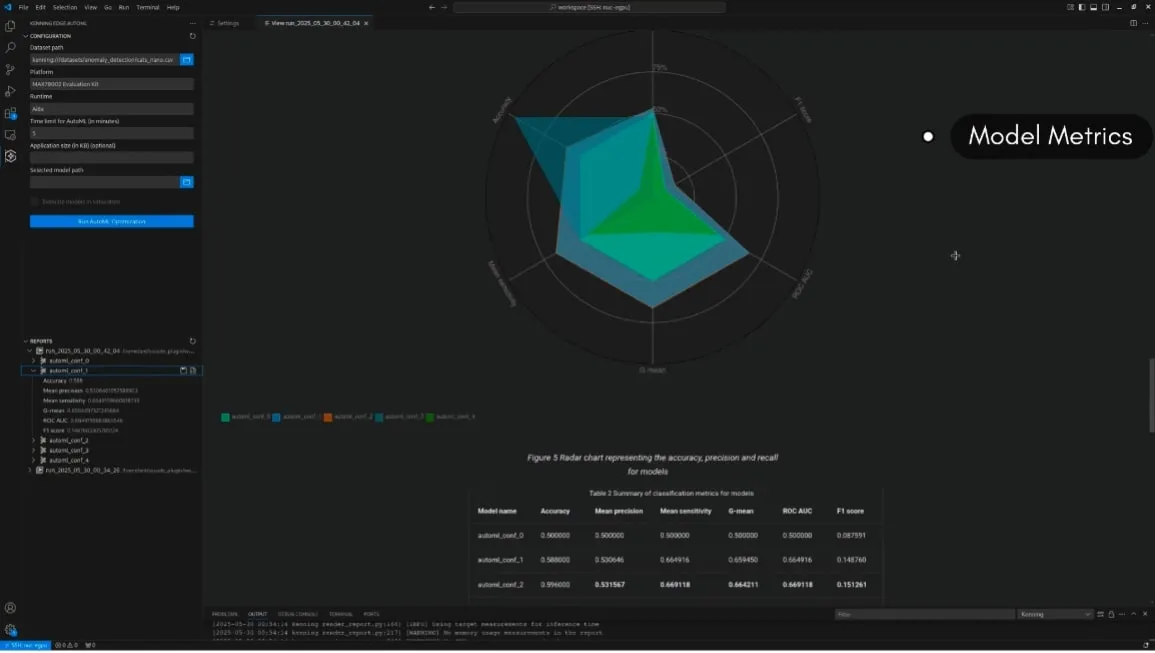
Now, Analog Devices (ADI) and Antmicro have teamed up to release AutoML for Embedded, a new open-source solution designed to remove much of that complexity. It’s built into the Kenning framework and available as a Visual Studio Code plugin, offering developers a streamlined way to generate, test and deploy ML models directly onto edge hardware.
Aimed at All Skill Levels
AutoML for Embedded targets both data scientists and embedded developers, offering automated workflows that cover data prep, model selection, hyperparameter tuning, and performance validation. Behind the scenes, it uses SMAC and Hyperband algorithms to search and evaluate model candidates, keeping only the best-performing ones that also fit within available memory and processing limits.
The end result: lightweight models that are deployment-ready for low-power devices like microcontrollers, without needing deep ML expertise.
Tight Hardware and Software Integration
The plugin integrates smoothly with ADI’s MAX78002 and MAX32690 MCUs, and it supports development using the Zephyr RTOS and Renode simulation, giving teams full control of testing and validation before hardware deployment.
Key features include:
- Visual Studio Code plugin interface
- Full support for ADI edge AI MCUs
- Kenning-based model benchmarking and optimisation
- Simulation support using Renode
- Open-source licensing with no vendor lock-in
The toolchain provides pre-built tutorials, datasets, and reproducible pipelines, making it easier to move from raw data to functional edge AI deployment without needing a complex DevOps setup or specialised ML frameworks.
Industry Use Cases
One recent demo used AutoML for Embedded to build an anomaly detection model using time-series data, which was deployed on both physical hardware and its Renode-based digital twin for validation.
Other applications include:
- Vision-based tasks on low-power cameras
- Predictive maintenance in industrial systems
- On-device NLP for text classification
- Action detection in robotics or wearable devices
Open, Transparent, and Scalable
This joint release reflects a growing move toward transparency and flexibility in AI deployment tools. “We developed an automated flow and VS Code plugin that vastly reduces the complexity of building optimised edge AI models,” said Michael Gielda, VP of Business Development at Antmicro. “With flexible simulation and Zephyr RTOS support, the road to transparent and efficient edge AI development is open.”
AutoML for Embedded is available now on the Visual Studio Marketplace and GitHub, with full documentation and support from both ADI and Antmicro. Developers are encouraged to test the platform, provide feedback, and collaborate on new features.
Learn more and read the full announcement on www.analog.com
Related Reading
Related news
Keep up with the components and technology shaping electronics.
Join the club for member features, engineering discussion and easier access to the latest Component Club content.