
Binder Adds Compact M12 Power Options and Adapters for Legacy Systems
Binder expands M12 Power connector line with compact DC options and adapters for integrating 7/8” systems in industrial automation.
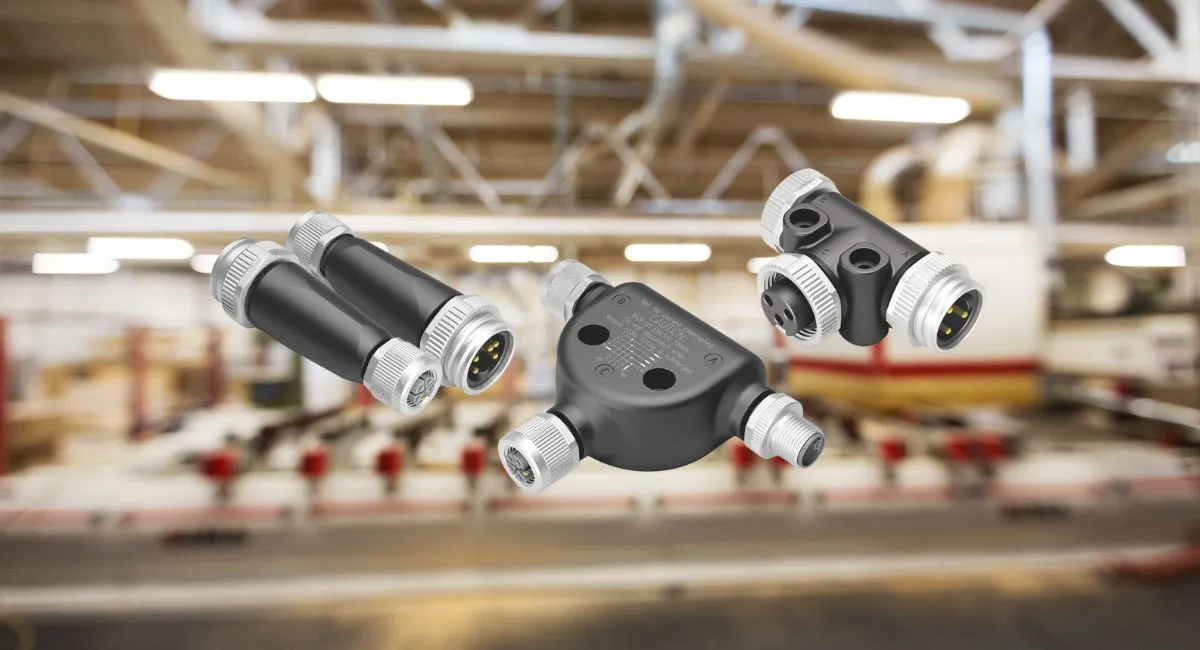
The company isn’t leaving existing systems behind. While M12 Power is now widely used in decentralised and space-critical automation designs, Binder continues to offer 7/8” solutions for installations where footprint isn’t an issue, or where the infrastructure is already in place.
One Format, Multiple Power Needs
The appeal of the M12 format comes down to size and familiarity. Originally used for signal and data, it now supports power up to 630V, using standardised codings for AC and DC configurations. S and K coding cover AC systems, while T and L coding handle DC rails.
By keeping the M12 form factor, designers can reduce bulk while relying on a well-known interface. Assembly is straightforward, and the connector housings are rugged enough for use in motors, lighting systems, and networked devices.
Binder offers M12 Power connectors across a range of codings and configurations, with mechanical lifespans rated above 100 mating cycles. Products meet IP67 or IP68 protection standards and operate from –40°C to +85°C. All models comply with UL2237 and UL2238.
Accessories That Bridge Old and New
Miniaturisation doesn’t mean starting from scratch. Binder has added new interconnect options that help engineers link modern systems to legacy infrastructure.
A redesigned 7/8” T-splitter is now available in 3-, 4-, and 5-pin versions. It includes mounting holes for easier installation and replaces an older model. A new 5-pin M12 splitter with L-coding brings structured DC power distribution to compact installations. Binder has also introduced two adapter modules that connect 7/8” and L-coded M12 interfaces, easing the transition to smaller, modular setups.
Each solution is part of a larger connector family, including the 813, 814, 820, 823, 824, and 870 series, supporting 3- to 5-pin layouts depending on the application. Codings, pin-outs, and mechanical footprints vary, but the emphasis remains the same: reliable power in rugged, space-limited environments.
As automation systems continue to shrink and decentralise, connectors like Binder’s M12 Power series are becoming central to high-density, field-ready power distribution. At the same time, the role of 7/8” connectors in existing systems can’t be overlooked. By supporting both, and providing the adapters to connect them, Binder gives engineers the tools to modernise without breaking compatibility.
Learn more and read the original article here.
Related Reading
- binder Expands Compact M9 Connector Portfolio for Demanding Applications
- Samtec Introduces Bulls Eye® ISI Evaluation Boards for Simplified SerDes Testing
- TE Connectivity Launches Modular MULTIGIG TRX Platform for Rugged Fibre Optic Applications
Want more content like this? Join the club for new product alerts, expert insights, and zero spam.
Related news
More from Binder
Keep up with the components and technology shaping electronics.
Join the club for member features, engineering discussion and easier access to the latest Component Club content.