
NOVOSENSE MT73xx 3D Hall Sensors Cut Complexity in Automotive Motor Control
NOVOSENSE MT73xx dual-output 3D Hall sensors improve speed and direction sensing accuracy while simplifying automotive motor control designs.
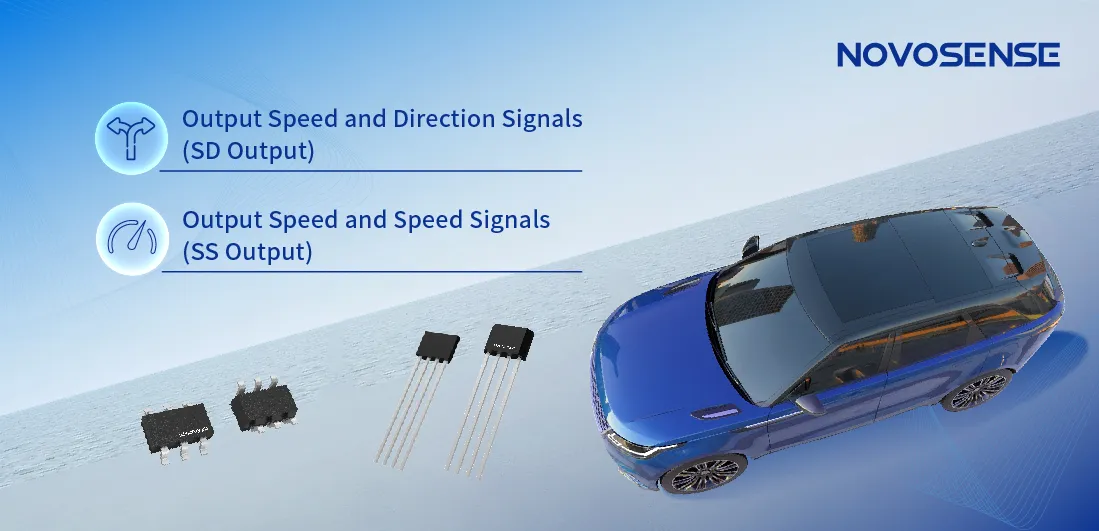
The MT73xx series from NOVOSENSE looks to take some of that pressure off. It packages two sensing channels into a single device, using 3D Hall technology to deliver either a pair of speed signals or a speed-and-direction combination. The idea is simple: fewer components to install and calibrate means fewer ways for things to go wrong.
Dual Outputs Without the Alignment Stress
In many current designs, dual outputs are created by pairing two separate Hall latches. That works, but it depends on perfectly positioned magnets to avoid phase errors. The MT73xx sidesteps that by generating orthogonal outputs from within the same sensor. Engineers can choose SS mode for dual speed signals with a 90-degree phase shift or SD mode for speed and direction.
Because the sensing happens in a single package, the system becomes less sensitive to mechanical tolerances. In a production environment, that means you can still achieve stable, synchronised signals without chasing down tiny alignment errors.
VHS Technology for Design Freedom
NOVOSENSE’s proprietary Vertical Hall Sensor (VHS) technology is what makes the MT73xx so adaptable. It can combine different axis pairs, XY, YZ, or XZ, while maintaining synchronisation between channels. That opens up compatibility with a range of magnet shapes and mounting styles, from standard axial and radial designs to more irregular geometries.
For the designer, this flexibility cuts down the trial-and-error phase and makes it easier to integrate the sensor into tight or unconventional mechanical layouts. It also means the same part can be used across different models or platforms, which can simplify sourcing.
Built for Harsh Conditions
The MT73xx meets Automotive Grade 0 requirements, so it is ready for high-temperature and demanding environments. Its dual outputs can connect directly to the ECU, eliminating the need for redundant sensors in many setups. That not only saves PCB space but also reduces the overall parts count and wiring complexity.
By blending dual-channel sensing with mechanical tolerance, broad magnet compatibility, and high-temperature reliability, the MT73xx series gives automotive engineers a cleaner, more robust way to get accurate speed and position feedback, without the usual installation headaches.
Learn more and read the original article here.
Related news
More from Novosense
Keep up with the components and technology shaping electronics.
Join the club for member features, engineering discussion and easier access to the latest Component Club content.