
SCHURTER ALO Fuse Series Supports 800 V EV Platforms
SCHURTER’s ALO fuses deliver up to 1000 VDC and 900 A protection, meeting global EV standards and supporting next-gen 800 V architectures.
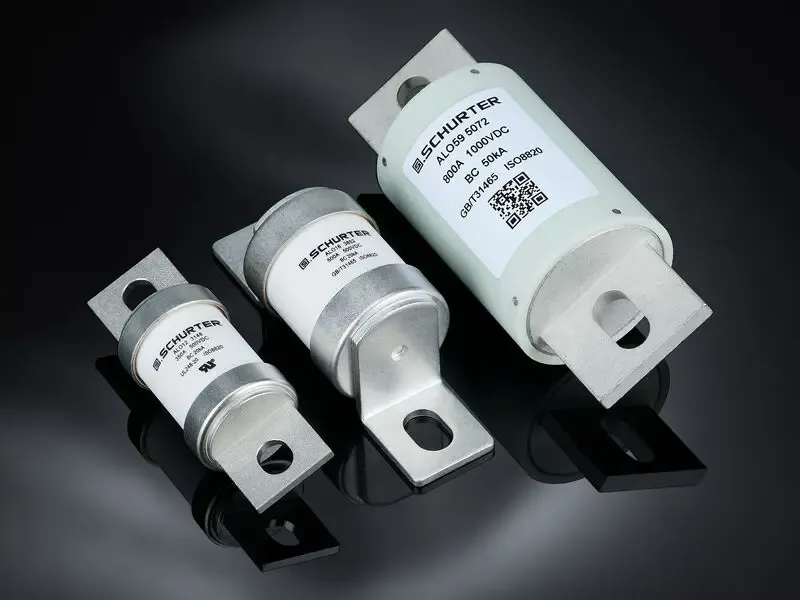
SCHURTER’s new ALO series addresses that gap. Rated up to 1000 VDC and 900 A with a breaking capacity of 50 kA, the fuses are built for the new generation of EV powertrains where safety margins are tight and reliability is critical.
Flexibility in design choices
One of the advantages of the ALO platform is its flexibility. Engineers can specify either axial or bottom bolt-on mounting, depending on how the PDU or battery disconnect is packaged. Housing options include ceramic, which offers greater thermal and mechanical robustness, and resin, which can help reduce cost and weight. This level of choice is valuable when designing across different EV models and performance classes.
The series spans voltage ratings from 250 VDC to 1000 VDC and covers currents from 100 A to 900 A. That range makes it possible to standardise on a single fuse family across multiple subsystems, whether it’s an auxiliary controller or a high-power battery disconnect unit.
Built for harsh automotive conditions
Reliability is a central theme in the design. The ALO construction is engineered to avoid common failure points such as cracked housings, loose terminals, or resistance drift over time. SCHURTER also uses a proprietary filling and curing process to contain explosions, reduce fire risk, and protect nearby components from splintering, features that go beyond the typical spec sheet.
Certification and deployment
Compliance is another practical factor. The ALO series meets JASO D622, ISO 8820-8, GB/T 31465.6, and UL 248-20 standards. Several models, including the ALO11, ALO12, and ALO14, already carry UL certification. For engineers designing platforms that will ship to multiple markets, this avoids the need to qualify different fuse families for different regions.
The takeaway for engineers
As EV platforms scale up in voltage and current, fuses like SCHURTER’s ALO series are more than passive components; they’re key enablers of safety and reliability. With high breaking capacity, design flexibility, and global certification, the series is well-positioned to become a standard protection device for 800 V-class vehicles.
Learn more and read the original article on www.schurter.com
Related news
More from Schurter
Keep up with the components and technology shaping electronics.
Join the club for member features, engineering discussion and easier access to the latest Component Club content.