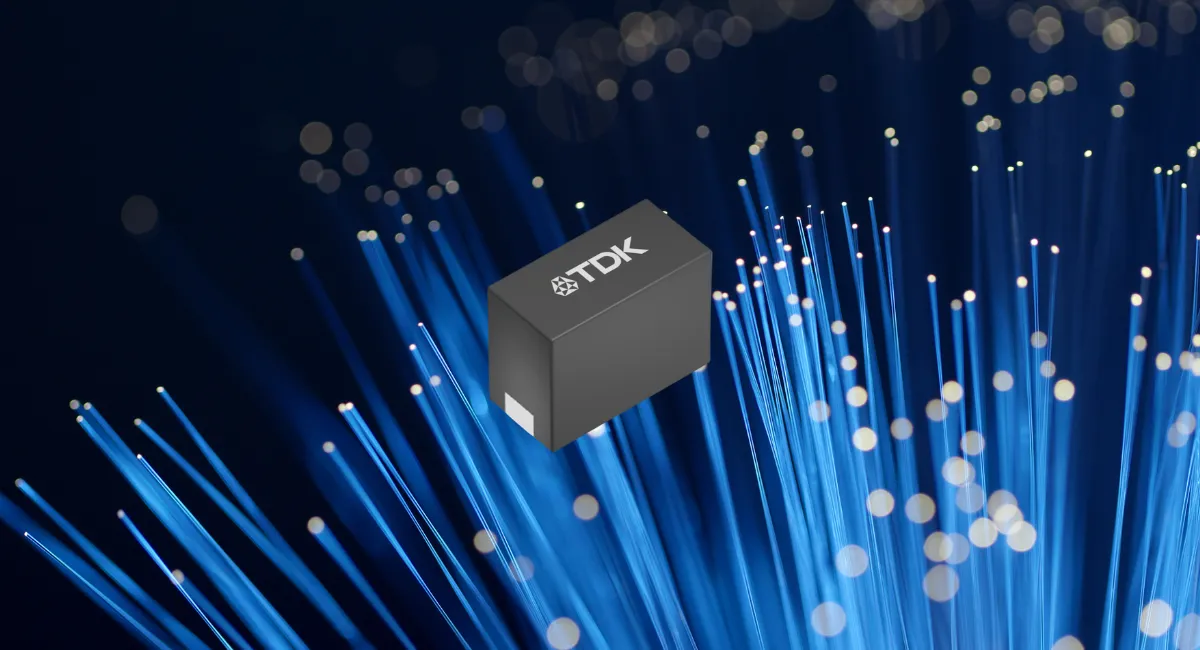
TDK Brings High-Inductance Thin-Film Parts to Optical Transceivers in AI Data Centers
TDK’s new 10 µH thin-film inductor delivers low resistance and high reliability for optical transceivers in AI data centres.
Signal Integrity in High-Speed Links
Optical modules used in AI servers run at ever higher data rates, with 400G and 800G systems already in production. In these modules, bias-tee inductors must show high impedance across the operating band so the signal path remains clean. TDK’s new part maintains useful impedance from 10 MHz up to 200 MHz, which helps reduce crosstalk and maintain link quality. For engineers, that means fewer bit errors and a more robust margin at higher baud rates.
Pushing the Limits of a Small Package
Packing 10 µH into a 1206 case is unusual. Most thin-film devices in this size are only a few µH at best. TDK gets there with its own magnetic materials and structural design. The result is a typical DC resistance of 1.4 Ω, roughly 70 percent lower than many equivalents, cutting heat and wasted power. The device can also handle a saturation current of 0.2 A, about 1.7 times higher than the last generation.
Of course, there are trade-offs. Raising inductance in such a small footprint usually brings down the self-resonant frequency and limits how much current can be pushed through. Layout and parasitics become important, particularly in multi-lane optical engines. Still, the lower resistance and tighter thermal profile make these parts attractive where efficiency matters more than brute current handling.
Broader Use Cases
Although the initial push is clearly for data centre optics, the same inductor can be applied to consumer and edge designs. Smartphones, wireless earbuds, and other compact devices can benefit from bias-tee or filtering functions in a small footprint. With an operating ceiling of +125 °C, reliability is not an afterthought either.
Outlook
Volume production started in August 2025. For system designers, the new PLEC69B devices show how far thin-film technology can be stretched to meet the needs of AI infrastructure. Inductors may be passive parts, but improvements like these directly affect power loss, heat, and ultimately the stability of the entire link.
Learn more here.
Related news
More from TDK
Keep up with the components and technology shaping electronics.
Join the club for member features, engineering discussion and easier access to the latest Component Club content.